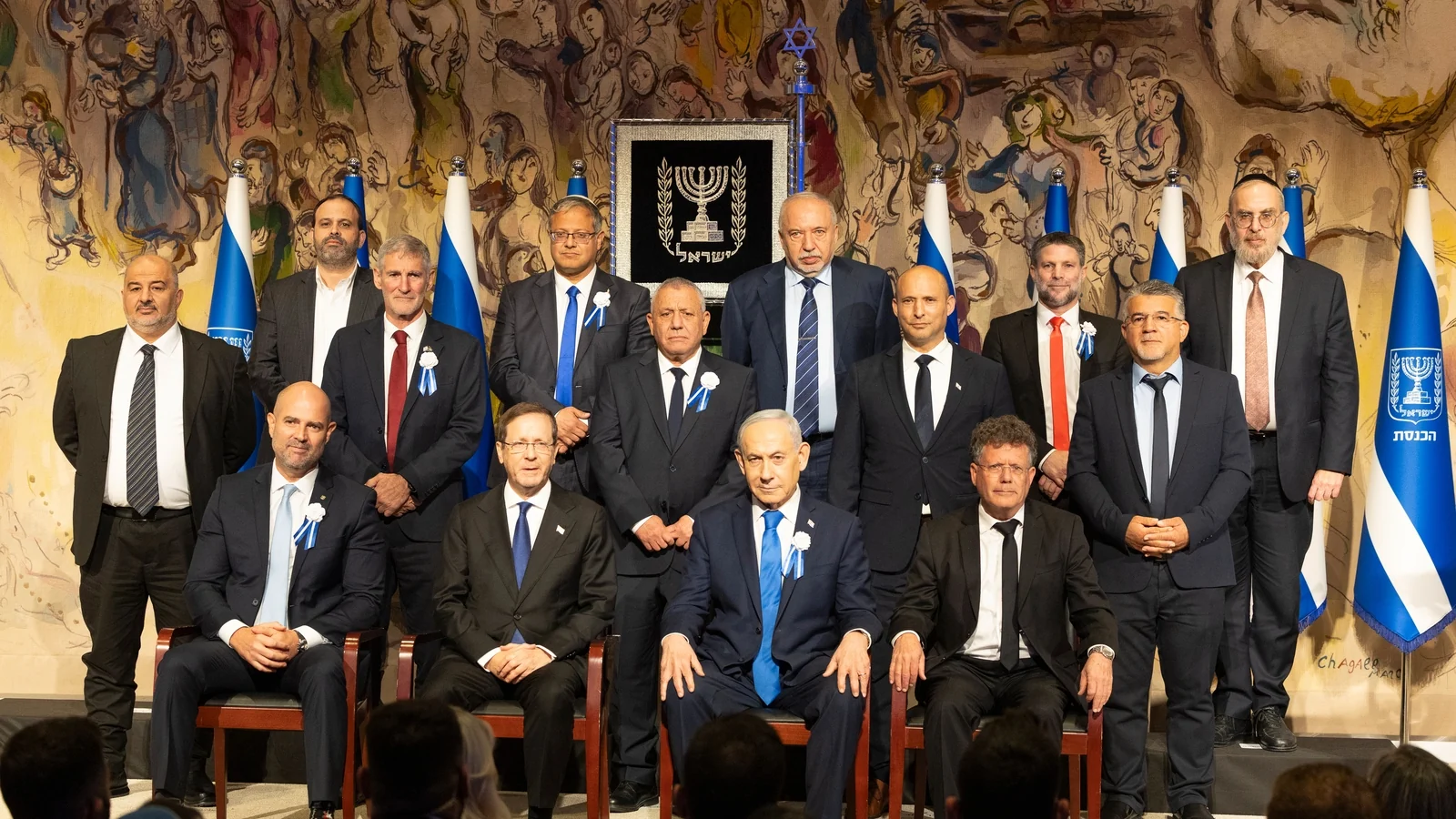
Israel’s new parliament convened and lawmakers were sworn in on Monday — but the country still has no new government, underscoring the political paralysis triggered by a deadlocked general election.
The 27 October vote cost Prime Minister Benjamin Netanyahu his parliamentary majority, yet it also failed to hand his leading opponents a clear route to power. The impasse leaves Mr Netanyahu in place as caretaker leader while coalition talks begin anew.
Newly elected politicians took their oaths as Gadi Eisenkot, a former general, moved to assemble a governing bloc after Israel’s president tapped him on Sunday to try to form the next government.
Mr Eisenkot and his partners, however, are also short of a majority and have not yet secured agreements with parties that could propel him into office.
The stand-off has revived the prospect that the new Knesset could be short-lived: if Mr Eisenkot and Mr Netanyahu both fail to build coalitions, Israel could be pushed into yet another election.
Overseeing the swearing-in, President Isaac Herzog issued a blunt appeal: “You must do everything to avoid a repeat election.”
“Reach out a hand for compromise, even between rivals… Look upon one another with generosity. There is much work to be done here, and it requires the ability and experience found in every part of this House.”
Parliament could try set up 7 October inquiry
Until a coalition is formed, Mr Netanyahu continues as caretaker prime minister.
His right-wing Likud party, running in tandem with far-right and ultra-Orthodox allies, exceeded expectations at the ballot box but still fell short of a majority, emerging with 53 of the Knesset’s 120 seats.
Mr Eisenkot’s centre-right Yashar party and an array of partner factions hold 48 seats.
That arithmetic leaves Mr Eisenkot looking toward Israel’s Arab-led parties, which control 19 seats and have aligned with him in their vehement opposition to Mr Netanyahu.
People hold Israeli flags during a demonstration on a pedestrian bridge in Tel Aviv, Israel
The new parliament, even without a government in place, could still move on some of Mr Eisenkot’s pledges. Among them is the possibility of establishing a commission of inquiry into the 7 October 2023 Hamas attacks — an idea supported by Arab parties but largely opposed by Mr Netanyahu.
The shifting balance could also allow Mr Eisenkot to seek the replacement of the current Knesset speaker, who is a Likud member.
Mr Herzog told members that the legislature was “duty bound to leave no stone unturned” in investigating and understanding the 7 October “catastrophe”, even as Israel continues to face threats from Iran and its proxies.
Mr Eisenkot has until 6 December to form a government, with the option to request a two-week extension through 20 December.
He has described his route to power as “extraordinarily complex”.
His limited options include trying to establish a minority government backed by Arab parties; attempting to bring ultra-Orthodox parties into a coalition, despite past refusals to work with them; or negotiating a unity government with Mr Netanyahu.
Each scenario carries steep political barriers.
Ultra-Orthodox parties have so far said they would not join a government led by Mr Eisenkot.
Mr Netanyahu, meanwhile, has sought to cast doubt on the election outcome by baselessly alleging voter fraud by Arabs, who make up a fifth of the population.
Election officials say they are investigating possible misconduct but have found no evidence of fraud that could have affected the result.
If Mr Eisenkot cannot form a coalition, Mr Herzog would likely turn to Mr Netanyahu as the next candidate to try.
If Mr Netanyahu also fails, another contender would get a chance — and if that effort falls short as well, Israel would be sent back to the polls.
Among the new lawmakers sworn in was Elisha Madan, a military reservist who lost both legs fighting in Gaza and drew an ovation from the plenum when he rose on his prosthetic legs.
At least seven killed in Gaza
As Israel’s political jockeying played out in Jerusalem, violence continued in Gaza. Local health officials said Israeli forces killed at least seven Palestinians, including a father and his 13-year-old son.
Medics identified the pair as Fadi Rajab and his son Abubakr, saying they were killed by an airstrike that hit the roof of a displacement shelter in the Zeitoun neighbourhood of Gaza City.
Health officials in the Hamas-run health service said a third Palestinian was killed in a separate Israeli airstrike near a school in Gaza City’s Daraj neighbourhood.
The Israeli military said it struck militants in both areas, without providing additional details.
In Khan Younis, in southern Gaza, medics said an Israeli shooting killed a man.
Displaced Palestinians gather to receive food distributed by a charity kitchen at the Nuseirat refugee camp
Later, medics said an Israeli airstrike hit a metal foundry in the Sabra neighbourhood of Gaza City, killing three people and pushing the day’s death toll to at least seven.
The Israeli military did not immediately comment on the incidents in Khan Younis or the Sabra neighbourhood.
A ceasefire brokered by the United States last year envisioned Gaza’s eventual reconstruction, but little has advanced since then.
Negotiators have been unable to agree on terms for Hamas to disarm or for Israel to pull back its troops, which control about two-thirds of the territory and areas from which residents have been ordered to leave.
Israel says Hamas is trying to regroup and refill its arsenal.
Hamas says it is committed to the ceasefire agreement and accuses Israel of trying to undermine it.
Since the ceasefire agreement, at least 1,600 Palestinians have been killed in Israeli attacks in Gaza, according to the territory’s health officials, while Israel says four soldiers have been killed.
Palestinian authorities say more than 74,000 people have been killed in Israel’s assault on Gaza, launched after Hamas-led fighters killed about 1,200 people in southern Israel on 7 October 2023.