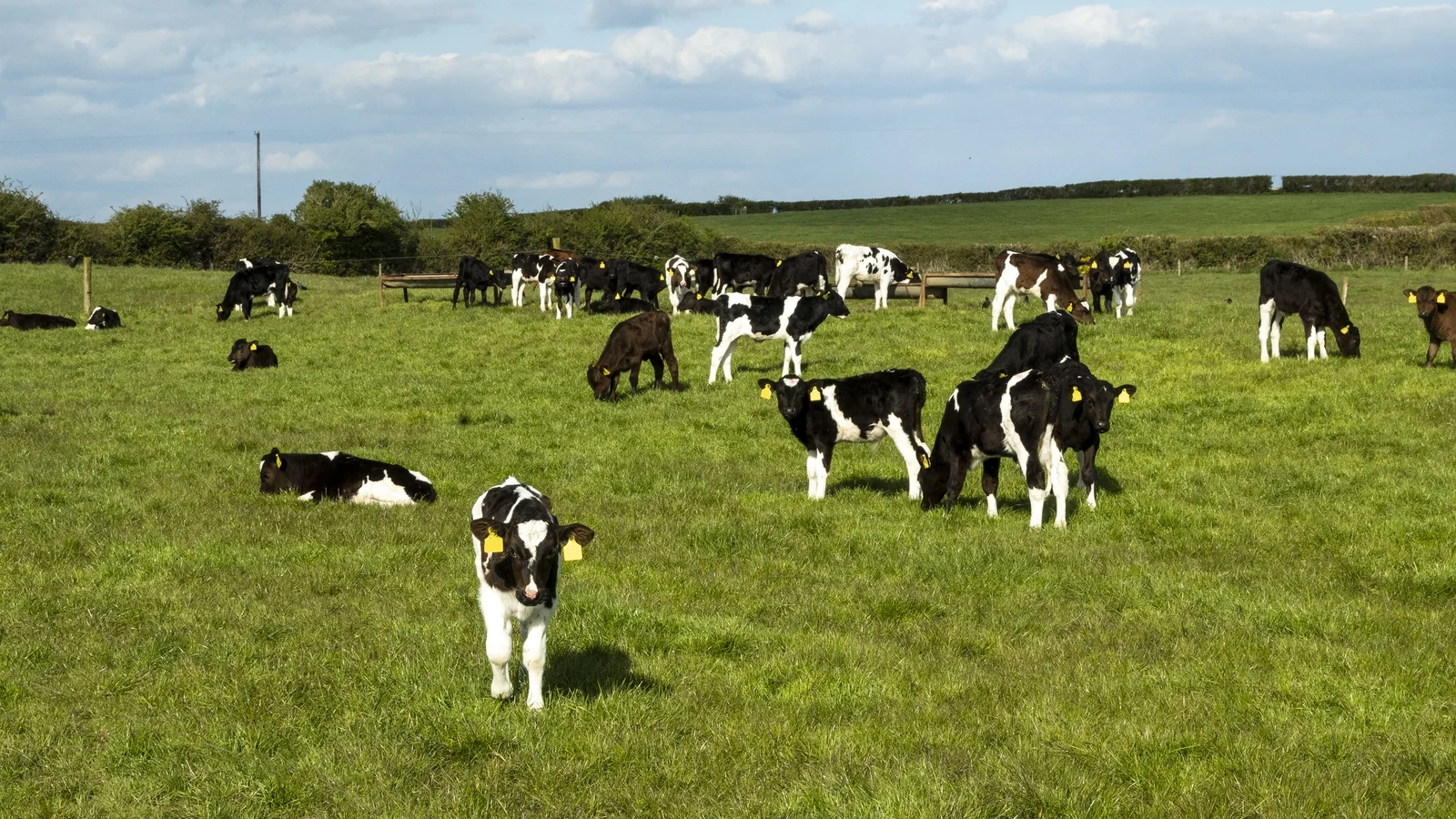
Four Irish transport operators moving unweaned calves to the Netherlands are set to face penalties after Dutch inspectors concluded the animals are going without legally required milk feedings on a journey that begins at Irish ports and ends in Dutch veal facilities.
The Dutch Food and Safety Authority (NVWA) said it will impose fines in response to claims that calves are not fed during the sea leg of the trip, despite rules requiring feeding during transport.
The Netherlands is a key destination for Irish dairy calves sold to mainland Europe, with around 200,000 animals leaving the country every year.
Most are destined for veal production and typically travel by sea from Ireland to France before continuing the remainder of the route by road.
Animal welfare organisations argue that the practice leaves calves vulnerable to weakness, dehydration and hypoglycaemia, and can result in deaths during transit.
Irish transporters bringing calves into the Netherlands are expected to receive an initial warning and a 12-month period to develop a more “humane and animal-friendly manner” of moving the animals.
If they fail to change their approach within that timeframe, the NVWA said fines of €3,000 will be issued per violation, increasing to €9,000 for a third breach and €27,000 for a fourth offence.
The measures will apply to any transporters of unweaned calves entering and leaving the Netherlands that have received an order subject to a penalty payment.
Dutch officials told RTÉ News they believe that “calves that are still dependent on milk feeding must always receive the care and nutrition they require throughout the entire journey”.
“This is currently not the case. During the long sea voyage from Ireland to the control post in France, and subsequently by road to the Netherlands, these very young and vulnerable animals are not fed.”
The NVWA said the problem is compounded by equipment and practical constraints, stating that trucks are “not equipped with suitable feeding systems to provide warm milk, and each individual calf must be assisted in drinking”.
“The latter is practically impossible. The NVWA strives for animal transport in which all parties are committed to transporting animals in a humane and animal-friendly manner.”
Animal welfare groups claim that calves can die en route to the Netherlands
It said that, “based on this conviction, we are imposing administrative orders subject to penalty on four Irish transport operators for failing to feed calves”.
The agency added that it is aligning its approach with guidance from the European Food Safety Authority (EFSA), which says the gap between milk feedings should not exceed 12 hours.
The EFSA also advises that unweaned calves should not be transported by truck for more than eight hours.
In its assessment, the NVWA said the breach “posing the greatest risk of suffering to the calves occurs at sea, between Ireland and France” and that this “makes enforcement using the authority to act available to the NVWA within Dutch territory challenging”.
Even so, the regulator said it is acting by “pushing the boundaries of its legal enforcement options to the fullest extent possible”.
The agency said it is pursuing enforcement “with respect to the entire transport operation from Ireland to the Netherlands”.
It also said its investigation found calves “require milk feeding not only during the sea crossing but also during transport from the control post in France to the Netherlands”.
Dutch authorities said the penalties are intended to send a “clear signal” and that, to meet the duty of care owed to milk-dependent calves, “transport operations must be organised differently”.
Separately, the Dutch veal sector has set a target of ending imports of Irish calves by 2028 as part of efforts aimed at improving animal welfare.
Campaign to stop calf transports
In March of last year, Brittany Ferries restarted live-animal transport on its Rosslare to Cherbourg route after a 30-year hiatus.
Animal welfare groups strongly opposed the move, arguing that unweaned calves travelling from Ireland to France can exceed 24 hours without food—an alleged breach of EU law.
After a sustained campaign to halt the ferry transport of live animals, including protests at ports, Brittany Ferries confirmed it will end live farm animal transport from Ireland to France from this autumn.
In 2025, Stena Line ended live animal transport on its Rosslare-Cherbourg route, leaving Irish Ferries as the only company facilitating such transit to the continent.
Minister for Agriculture Martin Heydon has said his department is ready to assess and approve vessels that might be made available to transport livestock out of Ireland.
‘We have to stand up for these vulnerable animals’
Annebeth van Aartsen, a veterinarian at the NVWA, said: “We have to stand up for these vulnerable animals that need to be taken care of.
“We tried to discuss this at EU level but no actions have been taken.
“We want to send a signal to the European Commission and are hoping that giving transporters a year before imposing fines gives us time to start a conversation at EU level.”
Animal welfare groups have welcomed the Dutch authority’s decision.
Caroline Rowley, Director of Ethical Farming Ireland, said: “It’s great to see an authority finally taking a stand to ensure legislation is respected. It’s just a shame this action isn’t coming from Ireland.
“Numerous studies have proven how much these young and vulnerable animals suffer due to extended feed deprivation during these long journeys so we very much welcome this move by the NVWA.
“The Dutch authorities care more about the welfare of Irish calves than our own Government does.”
Last year, Brittany Ferries resumed transporting live animals between Rosslare and Cherbourg
Lesley Moffat, Ethologist and Director of Eyes on Animals, said enforcement depends on verification in practice, arguing that “legislation only protects animals if someone actually checks what happens along the way”.
“We recorded the journey times and documented that calves barely three weeks old were left without milk for more than 30 hours. That fieldwork forms the basis for the enforcement request that has now finally prompted the NVWA to take action.”
Dier&Recht, another animal welfare group, said the intervention “strikes at the very foundation of these transports”.
Frederieke Schouten, a vet and member of Dier&Recht, said the calves “must be given warm milk individually during the journey, but this is not practically feasible in a fully loaded truck”.
“The calves are still far too young and need help drinking from a teat.
“We expect the Dutch veal sector, including VanDrie Group, to finally take both the welfare of these animals and the law seriously and to stop importing unweaned Irish calves.”
The Irish Creamery Milk Suppliers Association (ICMSA), which represents dairy farmers in Ireland, said it is “studying the announcement and its implications and will comment in due course”.