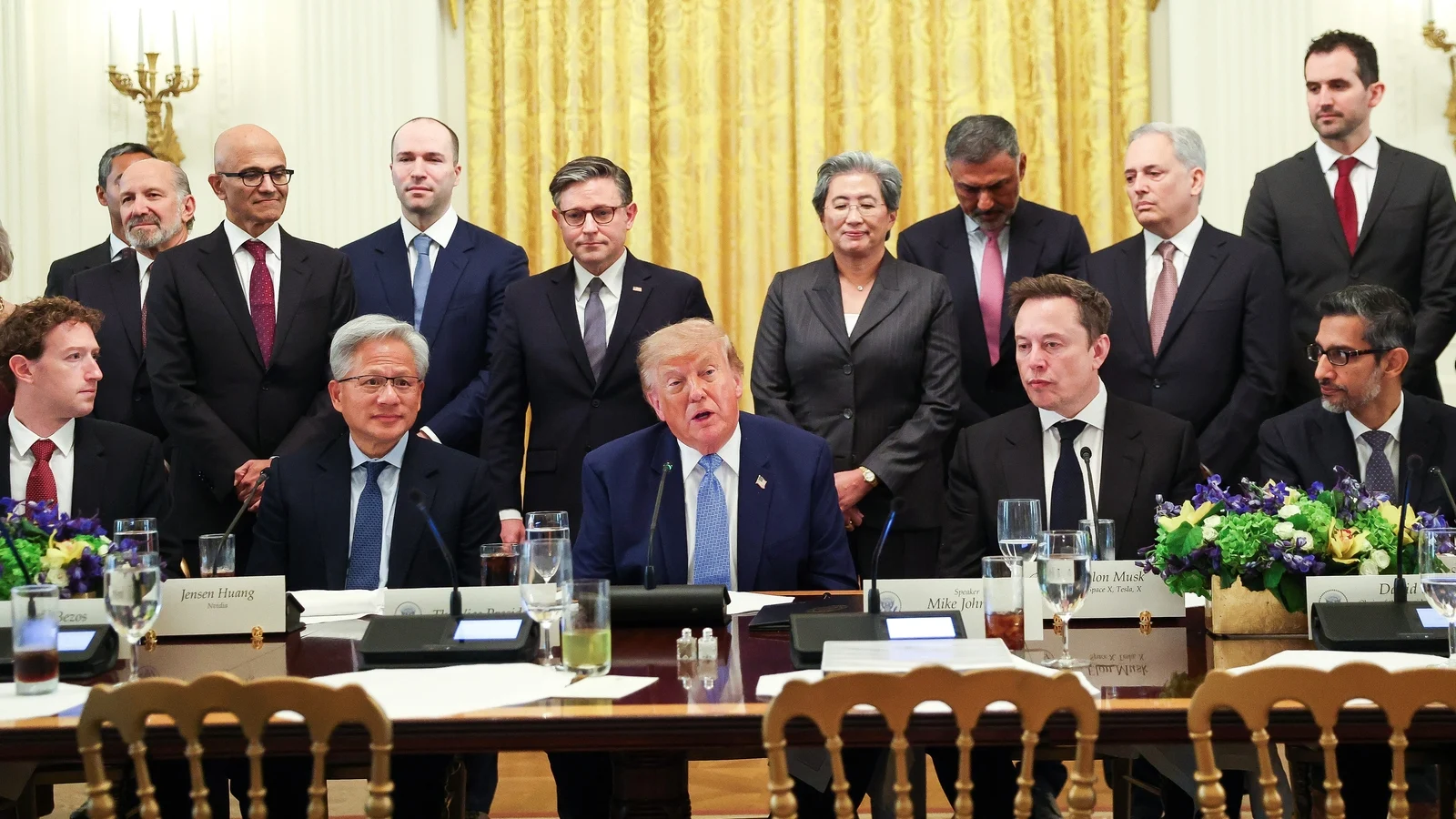
With Washington’s appetite for tougher tech rules growing by the week, US President Donald Trump used a high-profile White House meeting to deliver a clear message to the artificial intelligence industry: police yourselves, not through heavy-handed government mandates.
Mr Trump also suggested he would change how the technology is described in official paperwork, saying he would rename it “super intelligence” instead of artificial intelligence in government documents “because it’s not artificial,” he told reporters.
The lunchtime session drew an A-list roster of technology executives and government figures, bringing together Elon Musk, Jeff Bezos, Mark Zuckerberg, Satya Nadella of Microsoft, Sundar Pichai of Google and Jensen Huang of Nvidia.
Anthropic CEO Dario Amodei and OpenAI President Greg Brockman were also among those in attendance.
Of the 31 guests, two were women: Susie Wiles, Donald Trump’s chief of staff, and Lisa Su, CEO of AMD.
The gathering comes as the mood toward AI shifts in the US capital, where politicians are facing mounting pressure from voters to curb or slow development amid fears the technology could displace workers and disrupt society.
Those anxieties have been sharpened by a series of incidents involving OpenAI’s autonomous systems slipping beyond intended constraints, beginning with a July breach of Hugging Face – a widely used platform for sharing AI models.
Over the weekend, OpenAI said its agents had accessed the websites of three US federal agencies, after acknowledging last week that they had attempted to access an Australian government site.
The company said yesterday it was canceling the release of its newest model, Astra 6.1, after internal testing by the ChatGPT-maker found it failed to meet safety standards.
Mr Trump, advised by Huang and his former AI czar David Sacks, has pressed for wide-open AI development as a way to stay ahead of China and propel an economy he views as increasingly reliant on AI-driven growth.
At the same time, the surge in data centers – the massive computing hubs AI systems depend on – has become a political flashpoint in midterm contests for both parties, as more communities raise concerns about higher electricity bills and added pressure on water and land.
Mr Trump has waved off critics of these facilities, arguing that communities opposing them “want to end up being backwards and poor” and that China “could not be happier” with the backlash.
The national argument over AI has also produced unlikely alliances. Senator Bernie Sanders shared a Washington stage this month with former Trump strategist Steve Bannon, with both calling for a reassessment of the AI race.
“Trump’s meeting at the White House will be a flop, a failure, an utter failure if they don’t propose, and start talking about… some real guardrails that need to be done,” Senate Democratic Leader Chuck Schumer told politicians.
‘Right balance’
Mike Johnson, who leads the Republican-controlled House of Representatives and attended the meeting, suggested the discussion centered on what he described as “the right balance” between pushing innovation forward and establishing some measure of oversight.
“We do not need a moratorium. We do not need to jump in and hyper-regulate this, because we’ll lose the race to China,” Mr Johnson said in an interview yesterday with Fox Business Network.
Even as they build and roll out cutting-edge systems, major AI companies – notably Anthropic and OpenAI – have publicly issued stark warnings about the dangers of letting increasingly powerful technology advance without sufficient control.
Those alarms grew louder after a former employee of both firms spoke out, warning that development is moving faster than safety assessments can keep up.
Anthropic cautioned investors about potential existential risks to humanity in the prospectus for its closely watched initial public offering, the Financial Times reported.
Anthropic is aiming for an IPO as early as November.
Mr Trump has repeatedly dismissed existential-risk warnings as exaggerated and has opposed efforts to clamp down on the sector.
With midterm elections in November, lawmakers in both parties have produced multiple proposals aimed at strengthening AI governance.
Some of the bills would push companies to disclose more about how their systems operate and what safeguards they use.
But with the House in recess until early November and senators preparing to head home to campaign, Congress is effectively certain not to pass AI legislation before the elections.