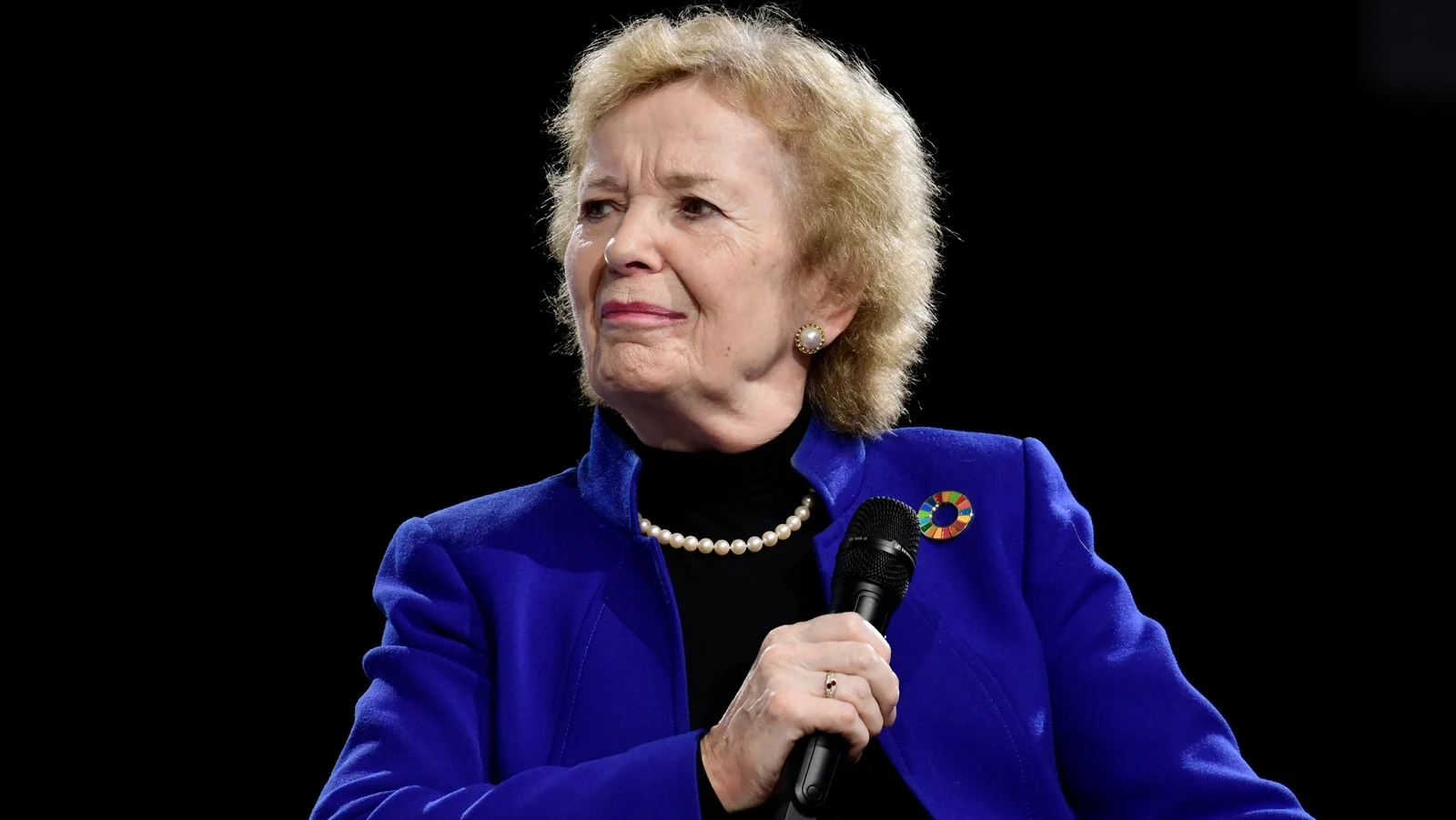
Mary Robinson is set to take the helm of a global body at the heart of efforts to steer billions of dollars toward greener growth in developing nations, as countries race to cut emissions and brace for a warming world.
The former President of Ireland has been elected to lead an international organisation that supports developing countries in attracting investment to build cleaner, more sustainable economies and confront climate change.
In doing so, she will become the first woman to serve as President of the Assembly and Chair of the Council of the Global Green Growth Institute (GGGI), replacing former United Nations Secretary-General Ban Ki-moon.
The decision was made following a meeting of the organisation’s member countries in Seoul, South Korea, last Friday.
Ms Robinson is due to begin the role at the start of 2027, serving a two-year term.
Founded in 2012, the GGGI is an intergovernmental organisation created to help developing countries pursue economic growth while lowering greenhouse gas emissions, safeguarding natural resources and raising living standards.
Based in Seoul, it works with 55 members and 30 partner countries and regional organisations, and runs programmes in more than 57 countries.
At the core of its mission is the case that development and environmental protection do not have to be at odds — and that moving toward a low-carbon economy can generate jobs, draw in investment and help tackle poverty.
A key strand of its work focuses on helping countries convert climate pledges into concrete policies and investment-ready projects.
To that end, it offers technical and financial expertise to governments, supporting efforts such as renewable energy development, public transport upgrades, forest protection and other measures that strengthen resilience to climate impacts.
The organisation also helps countries seek financing from international development banks, institutional investors and the private sector.
GGGI said it helped mobilise $4 billion in green investment commitments during 2025 alone, while also backing the adoption of 81 green growth policies.
It added that the cumulative value of green investment commitments mobilised through its work since 2015 has now risen to more than $18 billion.
Those totals reflect commitments secured with GGGI’s support, rather than funds necessarily already spent or projects fully delivered.
Among recent examples, the institute provided technical support for a $600 million green bond issued last year by Bogotá, the Colombian capital, aimed at funding cleaner transport infrastructure.
It has also backed renewable energy development and climate adaptation projects in vulnerable Pacific island countries, including Fiji.
In a statement released alongside her appointment, Ms Robinson said the institute’s aims matched her longstanding focus on climate justice.
“I believe that countries must accelerate the shift to sustainable, low-carbon economies while ensuring that the costs of this transition do not fall disproportionately on those least responsible for climate change,” she said.
Ms Robinson, a former UN High Commissioner for Human Rights, has repeatedly argued that the poorest countries and communities are bearing some of the harshest effects of climate change despite having contributed least to the greenhouse gas emissions driving it.
She said the GGGI role offered a chance to turn climate-justice principles into action, pointing to the potential to create green jobs, reinforce resilience and build economies that serve people as well as the environment.
She also stressed the need for women to be fully involved in shaping climate solutions and to share in the economic opportunities emerging from the transition.
Ms Robinson called for closer cooperation among governments, international institutions, businesses and civil society to mobilise investment and speed the rollout of cleaner energy systems.
Ban Ki-moon, the outgoing president and chair, welcomed her election, saying she has spent her career championing human rights and climate justice.
He said her leadership would help underline that economic prosperity, environmental sustainability and social inclusion can move forward together.
The appointment comes as governments look ahead to the COP31 UN climate summit in Antalya, Turkey, where financing to help poorer countries cut emissions and adapt to climate change is expected to remain a central issue.