How Tuvalu, a tiny island nation, is coping with rising sea levels
 Caalamka
With delegates gathered in Turkey this week for the COP31 climate conference, Tuvalu is using the global spotlight to press a stark message: without collective action, the Pacific nation fears it may not survive.
The country, made up of nine coral islands halfway between Australia and Hawaii, sits on some of the lowest-lying land on Earth. Its highest point rises just 4.5 metres above sea level.
For Tuvalu’s 11,000 people, that geography has turned daily life into a countdown.
Scientists predict that by 2050, large parts of the country will fall below today’s high-tide mark.
Ireland and Tuvalu are set to co-host an international conference next July focused on the shift away from fossil fuels.
Reporter Una Kelly travelled to Tuvalu to hear directly from residents confronting rising seas.
Gitty Yee remembers when the shoreline was a constant playground, a place she could run to at any hour. Now, she says, afternoons can be punishingly hot, and the edge of the island no longer feels fixed.
The 27-year-old climate activist says entire stretches of coast have disappeared.
“I feel devastated, because I feel like if I lose my land, I lose my identity. I lose everything that portrays who I am, who I am as a Tuvaluan. And I am no Tuvaluan if I have no land, if I have no country.”
‘I am no Tuvaluan if I have no land, if I have no country,’ says Gitty Yee
Asked what it means to be Tuvaluan, people consistently return to the same themes: respect, community and a peaceful way of life.
One man points to the word alofa — love — as the cultural foundation, expressed through sharing and mutual care.
Life, they tell me, is meant to slow down, to make room for each other.
Puaseiese Adrienne Pedro, once a journalist in Tuvalu, says evenings often end with a family swim in the turquoise lagoon.
“In other countries of the world, time is important, time is your boss,” she says. “Here in Tuvalu, you are your own boss. Everything is relaxed.”
Yet the climate emergency is increasingly intruding on that calm.
Puaseiese Adrienne Pedro is concerned some heritage could be lost in an uncertain future
A view of the blue lagoon
Along parts of the coast, the sea is inching closer to homes and schools. King tides force rocks and seawater into living rooms. More powerful cyclones knock down trees and can delay the container ships that deliver crucial food and medicine.
A young woman recalls one of the most haunting images: Cyclone Pam in 2015 washing away graveyards and exposing human remains on the outer island of Nui.
Even the rhythms that sustained previous generations are faltering. Droughts are hitting more often, squeezing drinking-water supplies, while saltwater seeps into soil and makes it harder for native crops to survive.
Kalisi Sogivalu takes me to a pit where he tries to grow pulaka, a carbohydrate staple and a pillar of Tuvalu’s food traditions.
“Our way of planting now is being disrupted by the water level,” he says.
“The water table is increasing every year. It’s destroying our crops, and strong winds are destroying our trees like breadfruit, bananas and pawpaw trees.”
Fresh fish cooked on leaves at the roadside
Families still fish the lagoon, but catches are scarce, and imported food has become a necessity — and a costly one as global prices climb.
In shops, shelves are dominated by packets and tins of processed goods. In refrigerated cases, a few apples and cabbages sit forlornly.
Mr Sogivalu says the national diet has shifted dramatically since he was a boy.
“They’re not fresh, because how many containers have they been transported in, from there to here? And then it arrives to us in four months.
“We’re having a lot of problems with diabetes and obesity. That’s the problem when you’re eating a lot of sugary food.”
More than a quarter of Tuvalu’s population is living with diabetes, and more than half of adults are obese.
As the threats mount, so do questions about how to protect a culture built on islands that could shrink further.
Tuvalu’s islands each have their own customs and dialects.
In airy traditional meeting halls, open to the breeze, communities perform fatele — dancers lined up in outfits made from local plants, moving with precision as singing swells and ebbs. The tempo is driven by drums beaten on tin and wooden boxes, accelerating into celebration.
Dancers seen performing fatele
Ms Pedro, now a media adviser to the prime minister, says the possibility of cultural loss weighs heavily.
“To me, as a mother and a grandmother, it is very personal to me, I mean losing our culture. Because culture gives young people a sense of identity and grounding in a rapidly changing world.”
“Even if our young people study overseas or build lives abroad, we want to still know our songs and our language and customs and that they know their roots as well.”
Like Ireland, Tuvalu has long been shaped by migration, and climate change is adding pressure to the economic reasons people leave.
Violeti Auega, 36, a mother of four from the outer island of Nukulaelae, says she has watched the community shrink within her lifetime — from 400 people to about 200.
Many have relocated to Funafuti, Tuvalu’s capital, or moved further to Australia and New Zealand.
Ms Auega does not intend to leave because she wants to remain close to extended family, but she says she hopes her children may one day find a “better future away from Tuvalu.”
“I do hope that my children will find an opportunity to move and live somewhere else, away from all this, if worse comes to the worst. But if Tuvalu is still livable, my hope is my children will still stay and support and develop Tuvalu.”
New routes for migration are emerging.
In 2023, Tuvalu and Australia signed the Falepili Union Treaty, which allows 280 Tuvaluans each year to secure an Australian residential visa and access the same rights to employment, healthcare, housing and education as Australian citizens.
In return, Tuvalu is required to consult Australia on any defence and security agreements it makes with other countries.
International headlines often billed the agreement as the first ‘climate refugee visa’ of its kind.
But many Tuvaluans I meet bristle at that framing, saying it paints them as helpless victims fleeing a doomed homeland and turns their country into a warning label for the world.
‘Climate refugee is not really a narrative that we like. We’re not refugees,’, says Suilelei Fuitau
Suilelei Fuitau, 27, plans to enter an upcoming ballot for the visa. She says her main reason is to pursue better education opportunities for her young daughter — not to escape climate impacts.
“Climate refugee is not really a narrative that we like. We’re not refugees,” she says.
“This was a treaty between my country with a friendly neighbour. So falepili means being a good neighbour. So, we’re not refugees, we’re just there [in Australia] as neighbours and helping each other.”
Ms Yee, who also works in communications for Oxfam Aotearoa, insists Tuvalu is not waiting passively for disaster.
“We are fighting the climate crisis; we are fighting something we did not cause in the first place.”
Tuvalu contributes less than 0.01% of global carbon emissions.
At a climate justice dialogue organised by the Tuvalu Climate Action Network, teenagers take to the stage and repeat a slogan that has become a rallying cry: “We’re not drowning, we’re fighting.”
Alongside grassroots climate justice groups, they talk about carrying Tuvalu’s voices — and its ideas — to the world’s negotiating tables.
Blind woman Mine Pili has Irish ancestry
At the event, I speak with Mine Pili.
She traces her Irish ancestry to Jack O’Brien, an Irishman who arrived in Tuvalu around the 1850s — a history that has left O’Brien a familiar surname across the islands.
Blind, and serving as a board member of the Fusi Alofa Association, which represents people with disabilities in Tuvalu, she says inclusion must be more than a slogan at COP-style gatherings.
She wants disability perspectives reflected in decisions that shape the future.
“It’s a way of looking through new lenses, not just through climate change as an environment issue, but a human issue and justice issue.”
Filiga Taukiei Nelu, of the Tuvalu Women for Change Association, also addresses the event, arguing that women’s voices must sit at the centre of climate discussions because the crisis expands women’s care burden.
At the government level, Tuvalu is pursuing adaptation — and, with no hills to retreat to, that has meant literally creating more ground.
Land is scarce. The airstrip functions as a playground, rugby pitch and volleyball court. When an aircraft is due, a siren sounds and people — and many dogs — clear the runway.
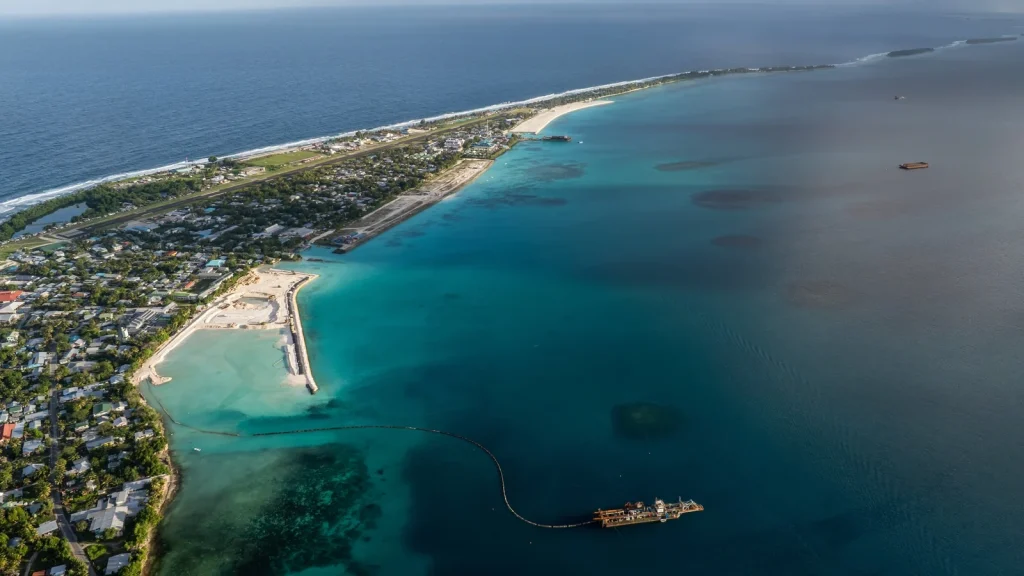
Tuvalu’s total land area is 26sq/km. In Funafuti, buildings are packed onto a thin ribbon of land that narrows at one point to just 20 metres between shorelines.
A view of the land reclamation project in Funafuti
On the lagoon side, dredged sand is being used to build out protected land.
The Tuvalu Coastal Adaptation Project, funded largely by the UN’s Green Climate Fund, is designed to create 3.6sq/km of elevated ground beyond the reach of storm surges.
A second initiative, known as Digital Nation, aims to build an online replica of Tuvalu’s landscape and assemble a digital archive of its language, music and cultural objects.
When Tuvalu first revealed the plan in 2022 — effectively a virtual copy of the islands — it attracted widespread media attention.
Petaia Meauma Moeaga, project manager for Digital Nation Tuvalu, says the government intended it as a jolt to the international community.
“We are trying to wake up the world, particularly the developed nations.”
Some Tuvaluans worry the project could be read as surrendering to eventual submersion, but Mr Moeaga rejects that interpretation.
“The government’s main aim is to protect Tuvalu not to sink. But given that aim, we are at the same time, parallelly creating this project to ensure that our cultural values, our cultural projects, our cultural principles are intactly preserved, so that when the worst comes to the worst, Digital Nation has already secured our culture.”
The effort highlights a dilemma confronting small island states facing physical loss: how to protect sovereignty when the land itself is under threat.
Currently, international law links sovereign statehood to both defined territory and a permanent population — conditions that, if projections prove accurate, may no longer be assured for Tuvalu.
Read more:
Listen: Tuvalu and the fight against rising seas
Tuvalu has already moved to address that uncertainty at home, amending its constitution to state that its maritime zones and statehood are permanent, no matter what climate change does to its physical territory.
New Zealand and Australia have formally recognised the position, though that does not guarantee worldwide acceptance. The idea of sovereignty and nationhood without physical territory remains unsettled in international law.
Every evening at 6.45pm, the country pauses. Traffic stops and streets fall still for a national moment of devotion lasting until 7pm. In this devoutly Christian nation, families gather indoors as hymns drift through the dusk and mingle with cricketsong.
We need your consent to load this rte-player contentWe use rte-player to manage extra content that can set cookies on your device and collect data about your activity. Please review their details and accept them to load the content.Manage Preferences
Luuni Tinilau, a community elder, says people must be lifted up to keep going. “No matter how high the sea may come up, our faith in God is unshakeable.”
That quiet determination — rooted in faith and community — is shaping how Tuvaluans face what lies ahead.
Falepili, the Tuvaluan idea of being a good neighbour, is the principle Ms Yee wants the wider world to live by, she says, and to recognise her country as more than a symbol of climate peril.
“Tuvalu is more than a sinking island. It’s a country of people with dreams, people with hopes, people with passion,” she tells me.
“Climate change is happening, but people here are coming up with solutions to tackle impacts of a crisis that we never created and caused in the first place. That’s why it’s important that everyone stands with us, because we cannot do this alone. We need collective action.”
This project was supported with a grant from the Simon Cumbers Media Fund