COP31 Talks Extend Into Overtime as Concerns Grow Over Final Deal
 Caalamka
As COP31 negotiations drag beyond their scheduled finish in Turkey, the European Union is signalling it is willing to leave Antalya without a final deal if the closing text fails to acknowledge a transition away from fossil fuels, RTÉ News understands.
In a bid to strengthen its hand, EU negotiators have been meeting representatives of small island states and the least developed countries to gauge whether they would back Europe in holding out for that language, or whether other parts of an agreement are viewed as too vital to lose.
Minister for Climate Darragh O’Brien summed up the EU stance bluntly, saying “no deal is better than a bad deal” as Europe insists any agreement must explicitly mention fossil fuels.
After talks with COP31 President Murat Kurum, Mr O’Brien said he had seen movement on electrification in a revised text that had yet to be published.
However, he said oil-producing nations — mainly within the Arab bloc — were still resisting any reference to fossil fuels.
The dispute centres on whether the final outcome will reflect steps already taken by Ireland and several other countries.
Those states have released roadmaps describing how they plan to move away from coal, oil and gas.
Three years ago in Dubai, countries agreed to call for a transition away from fossil fuels in energy systems.
But a draft issued in Antalya on Thursday contained no explicit mention of fossil fuels.
Bad COP31 dead worse than no deal, says minister
Pressed on whether securing that recognition is a red line, Mr O’Brien replied: “It is. It’s a core principle and it’s a core negotiation point.”
He said the EU remained unified and estimated that around 130 countries were aligned with its position.
He said that group includes island nations and states across Africa, the Pacific and Latin America.
Yet when asked directly whether he would walk away from an agreement that omitted any reference to moving away from fossil fuels, the minister stopped short of a definitive commitment.
“Too early to say that,” he said.
With negotiations continuing, he said he believes the EU’s arguments are being heard.
Mr O’Brien said he felt accountable to the Irish public for the outcome in Antalya.
“We have a moral imperative and a moral obligation, and that’s what I’m representing,” he said.
Delegates worked late into the night and returned to the table early today after the summit had been due to wrap up.
Mr O’Brien said he expected talks to gather pace during the afternoon.
“I think, though, that today will tell whether a deal can be done or not,” he said.
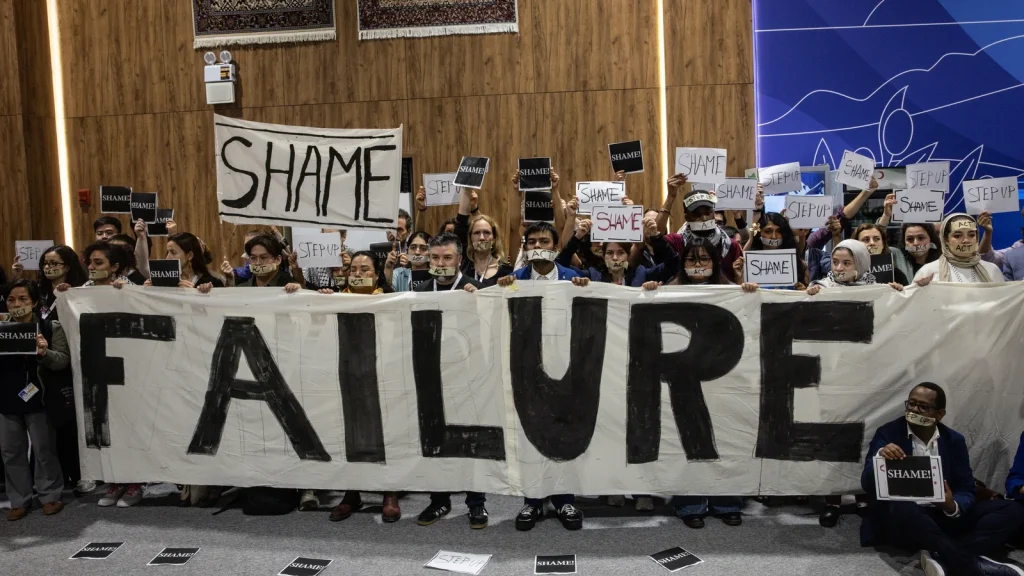
The Alliance of Small Island States has publicly criticised the omission of fossil fuels
The countries Europe is consulting arrive with priorities of their own.
The Alliance of Small Island States has publicly criticised the omission of fossil fuels.
The least developed countries, meanwhile, have been pushing for increased finance to help them withstand the effects of a warming world.
So far, neither bloc has publicly committed to joining the EU in rejecting an agreement over the wording.
Thursday’s draft remains the most recent text published by the UN.
It outlines potential targets for capturing carbon dioxide, but still contains no explicit mention of fossil fuels.
For European negotiators, much of the anger stems from how modest their current demand is: simply acknowledging the transition away from fossil fuels for the countries opposing that phrasing.
That irritation has been sharpened by growing global acceptance that warming is set to breach the 1.5 degrees Celsius limit established by the Paris Agreement in 2015.
Even so, as of last night, Saudi Arabia and its allies were not prepared to accept that wording.
At the summit, the Arab bloc has argued each country should retain the right to decide how it meets its energy needs.
One snapshot of the atmosphere emerged last night when the European group was asked to hear the Saudi argument for carbon capture.
The EU delegation pushed back on the proposal, saying it wanted clarity on fossil-fuel language.
Chair of the talks, Chris Bowen, said that he still believed a deal was possible
Thursday’s draft illustrates why the argument has become so heated.
Across nine pages, it sets out details on how much carbon dioxide industry might capture each year by 2035.
But it does not mention coal, oil and gas — the fuels whose combustion is the principal driver of global warming.
The EU accepts carbon capture can play a part in certain industries, such as cement manufacturing, where some emissions are particularly difficult to eliminate.
Its concern is that oil and gas producers could cite the promise of future carbon capture as a rationale for maintaining — or increasing — fossil fuel extraction for decades.
On other issues, diplomats have found more room to manoeuvre.
RTÉ News understands the EU has indicated it could уступ ground on electrification and on making climate funding easier to access for developing countries seeking to adapt to climate change.
Jordan has been urging simpler routes for those countries to obtain the money they have been promised.
Australia’s Chris Bowen, who is chairing the negotiations, said yesterday he still believed an agreement could be reached.
This morning, however, he and the Turkish presidency face a familiar obstacle: any overall deal requires consensus.
Saudi Arabia wants any reference to fossil fuels kept out.
Panama has said publicly it cannot accept an agreement without that language, and wants any deal to state specifically that global oil production should be capped at current levels.