
Netanyahu and Eisenkot factions fail to strike a coalition agreement
 Caalamka
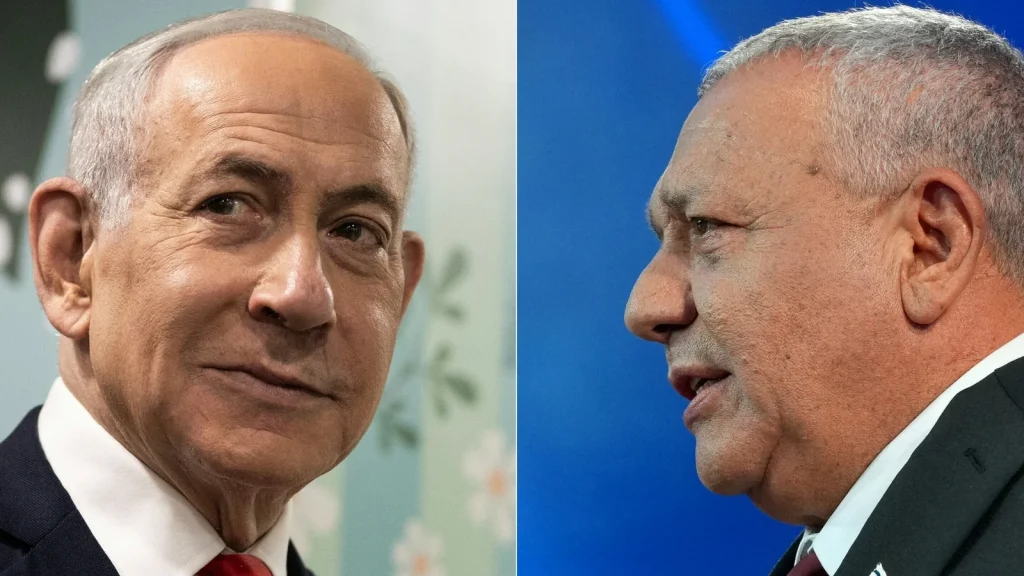
Israel’s political deadlock deepened after caretaker prime minister Benjamin Netanyahu’s Likud and rival Gadi Eisenkot’s Yashar party ended another round of coalition negotiations with no agreement — underscoring how steep the compromises would be for any governing deal.
Delegations from Eisenkot’s Yashar party and Netanyahu’s Likud met for four hours at a hotel in Herzliya, near Tel Aviv, following a first round of discussions last Sunday.
“The latest round of coalition talks… has concluded. The two sides outlined their positions on a range of substantive issues and discussed them in detail,” the two parties said in a joint statement.
“A follow-up meeting will be held,” they added, without specifying a date or revealing any other details.
A former army chief of staff, Mr Eisenkot, has until 6 December to form a government, with the possibility of a 14-day extension, after October elections failed to give either camp an absolute majority.
His 48-member bloc, which needs 61 members of parliament to reach a majority, remains divided over whether to build a coalition through an alliance with ultra-Orthodox parties, a rapprochement with Arab parties or a national unity government with Likud.
No single party has ever won 61 seats outright in the 120-seat Knesset, making coalitions the norm
Mr Netanyahu is pressing for a national unity government — an option that could again involve Mr Eisenkot and Mr Netanyahu alternating as prime minister, a power-sharing mechanism Israel has previously used.
Backers of that model say it could also help Mr Netanyahu preserve his political protection as he faces corruption charges, while allowing him to continue opposing the creation of an independent commission of inquiry into the security failures that preceded the Hamas attack of 7 October 2023.
Yet the very idea clashes with Mr Eisenkot’s pledge not to sit in a cabinet led by Mr Netanyahu — a leader he made the central focus of his campaign.
His ally Naftali Bennett, a former prime minister, has also reiterated his refusal to join a coalition with “Netanyahu or his bloc, under any circumstances”.
Coalition hurdles
Yesterday, Yashar portrayed the renewed contacts as “a genuine commitment to forming the broadest possible government”, saying Mr Eisenkot had instructed his team to test every available path.
Likud, however, quickly set out conditions for entering a unity government, the framework championed by Mr Netanyahu.
Among other things, it is demanding an end to “all personal attacks and incitement to hatred” aimed at Mr Netanyahu and his government.
It also called for uniting “all the parties that support the existence of the State of Israel as the nation state of the Jewish people”, while excluding Arab parties from participation.
Mr Netanyahu has served as prime minister for nearly 19 of the past 30 years
Mr Netanyahu and his allies have frequently targeted Arab parties, which won a record 19 seats in the legislature and oppose Mr Netanyahu remaining in power.
Likud is also seeking commitments on several major policy lines, including rejecting the establishment of a Palestinian state and maintaining Israeli control over territories in Syria, Lebanon and the Gaza Strip.
The party is also pushing for a compromise on conscription of ultra-Orthodox Jews, a long-running and politically charged issue in Israel.
On Friday, Mr Eisenkot warned he would not allow negotiations to become open-ended, saying he was prepared to bring to parliament an “emergency national government”.
While he did not provide a detailed roadmap, his remarks pointed to a two-step approach: first quickly assembling a minority government anchored by the core opposition parties, then expanding it.
Such a minority Eisenkot government could rely on support from the 19 Arab party lawmakers, but Mr Eisenkot’s right-wing ally Avigdor Liberman rejects cooperating with them and instead argues for an alliance with ultra-Orthodox Jewish parties.