Myanmar Rejects “Inappropriate” Elements of Genocide Court Ruling
 Caalamka
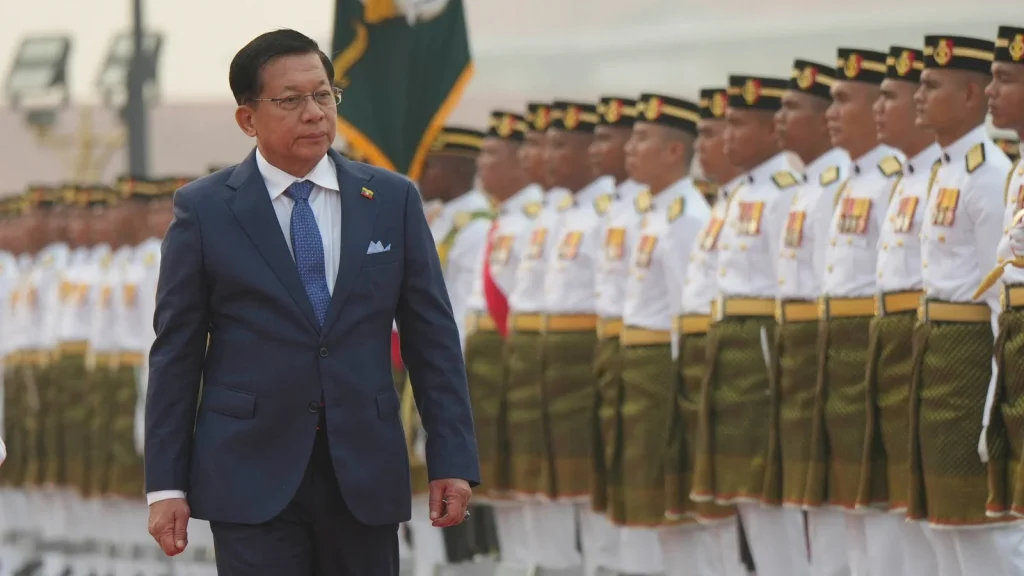
Myanmar’s leader, President Min Aung Hlaing, says his government will refuse to follow parts of a United Nations court judgment he deems “inappropriate” after judges found the state responsible for genocide against the Rohingya minority, according to state media.
Last week, the International Court of Justice (ICJ) issued its ruling, concluding that Myanmar’s forces systematically killed, raped and destroyed civilian property during a 2017 crackdown targeting the mostly Muslim Rohingya in western Rakhine state.
The court instructed Myanmar to prosecute and punish anyone suspected of carrying out genocide, provide compensation to survivors, and ensure refugees can return home safely — more than 700,000 of whom fled across the border to Bangladesh.
In comments carried by state outlets, Min said: “Myanmar would take the actions appropriate for a responsible country but would not comply with requirements it considered inappropriate.”
The former general led the military at the time of the Rohingya crackdown before toppling the elected government of Aung San Suu Kyi in a 2021 coup, a takeover that ignited an ongoing civil war.
He was appointed civilian president this year after tightly controlled elections.
In his first publicised reaction to the ICJ decision — which assessed state responsibility rather than individual culpability — Min characterised the case as a “one-sided accusation” levelled at Myanmar.
The 70-year-old also said the “term ‘genocide’ had seriously affected the country’s reputation”, according to the state-run Global New Light of Myanmar.
“As the country’s leader, he considered himself primarily responsible for all matters occurring in the country and would not accept any actions that undermined the nation,” it added.
Although ICJ rulings are binding and cannot be appealed, the court has no mechanism to enforce its decisions.
Rohingya refugees in Cox’s Bazar watched the ICJ ruling
The judgment marks the first time in the ICJ’s 80-year history that its judges have determined a state committed genocide.
The court found that Myanmar’s security forces killed thousands of Rohingya civilians, carried out “widespread sexual violence” against women and inflicted “extreme violence” on children.
It said Rohingya communities were methodically razed and then repopulated with non-Rohingya residents, concluding that the “only reasonable inference” was an intent to destroy the group — a central threshold for a genocide finding.
Among several measures ordered, the court said Myanmar must “facilitate the safe, voluntary and dignified return” of Rohingya displaced inside the country and those who fled abroad.
Much of Rakhine state, where the Rohingya once lived, is now under the control of the Arakan Army, an ethnic minority rebel group battling the military.
Across the frontier in Bangladesh, more than one million Rohingya now live in Cox’s Bazar, the world’s largest refugee camp.
The ICJ said the Rohingya are entitled to “adequate compensation” for the damage caused by the genocide.
It gave Myanmar two years to propose both the amount and the method of compensation, after which the court will decide whether the plan is sufficient.
The ruling also said authorities must “return or replace in kind all individual and collective property” lost in the 2017 crackdown and provide “physical and psychological rehabilitation”.
Read more:
Myanmar committed genocide against Rohingya, ICJ finds
Rohingya crisis remains unresolved as ICJ rules on Myanmar
Stories of horror told by Rohingya people for many years
The judges told Myanmar it must swiftly investigate anyone suspected of committing genocide, noting that earlier inquiries into abuses by state actors did not meet the required standard.
Myanmar has long rejected allegations of genocide, insisting its operations were directed at an armed insurgency after attacks that killed a dozen security personnel.
But the ICJ rejected Myanmar’s claim that it was conducting legitimate counter-insurgency operations.
On Friday, the government labelled the court’s decision unfair and “a great disappointment”.
The case was filed by The Gambia under the 1948 UN Genocide Convention, which permits any state to bring action against another it believes is violating the post-World War II treaty.