Ukraine Hits Key Russian Air Base, Damaging Multiple Aircraft
 Caalamka
A fresh Ukrainian long-range strike has hit deep inside Russia, targeting a key military air base and damaging aircraft Kyiv says are routinely used to bombard Ukraine.
Ukraine’s General Staff reported that the Savasleyka air base in Russia’s Nizhny Novgorod region, east of Moscow, was struck in what it described as the latest effort to undermine Moscow’s war-making capacity.
According to the General Staff, five aircraft were damaged: three MiG-31 jets — platforms used to launch hypersonic missiles — and two Su-34 fighter-bombers. The aircraft were rendered inoperable “for some time,” it said.
Russia did not immediately comment on the claim.
The reported operation comes amid a string of notable Ukrainian strikes in recent days. In that period, two Russian ships were hit in Libyan waters, and another Russian vessel was struck in the Gulf of Finland.
Last week, Ukraine also destroyed the road portion of Russia’s prized bridge to the Crimea peninsula after consecutive attacks.
Russia launched its full-scale invasion of Ukraine in February 2022, and the fighting has dragged on even as a renewed US-backed peace push seeks to end what has become Europe’s worst conflict since World War Two.
Kyiv has sought to erode Russian military power while contending with a renewed wave of attacks on Ukraine’s energy system and intensifying Russian strikes on frontline cities.
Ukrainian forces have been tracking down Russian ballistic-missile launchers used in many of those attacks, Defence Minister Yevhenii Khmara said this week, adding that 16 had been struck over the past several months.
In parallel, Ukrainian drone attacks have reduced Russian oil refineries’ processing volumes by 45% since late October, industry sources said this month.
Kyiv has said it will stop striking Russian energy targets only when Moscow does the same.
Russian attack damages Ukraine’s energy and gas sites
Overnight, Russian strikes on Ukraine’s power sector damaged energy and gas infrastructure and triggered electricity outages across five regions, Ukrainian officials said.
DTEK said the assault forced a halt to power generation at one of its thermal plants and severely damaged equipment, though it did not disclose the site’s location.
The strikes also sparked a major fire at a Naftogaz gas production facility in the central Poltava region, shutting down operations there.
A worker clears debris at a thermal power plant of the largest Ukrainian private energy company DTEK, which was heavily damaged following Russian missile and drone strikes
As winter conditions tighten their grip, officials warned the latest bombardment adds further strain to an energy system already under heavy pressure.
Deputy Energy Minister Artem Nekrasov said the attacks also cut external power to the Russian-occupied Zaporizhzhia nuclear plant for the 17th time this year.
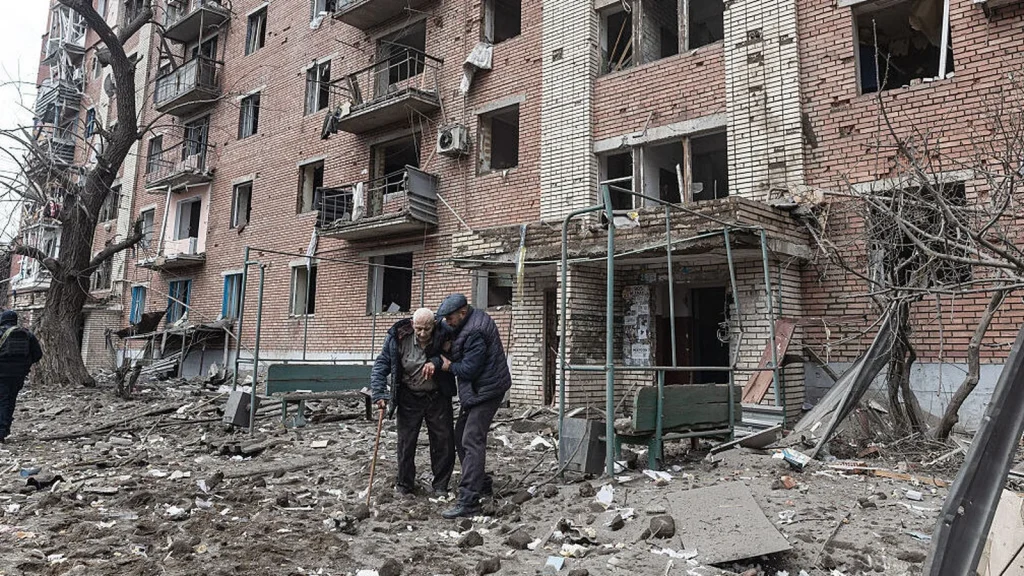
Zaporizhzhia governor Mykhailo Semikin said a morning strike on the region’s main city hit a residential building and injured six people, including two children.
A strike on a residential building yesterday had injured at least 50.
“The most difficult situation is in Zaporizhzhia, where all attention is now,” Prime Minister Sergiy Koretskyi said on Telegram.
We need your consent to load this rte-player contentWe use rte-player to manage extra content that can set cookies on your device and collect data about your activity. Please review their details and accept them to load the content.Manage Preferences
Kyiv region and Odesa hit
Mr Koretskyi said one person was killed in the Kyiv region, adding that Russian forces also attacked logistics routes in southern Ukraine, damaging civilian sites and residential buildings.
Volodymyr Vovkotrub, acting mayor of Bila Tserkva near Kyiv, said facilities belonging to Epicentr, a major household goods retailer, and Nova Poshta, Ukraine’s largest private courier, were damaged.
In the south, Odesa regional governor Oleh Kiper said a large-scale Russian drone attack struck civilian and energy infrastructure in Odesa and surrounding areas.
A residential complex in the city was hit, and two women suffered shrapnel wounds.
In the suburbs, a logistics company and a paper products factory were damaged, he said.
DTEK reported that parts of two Odesa districts lost power, while some critical infrastructure was operating with interruptions.
Russian official warns of Ukrainian attacks on utilities this winter
Russian Deputy Prime Minister Marat Khusnullin said preparations for possible Ukrainian drone attacks on Russia’s utility infrastructure this winter — especially in border regions — are the government’s top priority.
Russian Deputy Prime Minister Marat Khusnullin said drone attacks in border regions is the number one issue that needs to be dealt with ‘right now’ (file image)
Since the war began, Russia has repeatedly struck Ukraine’s civilian energy infrastructure, producing widespread disruption, particularly in large cities.
This year, Ukraine has demonstrated an ability to hit Russian refineries, ports and warehouses, including facilities far inside Russia.
With winter approaching, many in Russia expect further Ukrainian attacks on utility infrastructure, and residents have been stocking up on generators and high-capacity batteries.
In and around Moscow, some power and heating plants have been draped with anti-drone nets.
“This is now the most important question: how we’ll get through the winter, especially given drone attacks, particularly in the border regions. This is the number one issue we need to be dealing with right now,” Mr Khusnullin, who oversees the housing sector, told politicians.
His remarks echoed warnings from Ukrainian leaders about the risk of winter strikes on energy facilities disrupting electricity and heating supplies.
Temperatures are falling below freezing in Moscow this week and are already below zero in many regions.
Last year, drone attacks in Belgorod, near the Ukrainian border, left tens of thousands of residents without heating and electricity for days.
Mr Khusnullin said the problem is compounded by budget pressures and by legal provisions exempting residents in many border regions from paying utility bills.
Russia resumed large-scale attacks on Ukraine’s civilian energy and heating infrastructure in mid-autumn this year, causing widespread power, heating and water outages ahead of winter.
Moscow denies deliberately targeting civilians but says critical energy infrastructure is a legitimate military target.
‘Russia wants more than Ukraine,” says Germany’s Merz as he defends aid
German Chancellor Friedrich Merz accused Russia of “escalating” threats to European security as he defended plans to increase defence spending and continue financial support for Ukraine.
German Chancellor Friedrich Merz said Russia is escalating in his own country
Opposition parties — including the far-right Alternative for Germany (AfD), which tops national opinion polls, and the hard-left Die Linke — have urged an end to military assistance for Kyiv.
“It cannot be said often enough, against the far right as much as the far left: Russia knows exactly what it wants. And Russia wants more than Ukraine,” Mr Merz told the Bundestag lower house during debate on the 2027 draft budget.
“Russia is escalating in the Baltic region, in Poland, on the Black Sea; Russia is escalating in space, and Russia is by now also escalating massively here in our own country,” he said.
Russia did not immediately respond to a Reuters request for comment on Merz’s accusations.
It has repeatedly denied seeking military confrontation with NATO countries and says its actions in Ukraine are aimed at protecting its own national security.
Mr Merz’s government blamed Russia in September for an attempted drone attack at Leipzig/Halle airport — a charge the Russian Embassy in Berlin rejected as part of a “new wave of anti-Russian hysteria in Germany”.
Germany and other European countries have also faced a spate of cyberattacks and sabotage incidents targeting critical infrastructure — allegations they have often attributed to Russia. Moscow has denied those claims.
Read more: How ‘forced fighters’ are used by Russia in Ukraine war