Switzerland votes on relaxing restrictions for exporting weapons and military gear
 Caalamka
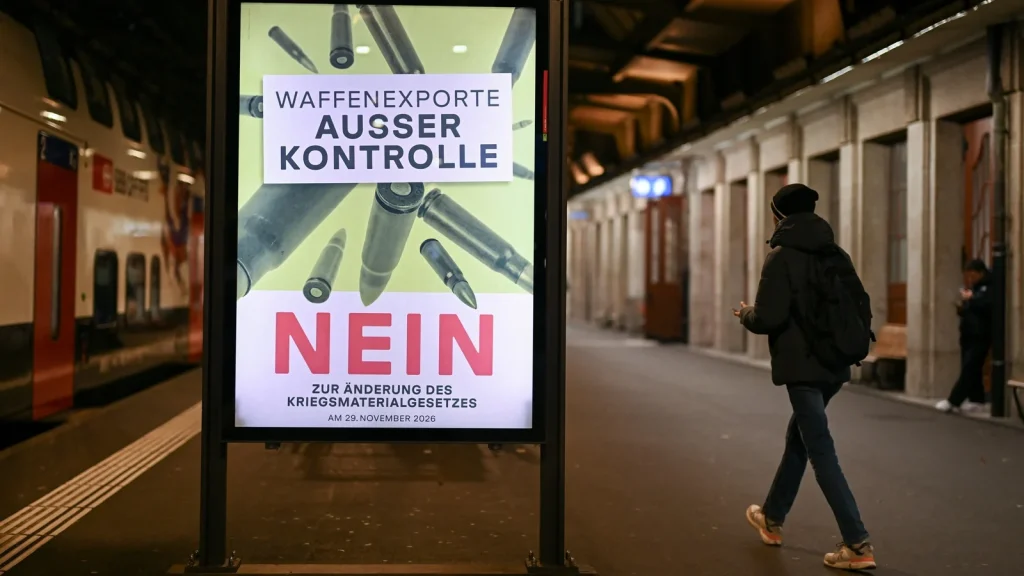
Switzerland heads to the polls today for a razor-close referendum that could loosen the country’s strict rules on weapons exports, setting its long-held neutrality and humanitarian identity against new security pressures and a billion-dollar defence sector.
The wealthy, landlocked nation currently bars exports to countries involved in armed conflict and requires clients to consult Bern if they intend to re-export Swiss-made weapons to another state.
But the government says Europe’s security landscape shifted fundamentally after Russia’s 2022 invasion of Ukraine. With that in mind, parliament last year approved an easing of the restrictions, a move supported by the government.
Switzerland’s direct democracy system gives citizens the final say on contested legislation, and left-wing parties along with NGOs succeeded in forcing the issue onto the ballot. They argue the revised rules put Swiss neutrality at risk.
In addition, the change “significantly increases the risk that Swiss weapons could indirectly end up in civil wars or in the hands of regimes that violate the law”, said Monika Maire-Hefti, president of the Caritas Switzerland charity.
Close contest
Supporters of the reform — led by centrist and right-wing parties — say the adjustment is necessary to keep Switzerland’s arms makers competitive and anchored in global supply chains.
Maintaining domestic know-how is central, campaigners say. “It is a matter of retaining, within our territory, the expertise essential to our independence and security,” said Yvan Pahud, a member of the hard-right Swiss People’s Party, during the campaign.
Polling suggests the outcome is on a knife edge. The last three surveys published on 18 November showed the pro-change camp holding only a slim advantage.
Voting stations are due to close at noon (11am Ireland time), though most ballots are expected to have been cast already by post.
Initial projections are expected shortly afterwards.
If approved, the amendments would allow Switzerland to export military materiel to 36 named partner countries even during an international conflict — as long as the deliveries do not confer a military advantage.
The list of 36 includes European states as well as Argentina, Australia, Canada, Japan, New Zealand and the United States.
No shipments to Ukraine
Estimates from the Stockholm International Peace Research Institute place Switzerland as the world’s 20th-largest arms exporter over the 2021 to 2025 period, accounting for 0.3% of the global market.
After two years of decline, exports rebounded sharply, rising 43% to 948.2 million francs in 2025 — driven largely by ammunition, armoured vehicles and spare parts sent to neighbouring Germany.
Even so, about 20 NGOs, including Amnesty International Switzerland, have denounced what they call “the dismantling of the main safeguards governing Swiss arms exports”.
Opponents also highlight that the proposal contains no steps aimed at supporting Ukraine, despite repeated requests from several European countries since Russia’s 2022 invasion.
Switzerland’s economy ministry says neutrality law blocks exports of Swiss weapons to Ukraine.
“Since Switzerland maintains an embargo on military equipment against Russia, it may not supply such equipment to Ukraine either,” the ministry says.
It adds that indirect transfers to Ukraine would continue to face restrictions.
Alongside the arms vote, Swiss voters will also decide whether to raise VAT to finance a pensions increase, whether to curb the sale and use of noisy fireworks, and whether to change how married couples are taxed