Bondi’s Silence: A Beach Town Remembers After a Hanukkah Night of Violence
On a humid evening a week after a seaside Hanukkah celebration turned catastrophic, Bondi Beach felt like a place suspended between two worlds — the one it has always been and the new, raw version it is learning to carry.
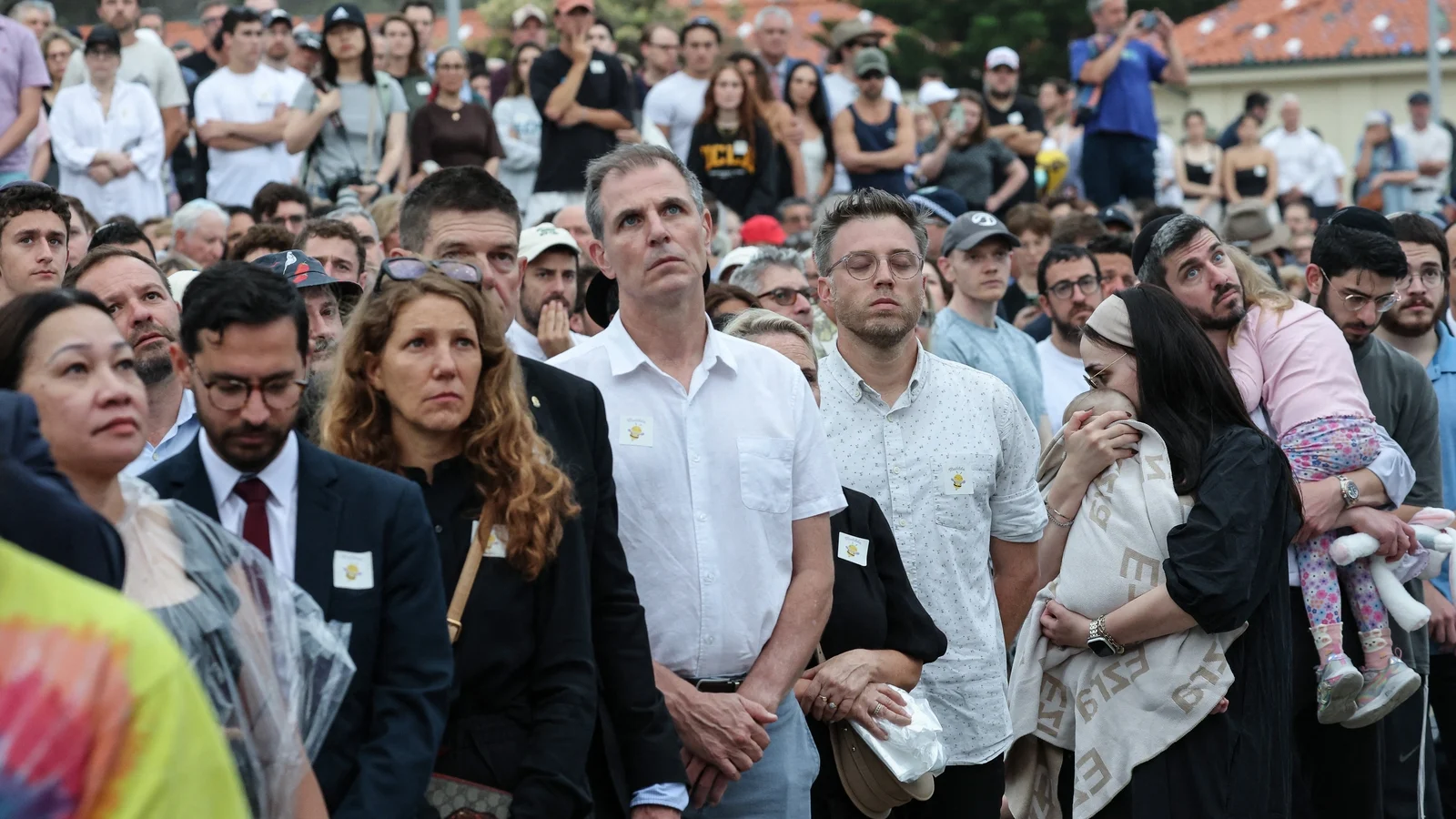
At 6:47pm, the exact moment that gunfire tore through a crowd celebrating the eighth night of lights, a minute of silence fell along the foreshore. Flags on government buildings flew at half-mast. Lifeguard towers that usually squinted into sunset light stood stoic. People who yesterday had argued over café tables about surf conditions now stood shoulder to shoulder with candles in their hands, light mixing with spray and the faint, familiar smell of the ocean.
“We come to Bondi for the tide, for the sunrise, for little things — and suddenly the little things feel fragile,” said Miriam Cohen, 67, a long-standing member of Sydney’s Jewish community, her fingers tightening around a wax taper. “Tonight we lit a candle for each life. My granddaughter wanted to know why we were being quiet. I told her it was so the sea could remember, too.”
The facts people are holding on to
Authorities say 15 people were killed and dozens more wounded when two men opened fire at the beachfront Hanukkah gathering. Police have identified the assault as an act of terrorism directed at Jewish people; investigators believe the shooters were inspired by the militant group Islamic State. One alleged gunman, identified as a 50-year-old father, was killed at the scene by police. His 24-year-old son survived, has been charged with 59 offenses — including murder and terrorism — and remains in custody while recovering in hospital.
The scene was chaotic in every sense: sirens, armored police vehicles, officers carrying long guns, and an outpouring of grief that threaded through synagogues, school halls and small living rooms across the country. In Bondi, the small emergency shrine of flowers and teddy bears that formed beside a surf club felt almost unbearably intimate in the face of national headlines.
Government response and the arguments that follow
Prime Minister Anthony Albanese announced a sweeping review of Australia’s law enforcement and intelligence arrangements, to be led by a former chief of the national spy agency. “The ISIS-inspired atrocity last Sunday reinforces the rapidly changing security environment in our nation,” the prime minister said, adding that the review would look at whether federal police and intelligence services have the “right powers, structures, processes and sharing arrangements in place to keep Australians safe,” with conclusions expected by the end of April.
The federal government has also announced a nationwide gun buyback initiative and pledged to beef up hate crime laws. New South Wales authorities said they would introduce legislation to ban the public display of flags and symbols of groups designated as terrorist organisations — a list officials announced would include Islamic State, Hamas, al-Qaeda, Al Shabaab, Boko Haram and Hezbollah.
“There are gaps that the perpetrators exploited,” said Dr. Samuel Ortega, a security analyst who has advised Australian law enforcement. “It’s not only about guns. It’s how information travels between agencies, how risk is assessed, and how radicalising content proliferates in online spaces. This is a complex ecosystem.”
On the ground: grief, fear and defiance
Bondi’s cafés and kiosks reopened the next morning, but with a different rhythm. A café owner, Jamal Singh, wiped down tables and said, “We’re still selling coffee. People need normal. But normal feels like a brave act. When I saw the minute of silence, I cried. My mate is Jewish; his family were there that night. We are all family here.”
Around the city, a palpable rise in antisemitism has put Australia’s Jewish communities on edge. Since the outbreak of the war in Gaza in October 2023, there have been repeated incidents around the country — vandalism at synagogues, attacks on buildings and cars, and heated confrontations at public rallies. For many, the Bondi attack was not an isolated tragedy but the most devastating peak in a troubling trend.
“We’ve seen threats increase, we’ve seen graffiti and intimidation, but nothing like this,” said Rabbi Leah Mendel, who runs a community centre in eastern Sydney. “Our community is resilient. But resilience wears thin when people you love don’t come home.”
Gun laws, loopholes and a painful history
Australia’s firearm laws have long been cited as among the strictest in the developed world — a legacy of the 1996 Port Arthur massacre that prompted a national ban on certain weapons and a landmark buyback program. Yet the Bondi killing has exposed what many officials now describe as loopholes in licensing, possession and assessment procedures.
“We have a framework that works broadly, but it was designed for a different moment,” said Professor Karen Liu, a criminologist at the University of Sydney. “Policies rarely keep pace with new modes of harm: small-caliber handguns, rapid online radicalisation, and complex family dynamics.”
The decision to introduce a new, nationwide buyback echoes the 1996 program. But buying back weapons, experts say, is only one piece of a much larger puzzle that includes improving mental health services, stiffening penalties for hate crimes and upgrading intelligence sharing between police, community organisations and social services.
A community’s small acts of resistance
As dusk deepened and the last of the candles burned low, there were moments of light that felt more like vows than simple gestures. A group of teenagers placed a paper star on the sand. An older man sang an old Yiddish lullaby, the notes floating out over the breakers. Volunteers distributed hot soup to anyone who needed warmth.
“We’re trying to stitch things back together in little ways,” said Layla Hassan, who helped organise a neighbourhood vigil. “When you live in a community that’s multicultural, you learn to be each other’s watchman. Tonight, that’s more literal than figurative.”
What do we do with this anger?
The questions multiply: How do democracies balance civil liberties and security? Can better policing and intelligence stop someone bent on violence? How do communities address the root causes of hatred and the online platforms that amplify it? And for every policy fix, what work needs to be done at the level of daily human relationships to prevent the drift toward dehumanisation?
“Policies matter, but so do the small, daily acts of seeing one another,” Rabbi Mendel said. “If we only tighten laws without addressing social fractures, we will be back here again.”
As the waves kept their old rhythm and Bondi’s iconic sandstone cliffs held their shape against the wind, the city’s candlelight vigil closed with an old prayer and a new determination. The sea that has carried surfers and dreamers for generations now cradles something else: the memory of those lost, the complex questions left behind, and a community learning, slowly and painfully, how to live with both grief and resolve.
So, what can the rest of us learn from Bondi’s silence? Perhaps it’s this: that democracy is not only defended in courtrooms and in Parliament, but also in the everyday refusal to let fear become the only language we speak. How will you keep the light alive where you are?