A New Front in the Digital Cold War: When Visas Became Weapons
Across a rain-slicked Parisian boulevard, a café owner wipes down a metal table and squints at his phone. “We used to talk about trade wars,” he says, stirring a small spoon with a practiced flick. “Now they’re arguing about who can tell whom what to say online. It feels like the world has gone inside-out.”
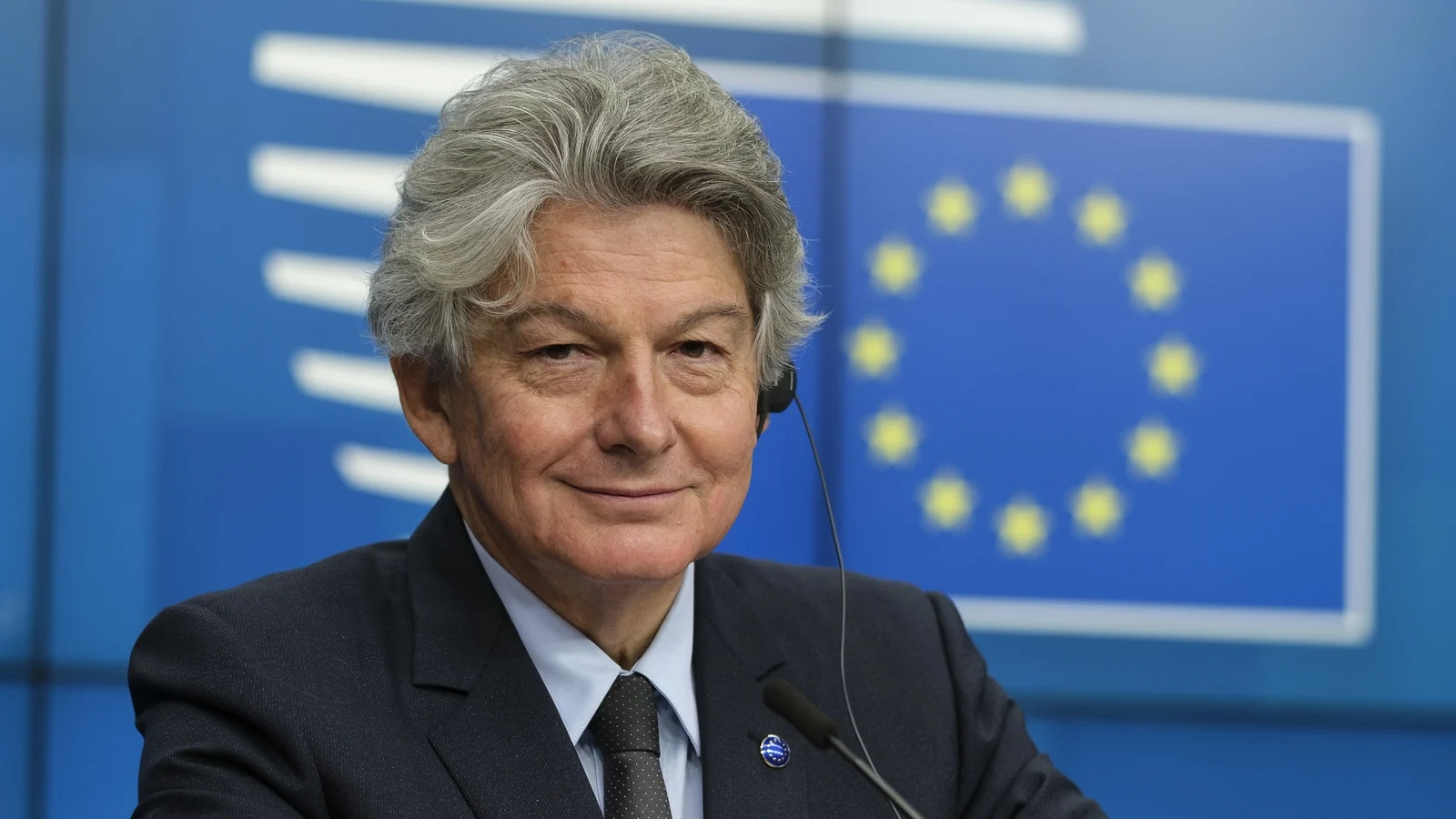
Two continents away, in a sunlit office in Washington, the State Department announced a move that has already reverberated through the halls of Brussels and the backstreets of Berlin. The United States will deny visas to a small group of high-profile European regulators and civil-society actors — among them Thierry Breton, the French technocrat who helped shepherd the European Union’s Digital Services Act (DSA), and several leaders of nonprofit organisations described by Washington as having “coerced” American tech platforms into censoring viewpoints they opposed.
“These radical activists and weaponised NGOs have advanced censorship crackdowns by foreign states — in each case targeting American speakers and American companies,” the State Department said in the statement that set off a storm of protest across Europe. Secretary of State Marco Rubio framed the action in blunt geopolitical terms: “Extraterritorial overreach by foreign censors targeting American speech is no exception.”
Who is affected?
The visa restrictions target five people who have been prominent in the EU’s digital-policy universe:
- Thierry Breton, former EU Commissioner and key architect of the DSA;
- Imran Ahmed, head of the Centre for Countering Digital Hate (CCDH);
- Anna‑Lena von Hodenberg and Josephine Ballon, associated with Germany’s HateAid;
- Clare Melford, who leads the Global Disinformation Index (GDI).
For Europeans, many of whom see the DSA and the UK’s Online Safety Act as efforts to shape a safer, more transparent internet, the decision landed like a diplomatic slap. “We strongly condemn these visa restrictions,” France’s foreign minister posted on social media. “Europe cannot let the rules governing our digital space be imposed by others upon us.” Breton himself called the move a “witch hunt,” invoking the McCarthy era as a warning about political persecution.
Why this matters: law, power and the architecture of speech
If you work in tech policy, the contours are familiar but the stakes are shifting. The DSA — negotiated in Brussels and agreed in the early 2020s — set a new standard for online accountability. It demands that very large online platforms (the so-called VLOPs, reaching roughly 45 million or more users in the EU) explain why they remove content, provide safeguards for researchers, and give users clearer routes for redress. For many European lawmakers, it was an effort to rebalance power between global platforms and the societies they serve.
But to the Trump-era US administration, and to influential conservatives who have loudly criticised the DSA, such rules look like a novel form of jurisdictional aggression. The fear they articulate is this: if Brussels can impose transparency rules and content moderation regimes, could it indirectly tilt public debate elsewhere? Could European regulation choke American voices — or at least make it easier to do so?
That question is not abstract. In recent months Brussels fined X (formerly Twitter) for breaches tied to ad transparency and account verification — a move that incensed some US political actors. The White House also paused a technology cooperation deal with the UK, citing incompatibilities between American priorities and Britain’s Online Safety Act. Taken together, these skirmishes signal a widening rift over who gets to govern speech online.
Voices on the ground
“It feels personal,” says Maya, a London-based content moderator who asked to use a pseudonym. “My work is to triage harm. But the rules keep changing depending on who is shouting loudest — governments, shareholders, activists. You wonder whether policy is serving people or political theater.”
At a university in Berlin, Dr. Luis Alvarez, a researcher who studies platform governance, offered perspective on the legal dynamics. “The DSA explicitly aimed for transparency and researcher access — that is, to understand algorithmic amplification and the exposure of children to harmful content,” he said. “What Washington calls ‘extraterritorial overreach’ is often described in Brussels as the EU exercising regulatory autonomy over companies that operate inside its single market.”
What’s at stake globally
Beyond personalities and headlines, this clash touches deeper questions about sovereignty, the reach of democracies, and the shape of public discourse in an age where code and law collide.
Some figures help frame the scale. More than half the human population now uses social media; internet platforms host billions of interactions daily. The companies targeted by EU and UK rules — giants with global networks of users and advertisers — often generate revenues that dwarf small nations. Regulators in Brussels and London argue that if a global platform serves European users, Europe has a right to insist on safeguards. Washington’s counterargument is straightforward: American speech and American companies must be defended from foreign pressure.
But is the conflict really binary — Europe vs America, regulation vs freedom? Or is it a more complex scramble to set global norms? “Every big tech regulation becomes a template,” Dr. Alvarez noted. “Once a standard is implemented in one market, companies often extend it globally for operational simplicity. That’s why everyone fights over the rulebooks.”
Cultural colors and human reverberations
Walk through the Marais in Paris or Kreuzberg in Berlin and you’ll hear debates tie themselves to daily life: a small bookstore owner worrying about algorithm-driven visibility; a schoolteacher fretting over the platforms her students consume; a pensioner in Marseille, who uses Facebook to follow grandchildren, confused by sudden content removals. These are not abstract policy contests; they shape how communities find one another, recall memory, and contest truth.
“We don’t want to be told what to think from Washington, nor from Brussels,” said a Parisian retiree, name withheld. “We want rules that protect our children and our neighbours, not rules that silence some voices because others are louder.”
Where do we go from here?
The visa ban may be a punitive stunt — or it could be an opening gambit in a broader strategy to keep the digital commons fragmented along national lines. Either way, the current episode raises questions we all ought to consider: who decides the rules of the global internet? How do we balance the protection of vulnerable users with the protection of political speech? And what happens when norms and markets collide across borders?
As you scroll through your feed tonight, pause to think about the invisible architectures shaping those pixels. Who built them? Who polices them? Whose voice gets amplified and whose is muffled?
Policy fights like this one are messy, human and consequential. They are fought not only in capitals and courtrooms, but in cafés, classroom chats, and the small civic acts that keep public life alive. If the internet is a public square, then debate over its rules is an argument about what a public square should be — and who gets to speak there.