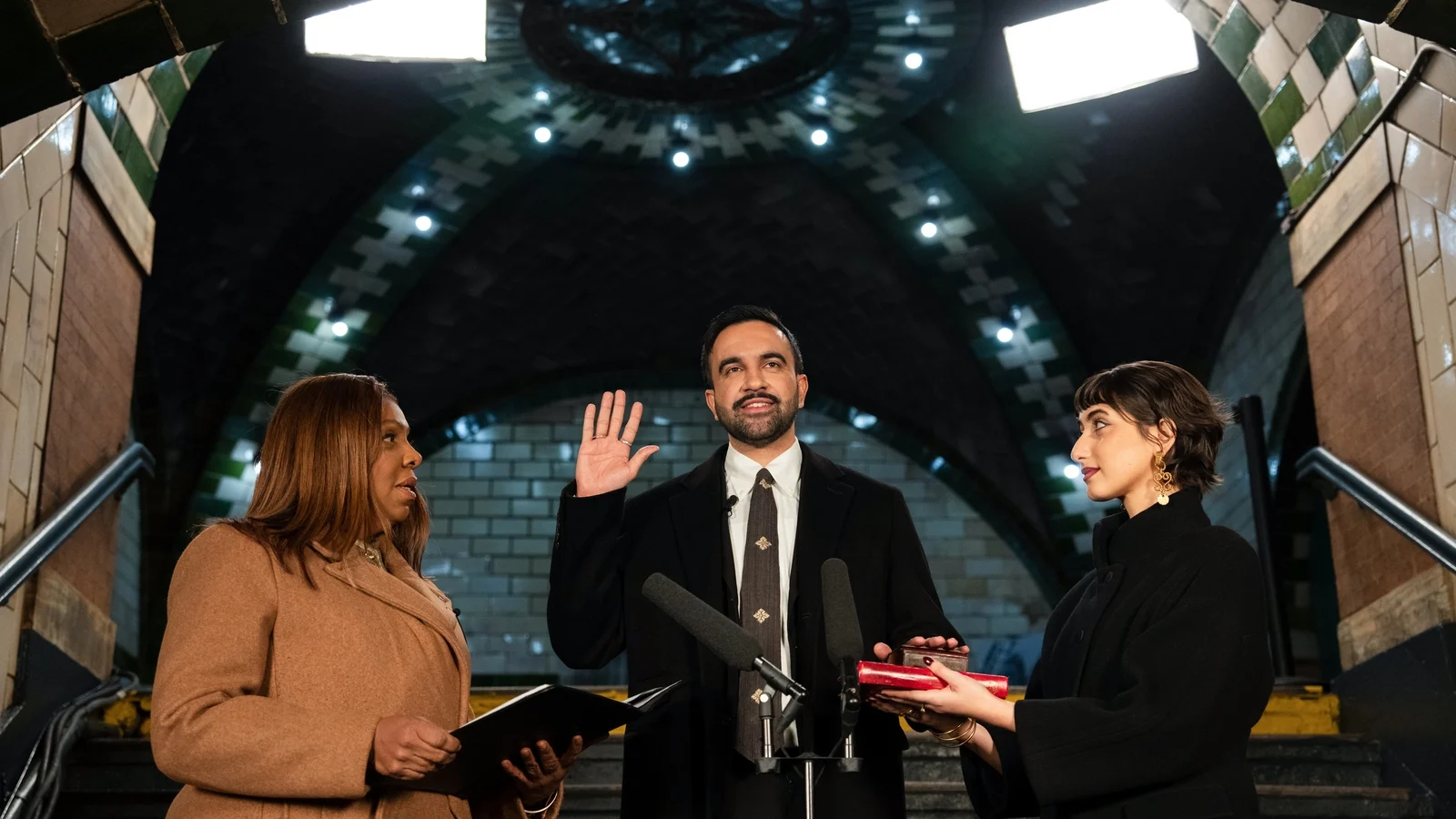
Under the Vaulted Ceiling: A New York Inauguration Like No Other
At 12:07 a.m., beneath the ceramic glow of a forgotten subway station, Zohran Mamdani rose and took an oath that, for a few dozen people standing in the hush of Old City Hall, felt like the hinge of history.
The platform’s curved tiles threw back light like a theater set. Above them, carved into the arch, the single word CITY HALL looked down as Attorney General Letitia James administered the pledge to “support the Constitution” and the laws of New York. Mamdani’s wife, Rama Duwaji, stood at his elbow. For a moment the city’s rumble — the distant diesel, the muffled heartbeat of trains elsewhere — fell away.
“Happy New Year to New Yorkers, both inside this tunnel and above,” Mamdani said, his voice measured but bright. “This is truly an honour and a privilege of a lifetime.”
Why a Closed Station?
The choice of Old City Hall — a decommissioned stop most New Yorkers only glimpse on guided tours — was deliberate. It is part museum, part metaphor: ornate, intimate, and buried beneath the modern city’s noise. Mamdani’s team called it a nod to “the working people who keep our city running every day,” an image meant to tether his political promises to subway conductors, nurses, bus drivers and the janitors who live in rent-regulated apartments.
Standing among them was Luis, a 58-year-old Transit Authority retiree who volunteers as a tour guide there twice a year. “This place smells like the city you read about in old books,” he said, handing out laminated maps. “To bring a new mayor here — it tells you who he’s thinking about.”
A Campaign Built on Everyday Struggles
Mamdani, 34, campaigned as a democratic socialist who framed his candidacy around the mundane cruelties of modern urban life: skyrocketing rents, packed buses, childcare costs that make two-paycheck households feel precarious. He promised sweeping measures — a rent freeze, free buses, expanded childcare — and wove them into a narrative about dignity and daily survival.
His message resonated. In a turnout that shattered recent patterns, more than two million New Yorkers cast ballots. Mamdani captured roughly half of them — about 50% — and beat Andrew Cuomo, who ran as an independent, by nearly ten points. That scale of participation reflects not only a victory for a single candidate, but a broader appetite for change in a city of roughly 8 million souls.
Policy Promises — In Plain Sight
- Immediate push for a rent freeze mechanism to stabilize household budgets
- Free bus service aimed at low-income neighborhoods and environmental gains
- Expanded publicly funded childcare programs to support working families
These are not minor platform lines; they are expensive, administratively complex and politically combustible. Yet Mamdani sold them not as abstract reforms but as practical fixes to problems New Yorkers live with every day.
Money, Momentum and Modern Organizing
Campaign finance underscored the movement’s muscle. Mamdani raised $2.6 million for transition and inauguration events from nearly 30,000 contributors — a breadth of small donors that meant as much as the total dollar figure. It’s a reminder of how political fundraising in the 2020s is as much a story of grassroots digital mobilization as it is of big checks and institutional backing.
“This is political energy translated into resources,” said Grant Reeher, a Syracuse University political scientist. “Having the state attorney general swear him in, too, sends a signal: he’s staking out independence from national divisions while still demonstrating a network of support at the state level.”
A Nation Watching
This inauguration is not merely a city story. Mamdani will be the first Muslim mayor of New York City, and his victory has implications far beyond municipal sanitation budgets and housing codes. It reverberates through the national conversation about what the Democratic Party can be: a coalition that centers affordability and expands the policy imagination without alienating moderates or Wall Street.
Before the vote, bankers and corporate executives voiced concern. After it, many said they were ready to engage. “People are pragmatic,” said Maya Patel, who manages a small financial services firm across from the East River. “The city’s economy depends on cooperation. We’ll test policies, adapt, but we won’t panic-sell the city.”
From Astoria to Gracie Mansion
Mamdani will trade his one-bedroom apartment in Astoria — a rent-stabilized sanctuary that kept him insulated from the worst spikes in New York rents — for Gracie Mansion on the Upper East Side. The move will be literal, but it also marks a symbolic crossing: the private struggle of a young family becoming the public stewardship of a city with a massive and complex municipal machine.
“There is no greater test of conviction than when policy meets payroll,” said a local nonprofit director who asked not to be named. “How you balance budgets, who you protect, and who you ask to sacrifice — those choices tell you who a leader really serves.”
Alliances, Warnings and the Long Arc of Urban Progress
Letitia James administered the oath in a moment that stitched together local and national threads. James, who rose to national attention for investigations that cut into the fortunes of powerful figures, has been an early backer. Senator Bernie Sanders, the inspirational touchstone for many progressives, will preside over a larger, daytime ceremony on City Hall’s steps, and Representative Alexandria Ocasio-Cortez is slated to speak. The guest list underscores a coalition that mixes grassroots activists with influential national figures.
History offers both precedent and caution. David Dinkins, the city’s first Black mayor and someone loosely associated with democratic socialist ideas, governed from 1990 to 1993 and navigated budget deficits while persuading businesses to remain in New York. The scale and texture of Mamdani’s challenges differ, but the lesson is familiar: governing a city like New York is always a test of negotiating power, patience and persuasion.
Questions to Watch
As the inaugural confetti settles and the first budgets are drafted, a few questions will define his early months in office:
- Can a rent freeze be designed to protect tenants without precipitating a housing supply crisis?
- Will free buses measurably reduce traffic and emissions while preserving transit budgets?
- How will labor, business and civic sectors be brought into negotiations so policy experiments can scale?
And a softer but no less honest question: can a mayor who came of age in activist circles translate moral clarity into the messy compromises that keep a city running?
What This Means for You
If you live in New York, Mamdani’s decisions will touch the price of your rent, the frequency of your commute and the cost of childcare. If you live elsewhere, his tenure will be watched as a test case — a model for progressive governance or a cautionary tale depending on outcomes. The nation’s conversations about inequality, urban policy and the role of government will, for better or worse, look to New York.
So I ask you: what do you want your city to be — efficient and prosperous, or equitable and compassionate? Must it be only one, or can it strain toward both? New York’s experiment begins now, under an old station’s tile, in the hush after midnight. The work of the day will come soon enough.