Midnight Flame: How Amsterdam’s New Year’s Eve Turned into a Night of Fire and Fracture
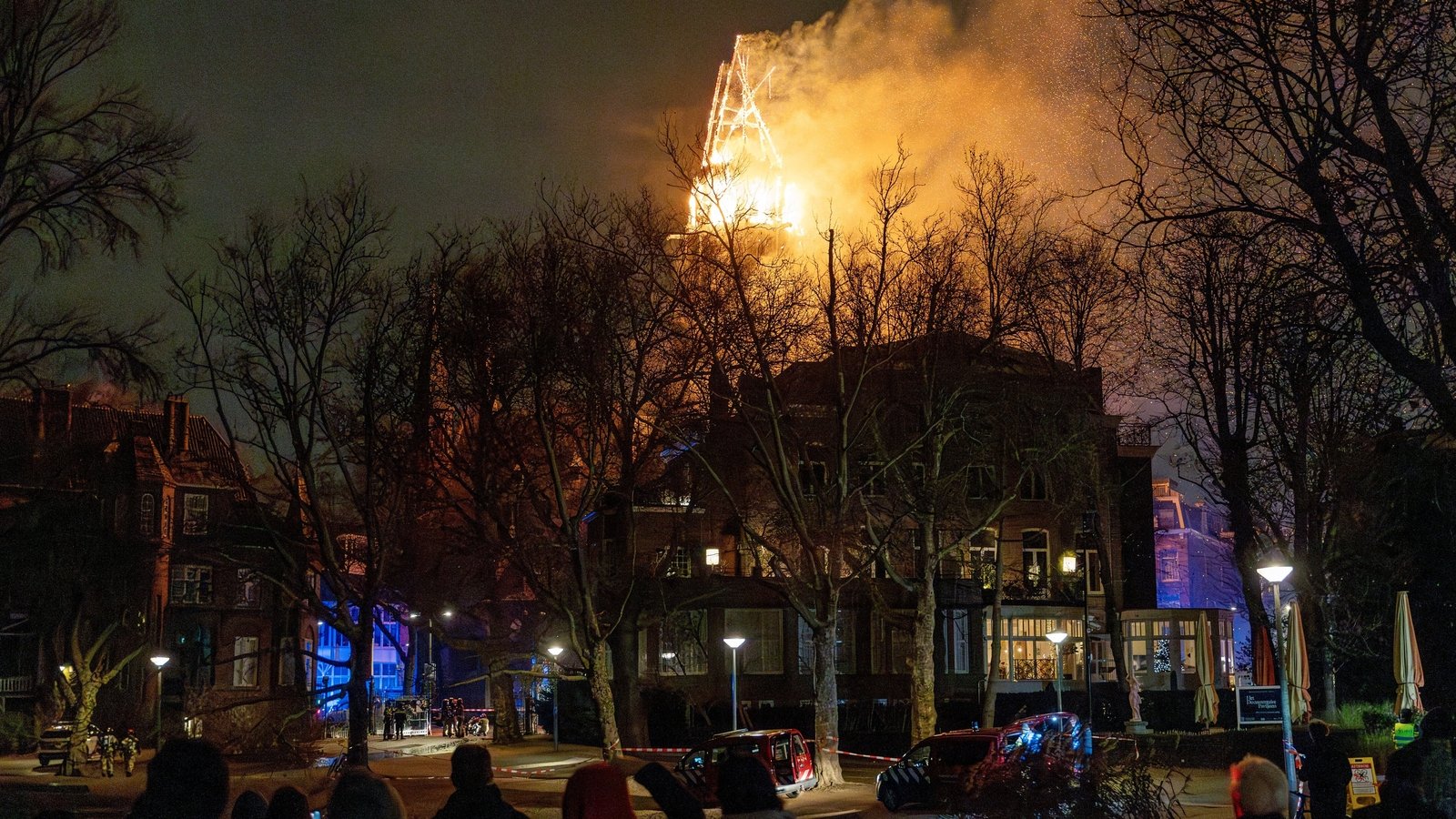
On the cold, damp cusp between one year and the next, Amsterdam’s familiar skyline — the church spires, the gabled houses, the blotchy glow of streetlamps — was sliced by a new silhouette: a 50-metre tower collapsing inward, its roof gone, embers curling into a bitter winter sky. The Vondelkerk, a 19th-century church that had watched over Vondelpark since 1872, became the scene of a blaze that felt less like an accident and more like a sharp, public punctuation mark at the end of a chaotic year.
Witnesses described a scene out of a nightmare. “I saw the tower fall and for a moment it felt like the city had been unmoored,” said Marieke, who lives two blocks away and came with neighbours in the grey dawn to see what was left. “There was smoke everywhere — I could still taste it on my tongue.”
Not Just a Fire: Violence, Injuries, and a Nation on Edge
The inferno at the Vondelkerk was only one thread in a frayed tapestry of New Year’s Eve disturbances that spread across the Netherlands. Authorities reported two people killed in fireworks accidents — a 17-year-old boy and a 38-year-old man — and several others seriously injured. Eye wards saw an alarming number of casualties: Rotterdam’s specialised eye hospital said it treated 14 patients for eye injuries that night, ten of them minors, two of whom required surgery.
But the physical toll was accompanied by another kind of damage: an “unprecedented” wave of aggression directed at the very people trying to keep the night from descending into catastrophe. Nine Kooiman, who heads the Dutch Police Union, said there was an “unprecedented amount of violence against police and emergency services.” She told reporters she had been struck repeatedly by fireworks and other explosives while on duty. “I’ve never seen it like this,” she said. “Bravery was commonplace that night, but so was targeted cruelty.”
In cities from Amsterdam to Breda, accounts of petrol bombs hurled at officers and emergency responders were distressingly common. In Amsterdam’s central Dam Square, footage circulated of police moving through a chaotic crowd as pyrotechnics exploded overhead. In the southern city of Breda, local officers battled individuals who attacked with incendiary devices.
Why Did It Escalate?
Several factors collided to make this New Year’s Eve particularly combustible. For one, it was the last legal year for the sale and private use of many consumer-grade fireworks before a planned ban on unofficial pyrotechnics — a ban meant to reduce injuries and curb the large-scale, often illegal detonations that have become a yearly hazard. The Dutch Pyrotechnics Association reported that shoppers spent a record €129 million on fireworks this season, a surge that translated into more explosives in more hands.
Another element was the national overload of emergency services. Shortly after midnight authorities issued a rare country-wide alert on mobiles — a blunt message urging people not to call emergency services unless there was an immediate threat to life. The message was born of necessity: 112 lines — the Dutch emergency number — were being flooded. “We could not get through,” said a paramedic who did not want to be named. “It’s terrifying when people call for every bang and light and you can’t reach those who truly need help.”
The Vondelkerk: More Than Bricks and Mortar
To the people who live nearby, the Vondelkerk wasn’t simply a weathered building; it was a keeper of memories. “My parents had their wedding photos taken in front of that church,” said Ibrahim, a café owner around the corner. “It stood through wars and floods. For it to burn on New Year’s felt like losing an old relative.”
Architectural conservators and cultural historians are poring over the damage assessments. Early reports from city officials were oddly hopeful: while the 50-metre tower collapsed and the roof was badly damaged, the core structure — the bones of the church — was expected to remain intact. Still, the image of charred beams and a roofless nave will be the new photograph of this place for some time.
“We will mourn the loss of original fabric,” said Dr. Elise van der Meer, a historian specialising in Dutch ecclesiastical architecture. “But we mustn’t sentimentalise ruins at the cost of public safety. The burning of historic sites on nights of mass pyrotechnics is a pattern we have to break.”
Faces in the Crowd: Stories from the Ground
The human stories from the night vary in scale and sorrow. There was the volunteer firefighter who describes arriving to find crowds cheering as the blaze ate the roof: “People stood filming on their phones while flames were devouring the church,” he said. “We were trying to pull hoses through a throng of revelers who had no idea the risk they were creating.”
There were small acts of kindness too. A schoolteacher collected blankets for those evacuated from nearby homes. A florist laid a bouquet at a temporary cordon and whispered, “For what we can’t fix overnight.”
And there were the scared children dragged away from a scene they did not understand. “My son asked if the church was angry,” a mother told me, laughter brittle around the edges. “How do you explain that sometimes people are dangerous and sometimes we are just unlucky?”
What Does This Mean for the Future?
The blaze, the violence, and the injuries raise questions about law, culture, and the rituals that govern public life. Do we preserve a centuries-old tradition of private fireworks at the cost of repeated harm? Can a society balance festivity with restraint? The upcoming ban on many consumer fireworks is meant to be an answer, but bans alone do not dismantle the social scripts that lead to mass purchases and risky behaviour.
“Regulation helps, but education and enforcement must go hand in hand,” said Dr. Anouk de Jong, a sociologist who studies crowd behaviour. “If a community sees New Year’s as a time to ‘let go’ regardless of rules, then legality won’t change the impulse. That’s a tougher conversation — about identity and ritual — that we haven’t fully had.”
Questions for the Reader
What would you do if a beloved landmark in your city was suddenly reduced to embers? How do we reconcile the joy of celebration with the responsibility to protect each other? As the Netherlands prepares to tighten rules on fireworks, these are not abstract questions. They are practical, urgent, and deeply human.
One image from that night keeps returning to me: a small boy, soot-smeared and still gripping a candy wrapper, craning his neck to watch the Vondelkerk’s shadow collapse. His wonder was untainted by politics; it was pure, the way a child looks at fire. How we respond now will teach that child — and us all — what it means to celebrate without destroying the things we love.
Aftermath and Where We Go From Here
Amsterdam’s municipal teams and heritage groups will spend months assessing structural safety and planning restoration. The social aftershocks — policy debates, community dialogues, and, one hopes, a reduction in private pyrotechnics — will take longer. The costs are not only measured in euros but in trust, in the fragile agreements between citizens and institutions that keep a city whole.
“We cannot simply rebuild what burned and expect the problem to go away,” said a local councillor. “This is a moment to think differently about how we mark time, how we keep revelry from tipping into ruin, and how we protect the people whose job it is to help us when things go wrong.”
As smoke clears and scaffolding goes up, Amsterdam — like many cities around the world — faces a test: can age-old customs be reimagined for a modern, safer public sphere? Or will the cycle of spectacle and damage continue until something even dearer is lost?