At the Mausoleum: A Quiet Photograph and a Loud Question
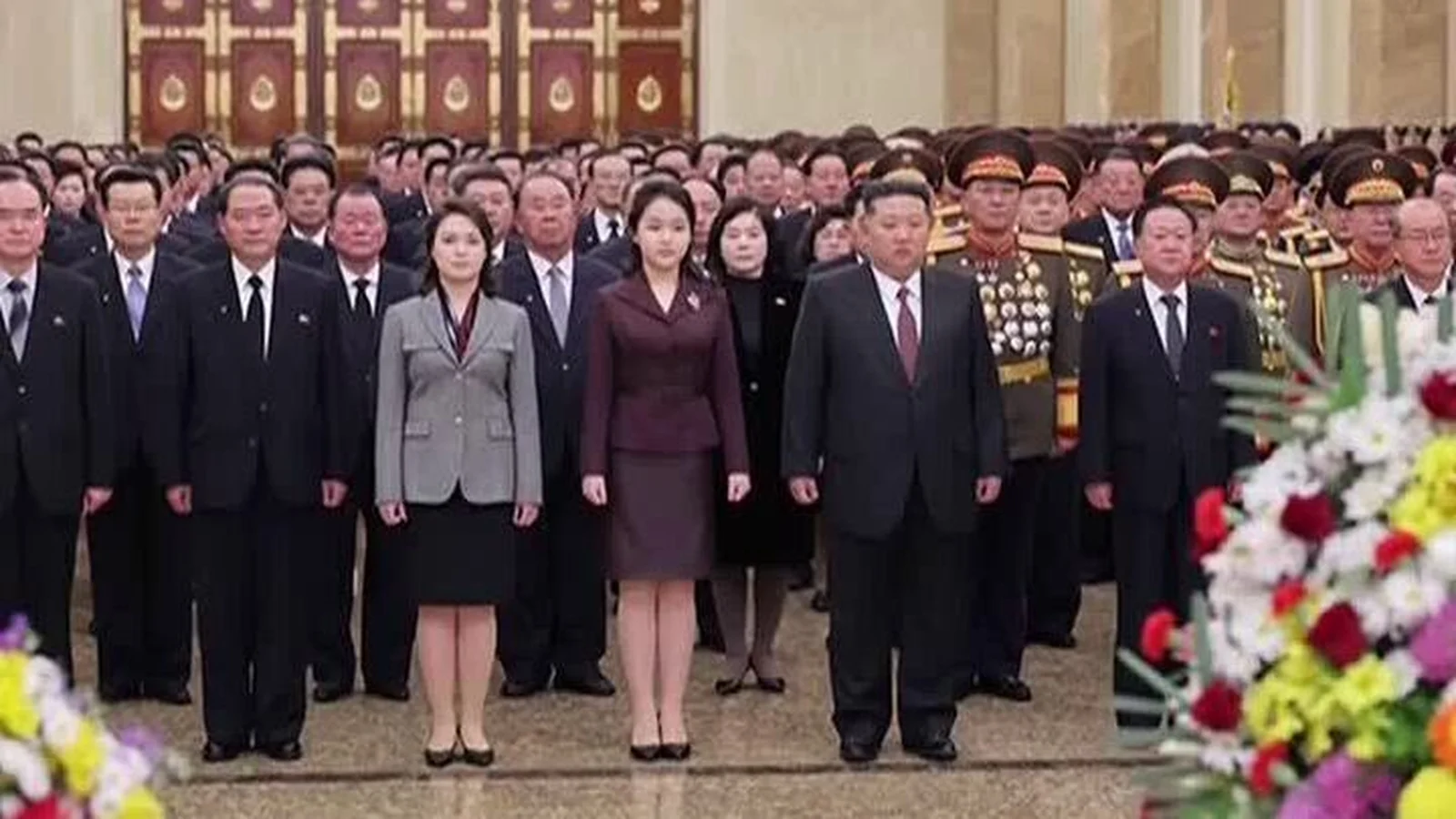
There are images that speak in a dozen languages at once, and then there are images that aim for silence. North Korea’s state news agency released a few such photographs recently—glossy, staged, and instantly thorny—showing a young girl flanked by her parents in the cavernous, torch-lit interior of the Kumsusan Palace of the Sun.
The girl, Kim Ju Ae, stood between Kim Jong-un and Ri Sol Ju as they paid homage to the embalmed bodies of the country’s founders. For a regime that treats ceremony like scripture, even a single frame can be a sermon. The question the photographs pose—deliberate or not—is unavoidable: who will lead next?
More than a Family Snapshot
North Korea has long used pageantry to stitch together authority. The Kumsusan Palace of the Sun is not merely a mausoleum; it is the shrine where the state’s legitimacy is on permanent display. To appear there is to be woven into the national story.
Kim Jong-un’s choice to place his daughter in the center of such a tableau is neither casual nor new. Over the last few years, Ju Ae’s visibility has increased: she appeared at New Year celebrations, and in September she reportedly accompanied her father on a high-profile trip to Beijing—the sort of diplomatic flourish that once would have been unthinkable for the private children of a closed leadership.
“This is image-making with a purpose,” said a Seoul-based analyst who has tracked Pyongyang’s media moves for two decades. “The regime is sending more than a symbol; it is rehearsing a narrative of continuity. Whether that narrative becomes law is another matter.”
What the Experts Say
South Korean intelligence and outside analysts have increasingly floated the idea that Ju Ae might be groomed as a successor, the fourth generation in a lineage that began with Kim Il Sung in 1948. Sejong Institute vice president Cheong Seong-chang has described the child’s appearances as a calculated prelude to formal succession moves, particularly ahead of party gatherings and anniversaries that codify power in North Korea.
“Showing a stable family image—father, mother, daughter—on the state stage underscores dynastic legitimacy,” said Hong Min, an expert at the Korea Institute for National Unification, in comments to reporters about the imagery. But he and others caution against leaping to conclusions. Ju Ae’s age, believed to be in the early 2010s, makes it unlikely the regime would announce the succession formally any time soon. As Hong observed, it would be “practically impossible” to publicly name a child who cannot legally join the Workers’ Party, let alone assume an office that demands absolute control.
Quick Facts
- Kim Jong-un has led North Korea since 2011, following the death of his father Kim Jong Il.
- The Kumsusan Palace of the Sun houses the preserved bodies of Kim Il Sung and Kim Jong Il and is a central site for state rituals.
- North Korea’s population is roughly 25 million people, living under a highly centralized, dynastic state.
The Optics of Succession
Consider the choreography. In a nation where every public move is choreographed with the precision of a military drill, placing a child in the frame is a message to multiple audiences—domestic, regional, and global.
To the North Korean populace, the portrait of a smiling first family sends reassurance: the “revolution” will continue unbroken. To the region—particularly Seoul and Beijing—it is a reminder that the regime is alive to perceptions and optics, willing to stage-managed shifts and reassure partners and rivals alike. And to the international community, it poses a more uncomfortable question: what does it mean when nuclear authority is passed down like an heirloom?
“Leadership in Pyongyang has always been intimate and symbolic,” said a former diplomat who served in East Asia and now lectures on authoritarian succession. “But the stakes are different when the leader is also the commander-in-chief of a nuclear arsenal. The world pays attention.”
Voices on the Ground and in the Halls
Outside the neatly curated frames of state media are other, messier perspectives. In Seoul, an elderly woman I met in a tea shop frowned when I described the photographs. “It feels like history folding over itself,” she said. “We watched our grandparents worship statues; now they want us to worship a child. It comforts some people, frightens others.”
In foreign tour groups permitted brief glimpses of Pyongyang, guides discuss the mausoleum with a reverence that feels rehearsed; in private, visitors sometimes note a dissonance—the grandeur of the halls set against a country struggling with chronic shortages and isolation. The images of Ju Ae are part of that dissonance: a reminder of continuity even as the state confronts economic strain, sanctions, and geopolitical isolation.
North Korea’s official silence on Ju Ae’s exact age and status feeds talk but stymies clarity. South Korea’s Unification Ministry has publicly declined to make definitive claims, saying it is “too early” to treat her as a successor given her age and lack of formal position. That is the cautious posture of a democracy watching a closed state make moves few outsiders can see in full.
What Does This Mean for the World?
Succession in authoritarian regimes is a delicate dance. Sometimes it is a smooth handover orchestrated behind closed doors; sometimes it is a crucible of competing elites. The North Korean model has historically favored family succession—three generations in a row now—so the possibility of a fourth is not merely tradition but an institutionalized logic of the regime.
Yet the implications transcend domestic ritual. A child leader, or the preparation of one, raises questions about stability, deterrence, and negotiation. Who speaks for the young heir on matters of defense or diplomacy? How do regional powers recalibrate strategy? These are not abstract concerns when nuclear weapons and missile programs are involved.
“Whether they announce Ju Ae as successor tomorrow or groom her for a decade,” the Seoul analyst said, “the message is that the Kim family intends continuity. That has both domestic stabilizing aims and international signaling effects.”
Looking Ahead: Theater, Reality, and the Human Element
For the North Korean people—whose daily realities include rationing, state labor campaigns, and tightly controlled information—the announcement of an heir might be another headline in a life built around waves of state narrative. For the global observer, it is an evolving story that will test how we read images, signals, and silences.
So what do you see when you look at those photographs—a rehearsal for history, a wink at propaganda, or something more dangerous? Does a dynasty’s continuity make the world more predictable, or does it plant a new set of uncertainties?
Images are invitations. They ask us to imagine the future, to weigh the consequences, and to consider how a child being placed into a frame of power changes not only a nation but the map of regional stability. Keep watching. The portrait is only the beginning.