A Quiet Corner of the Sky, Loud with Human Hope
There is a peculiar hush that falls over places when people gather to watch something larger than themselves. In living rooms, classrooms, coffee shops and on the lawns outside space centers, eyes tilt upward not toward fireworks but toward a tiny white capsule that will soon cross a boundary humans have felt rather than crossed in half a century.
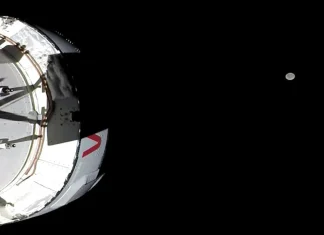
On day five of their ten-day voyage, the four astronauts aboard Orion—Christina Koch, Reid Wiseman, Victor Glover and Jeremy Hansen—are on the verge of a moment that will feel cinematic and intimate at once: the spacecraft is slipping into the Moon’s greater pull. NASA’s live telemetry showed Orion roughly 346,000 kilometres from Earth and about 105,000 kilometres from the Moon as the crew prepared for the transition into the lunar “sphere of influence.”
Morning on a Ship Between Worlds
Imagine waking up while the blackness outside the window is edged in a silver disk you have only seen through photographs. That was the mood aboard Orion as the crew stirred for the fifth day—some with an astronaut’s practiced calm, some with the childlike awe that visits even the most experienced spacefarers.
“Waking up and looking through the porthole, it felt like someone had opened the world,” one of the crew later told Mission Control. “Everything else—the training, the tests—was preparation for the moment the Moon goes from a map to a place.”
There was a ceremonial, almost generational handoff to set the tone for that morning. Charlie Duke, who left his footprints on the Moon during Apollo 16 in 1972, phoned in the wake-up call. “Below you on the Moon is a photo of my family,” the 90-year-old said. “I pray it reminds you that we in America and all of the world are cheering you on.” His voice threaded the Apollo heritage to Artemis—an intergenerational blessing for a program meant to build a lasting human presence in lunar orbit and on the surface.
The First Human Gaze at an Ancient Scar
From the capsule, the crew photographed a sight that, until now, had been the province of orbital cameras and robotic spacecraft: the Orientale basin. A colossal bullseye on the Moon’s limb, Orientale is a multi-ringed impact basin roughly 930 kilometres across—one of the most well-preserved scars on the lunar surface.
“This is the first time the entire basin has been seen with human eyes,” NASA said when releasing the photograph. It is a reminder that even in this era of satellites and probes, human vision—unmediated, direct—retains a power of perception and meaning.
Closer Than Ever: The Lunar Sphere of Influence
Technically, entering the Moon’s sphere of influence means the Moon’s gravity will tug on Orion more strongly than Earth’s gravity does. The boundary is not a hard line etched in space but a shifting threshold roughly tens of thousands of kilometres from the lunar surface—an invisible marker of a new phase in the mission.
“We’re all extremely excited for tomorrow,” said Lori Glaze, deputy associate administrator for NASA’s Exploration Systems Development Mission, during a pre-flyby briefing. “Our flight operations team and our science team are ready for the first lunar flyby in more than 50 years.”
Once Orion is under the Moon’s dominant pull, the crew will conduct hours of observation: naked-eye views, targeted photography, and live science experiments. Kelsey Young, lead scientist for a suite of mission observations, reminded reporters that the human element is the wild card in exploration. “We don’t always know exactly what they’re going to see,” she said. “That’s precisely why we send people.”
How Far Can We Go?
Part of the drama is not just the view but the readout: at some point during the flyby, the four crew members may travel farther from Earth than any human in history. Apollo-era missions set records that have stood for decades; Artemis II could nudge that boundary a little farther out, stretching the human envelope once again.
Orion Under the Microscope
Beyond the poetry of the Moonrise, Artemis II is a practical, workmanlike endeavor. This mission is, above all, a systems test—a dress rehearsal of life-support, navigation, and spacecraft operations that will underpin future human landings.
“We’re focused very much on the ecosystem—the life support system of the spacecraft,” a NASA flight engineer told me. “This is the first time astronauts have ever flown on this particular vehicle. Gathering that on-orbit data is crucial.”
The crew has already completed manual piloting demonstrations and run through their flyby checklist. On day five they practiced donning and pressurizing the bright orange “survival” suits—the garments for launch and re-entry and for emergency scenarios such as cabin depressurization. The sequence included leak checks, simulated seat entries and real-world assessments of mobility: could they eat, drink, and work while in the suit?
- Suit operations: donning, pressurization, leak check
- Mobility tests: simulated seat entry, mobility, eating/drinking
- Systems monitoring: life support, telemetry, avionics
Simple tasks in a gravity well gain complexity in microgravity. A spilled drink, a stiff glove, even the angle of a helmet camera can change the flow of an operation. That is why this mission is invaluable as a testbed for Artemis 3, currently planned to return crewed landings, and missions beyond.
On Earth: Reactions, Rituals, and Small Joys
Back on Earth, the mood ranged from reflective to raucous. In Titusville, Florida, families clustered outside a diner near the launch complex, sharing coffee and stories of their own—some of which reached back to Apollo-era memories. “My father watched Apollo 11 from our front porch,” said Maria Alvarez, who brought her teenage son to see the mission updates. “We told him this morning and he wept a little. It’s like visiting a house you never thought you’d see again.”
In Toronto, a group of university students gathered in a late-night study room, pausing their exams to watch the live feed. “There’s a hum in the room like we’re all connected to something bigger,” one of them said. “It makes the long hours feel worth it.”
Why This Matters—Beyond Distance and Photographs
Artemis II is not just an exercise in nostalgia. It’s an investment in infrastructure: testing the Orion capsule, validating crew procedures, and building confidence for future surface missions that promise scientific returns—as well as strategic partnerships with international and commercial partners.
It also raises philosophical questions: What does it mean for humanity to resume an intimate relationship with our nearest celestial neighbor? How do we balance exploration, science, and stewardship of off-world environments? And who gets to be part of that story?
“Exploration changes us,” said a veteran planetary scientist. “It shifts our perspective—on Earth and on ourselves. Artemis is building more than hardware: it is building a new ecosystem of collaboration, skills, and aspiration.”
What to Watch For
In the coming hours the crew will trace a path behind the Moon and back into an Earth-centric orbit—the far side will be their temporary sky. If you want to follow along, NASA’s public dashboards and live broadcasts will provide a steady stream of images and commentary. Listen for the small things: a laugh through the headset, the soft clatter of a tool, a gasp at a view that no human eyes have taken in before.
Have you ever wondered what it feels like to be on the edge of the familiar and the unknown? To stand at a shoreline and watch a tide that’s been patient for billions of years? This mission offers a rare chance to contemplate those questions on a planetary scale.
And when Orion completes its loop, when those who watched in parks and pubs and laboratories file home with the echo of a wake-up call in their minds, we will have taken one more step—not back to the past, but forward along a path that will one day lead to sustained human presence on the Moon and, perhaps, beyond.