Morning Light, Sudden Darkness: Bondi After the Shots
There is a particular hush that falls over Bondi at dawn — a soft, briny quiet that belongs to fishermen, early surfers and takeaway coffee cups steaming against the air. This week, that hush was broken in a way the city remembers in its bones: by gunfire on a summer evening that turned a Hanukkah celebration into a scene of carnage and grief.
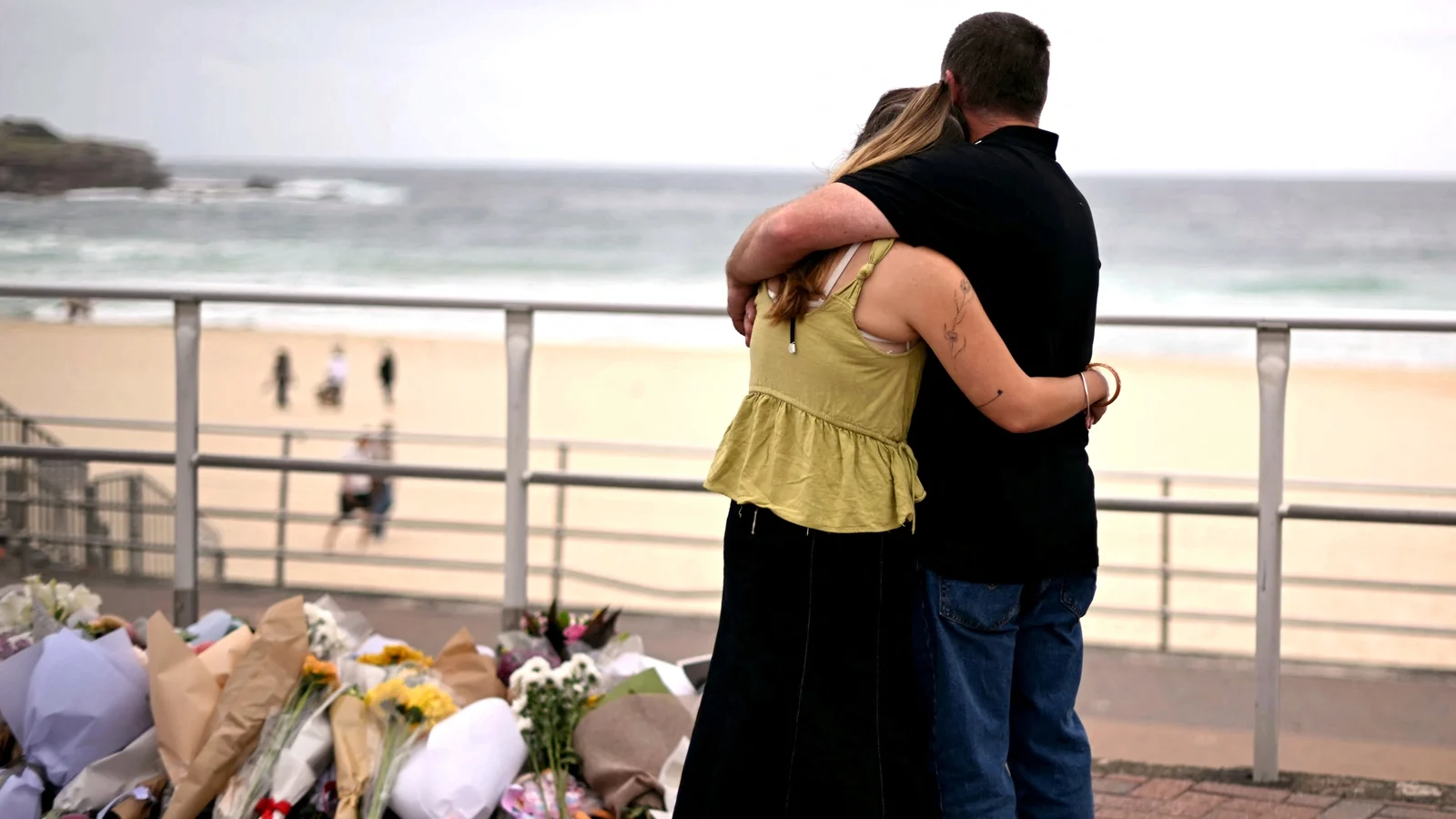
Walk the Bondi promenade now and you see the small, human things people do when the world has been cleaved: bouquets tucked under stone benches, candles protected by clear plastic cups, notes with shaky handwriting apologising for not being able to attend a service, words of comfort written in glitter. Swimmers who normally thread the shore on weekends stood shoulder‑to‑shoulder and observed a minute’s silence in the surf, the ocean like a witness.
The Attack and the Aftermath
On Sunday night, two men allegedly turned a Jewish Hanukkah celebration into Australia’s deadliest mass shooting in three decades. One of the suspects, named locally as Sajid Akram, 50, was killed by police at the scene. His 24‑year‑old son — referred to in local reporting as Naveed — was shot and fell into a coma; he has since regained consciousness and, according to Prime Minister Anthony Albanese, is expected to be formally charged in the coming hours.
“We will work with the Jewish community; we want to stamp out and eradicate antisemitism from our society,” Mr Albanese said this week, wrestling publicly with grief and with a raft of questions about how and why this horror occurred.
New South Wales Police Commissioner Mal Lanyon has said investigators expect to question the younger suspect once medication wears off and legal counsel is present. The man remains under heavy guard in a Sydney hospital while authorities gather evidence, interview witnesses and try to stitch together motive from travel records and communications.
Alleged Links, Travel and Motivation
Australian police say the pair travelled to the southern Philippines — a region that has long battled Islamist militancy — weeks before the shooting. Investigators have signalled that the bloody raid appeared to have been inspired by Islamic State. The younger suspect was briefly investigated by domestic intelligence in 2019 over alleged links to extremism, but at the time agencies found no evidence he posed an active threat.
That incomplete thread has exposed a raw nerve in public debate: was there a missed opportunity to stop this? Or was the risk genuinely low enough to evade further action? “We’re asking the hard questions,” Commissioner Lanyon told reporters. “We will examine every contact, every travel movement, every transaction.”
Funerals, Faces, and the Weight of Loss
On the official calendar of mourning, funerals for the Jewish victims began almost immediately. Among them was Rabbi Eli Schlanger, an assistant rabbi at Chabad Bondi and a father of five. He was known in the community as a resolute presence: visiting inmates, befriending residents in public housing, making time for people whose lives were quiet and often lonely.
“He would come to the little corners of our lives we thought nobody noticed,” said Alex Ryvchin, a Jewish community leader who has worked alongside Schlanger. “He was not a rabbi for the synagogue alone — he was a rabbi for the city.”
Other victims included a Holocaust survivor, a married couple who had approached the gunmen before the firing began, and a 10‑year‑old girl named Matilda. Health officials said 22 people remained in Sydney hospitals with a range of injuries from gunshot wounds to trauma-related conditions. Among them are people whose lives will be turned upside down by recovery and by the slow, stubborn work of healing.
Heroes in the Chaos
In the small, immediate ledger of bravery, names stand out. Ahmed al‑Ahmed, 43, leapt at one of the shooters and wrestled a rifle away, sustaining serious wounds in the process. He remains in hospital and is due to undergo surgery. “Ahmed is a hero,” his uncle Mohammed told media from Syria. “We are proud of him. Syria is proud of him.”
A young police constable, only four months on the force, was also shot twice. Twenty‑two‑year‑old Jack Hibbert has lost vision in one eye and faces a long recovery. “In the face of violence and tragedy he responded with courage and selflessness,” his family said in a statement, asking for privacy as he heals.
Questions of Prevention, Guns and Community Trust
Australia’s last mass‑shooting pivot came after the 1996 Port Arthur massacre, which resulted in sweeping gun law reforms that are often cited globally as a model. The current attack has reopened difficult debates about how weapons were sourced and why a man with alleged extremist ties could legally acquire high‑powered rifles and shotguns.
The federal government has promised sweeping reforms to gun regulations, and the issue now sits at the center of a national conversation. “We have always regarded public safety as our priority,” Prime Minister Albanese said, “and in the coming weeks you will see concrete proposals.”
Critics say more than regulation is required: intelligence coordination, community outreach and sustained attention to online radicalisation must be part of any durable response. Experts note that violent extremism is increasingly transnational, its signals amplified by social media and its operatives sometimes moving fluidly across borders.
What This Means for the Jewish Community and Beyond
For Sydney’s Jewish population — and for Jews around the globe — this shooting landed not only as a crime but as a cultural blow. It arrived amid two years of fraught coverage and passions surrounding the Israel‑Gaza war, a period that, community leaders say, has seen a rise in reported antisemitic incidents.
“Fear is a real, material thing now,” a Bondi resident and regular at the Chabad synagogue told me, voice trembling. “We used to leave our doors unlocked here in the summer. Now people are asking whether that safety is gone.”
The pressure on government and law enforcement is real: to show they can protect minority communities, to explain what went wrong, and to rebuild trust. That work will involve policy, yes — but also long afternoons in living rooms, coffee with rabbis and imams, school visits and public vigils that stitch social fabric back together, one small act at a time.
Broader Shadows: Extremism, Migration and Identity
Beyond the immediate horror at Bondi lies a convergence of global trends: the spread of violent extremist ideology, the challenge of integrating diasporic communities, heightened polarisation around international conflicts, and the ready availability of lethal weapons. Nations from Europe to North America are grappling with similar patterns. How do democracies keep hope and pluralism alive when the tools of violence are so easily obtained?
These are not questions with quick answers. They require policy and patience, technology and tenderness, law enforcement and human services. They demand community alliances that stretch beyond religious or ethnic lines.
Where Do We Go from Here?
As Bondi heals, the faces of those lost will not be reduced to headlines. They will be remembered in schoolyards, at family tables, in the quiet corners of a synagogue where a rabbi used to sit. The heroism of strangers who rushed into danger will be told and retold. And the conversations about how to prevent the next attack must continue — with clarity, compassion and accountability.
What would you do if faced with the question of safety versus liberty in your own community? How far should a democracy go to monitor potential threats before a line is crossed? These are thorny, urgent questions that reach far beyond Bondi’s sand.
In the weeks ahead, Sydney will watch courtrooms, policy briefings and community meetings. It will also hold shiva and read names and pass around photographs. There will be arguments and memorials; there will be coffee and casseroles left at front doors. The work of recovery will be slow, and it will be shared.
One thing, in the end, seems certain: the shoreline where people come to find breath and relief is now a place where many will come to mourn. Life — noisy, defiant, tender — will return. But the memory of that night, and the lessons demanded by it, will linger long after the candles have melted.
- Police: younger suspect to be charged once able to be questioned.
- 22 people remain in Sydney hospitals with injuries.
- Investigations into travel to southern Philippines and potential Islamic State inspiration ongoing.
- Government has pledged gun law reforms amid criticism over prevention and intelligence gaps.