A Night in Black and Red: When Bad Bunny Turned the Super Bowl into a Puerto Rican Callejón
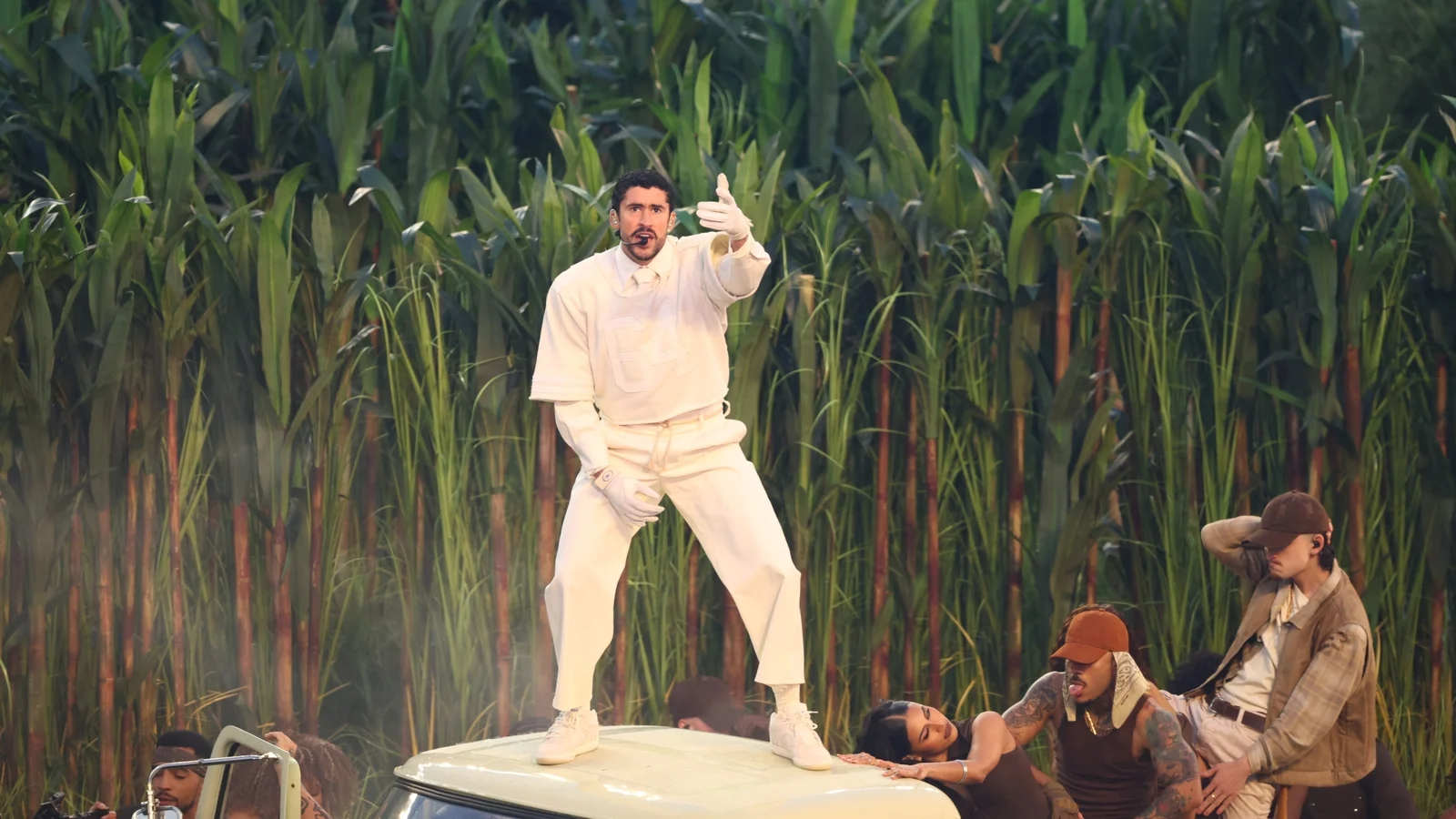
There are images that linger: a sea of phones held high like lanterns, a stage wrapped in neon and reggaetón drums that felt like a heartbeat across an ocean. When Benito Antonio Martínez Ocasio—known to most of the world as Bad Bunny—stepped into the Super Bowl limelight, he did not deliver a pop-music interlude. He opened a window onto Puerto Rico’s sound, swagger, and stubborn joy, singing almost entirely in Spanish for roughly 15 pulsing minutes that many viewers say they will not soon forget.
“It felt like my abuelo was in the stands,” said Marisol Vega, a nurse from San Juan who watched the broadcast with her family. “We danced, we cried, and when he sang in Spanish we all sang back. That stage became our street.”
On the scoreboard, the night belonged to the Seattle Seahawks, who beat the New England Patriots 29–13 in a competitive rematch of the 2015 final. But on the turf—on the stage suspended between the halves—the evening belonged to a cultural reckoning and to a young artist who has made language and identity central to his art.
How Big Was It? The Numbers That Matter
It wasn’t just emotion that measured the moment. Nielsen’s Big Data + Panel system reports the half-time show averaged 128.2 million viewers across television and streaming platforms in the United States—making it the fourth most-watched Super Bowl performance in the nation’s history. Only Kendrick Lamar’s 2025 set, Michael Jackson’s epochal show, and Usher’s high-energy performance sit above it on that list.
The game itself drew an average audience of about 124.9 million viewers in the U.S., slightly down from the previous year’s championship. But social-media metrics tell a story of global reach: NBC and Ripple Analytics tallied a staggering four billion social-media views of Bad Bunny’s half-time appearance within the first 24 hours. More than half—roughly 55%—of those engagements came from outside the United States, underscoring the worldwide appetite for music that speaks in other tongues.
- Halftime average U.S. viewers: 128.2 million
- Game average U.S. viewers: 124.9 million
- Social media views in 24 hours: approximately 4 billion
- International share of NFL social views: ~55%
“This is a reminder that culture is global,” said Dr. Ana Rodríguez, a professor of Latinx Studies at Columbia University. “When artists perform in Spanish on the biggest American stages, they are not excluding English speakers—they are insisting on the multilingual reality of contemporary audiences.”
Stars, Cameos, and a Carnival of Reactions
Bad Bunny’s set featured a constellation of collaborators—Ricky Martin and Lady Gaga provided high-impact guest spots, while brief cameos from Cardi B, Jessica Alba, and Pedro Pascal added star-struck moments that felt like a Hollywood wink to the mainstream. Cameras cut to fans who had painted faces with Puerto Rican flags, to couples swaying shoulder to shoulder, to older generations watching younger ones reclaim a cultural lineage on national television.
Ricky Martin later posted about the performance, describing a rush of gratitude and emotion. “Standing on that stage, surrounded by that music, reminded me why we sing,” he wrote, noting that the night felt both intimate and monumental.
Lady Gaga, who joined the spectacle, told reporters backstage, “There’s nothing like music in your mother tongue. Benito invited us into his home, and the world was invited too.” Her social posts—photos of behind-the-scenes embraces and shared smiles—underscored a camaraderie that many viewers found heartening.
Beyond the Music: Politics, Protest, and an Alternative Stream
Not everyone received the show warmly. In a country where art and politics increasingly clash, the decision to have a Spanish-language-heavy performance prompted outspoken criticism from conservative quarters. Former President Donald Trump called the set “absolutely terrible” on social media, calling it “a slap in the face” to the country—comments that only fanned the flames of debate.
Conservative nonprofit Turning Point USA organized an alternative half-time broadcast headlined by Kid Rock. The group’s stream peaked at around five million simultaneous viewers on YouTube and has since accumulated more than 21 million views on its channel. By comparison, the NFL’s own official post of Bad Bunny’s performance had amassed more than 62 million views on YouTube within days.
“We wanted to offer a counter-programming option,” said a Turning Point organizer who spoke on condition of anonymity. “People should have choices.”
That pushback, and the fervent support, reveal how a pop-culture moment can become a mirror for national anxieties: about language, about who is seen as authentically “American,” and about the role of live spectacle in shaping identity.
What This Means for Language, Identity, and the Global Stage
Bad Bunny’s ascent to global stardom—propelled earlier by last year’s sixth studio album, which won album of the year at the Grammys as a record sung entirely in Spanish—has been both commercial and cultural. At the Grammys he used his acceptance speech to call for compassion on immigration enforcement, urging authorities to “opt for love” in cities where communities live in fear. Whether you agreed with his politics or not, you could not deny the force of his platform.
“This was not just performance; it was visibility,” said Javier Morales, owner of a small music shop in Boston’s South End, where fans gathered after the game to trade reactions. “For our kids to see someone singing in Spanish on this stage—it matters. Languages should not be gatekept. They should be celebrated.”
The NFL’s embrace of global audiences has been deliberate: international games, multilingual marketing, and a concerted push into streaming markets. The halftime viewership and social numbers suggest those efforts are paying off, even as they ignite cultural debates at home.
Questions to Sit With
As you scroll past highlight reels and think pieces in the days after, consider this: what does it mean when a massive American institution showcases an artist who foregrounds a non-English language? Is it a sign of pluralism, a commercial calculation, or both? And when millions worldwide watch in adoration while a loud minority decries the same performance as un-American, what does that say about our shared cultural future?
Art never exists in a vacuum. It carries the freight of history, migration, and longing. On this Super Bowl Sunday, as reggaetón beats reverberated from Miami’s stadium to living rooms across continents, a distinct truth was on display: culture travels faster than borderlines and louder than political rhetoric.
“Music is the place where we can meet without words sometimes,” Bad Bunny said in an earlier interview this season. If last night was any indication, millions arrived ready to meet—speaking different tongues but humming the same chorus.