The Day Budapest Showed Up
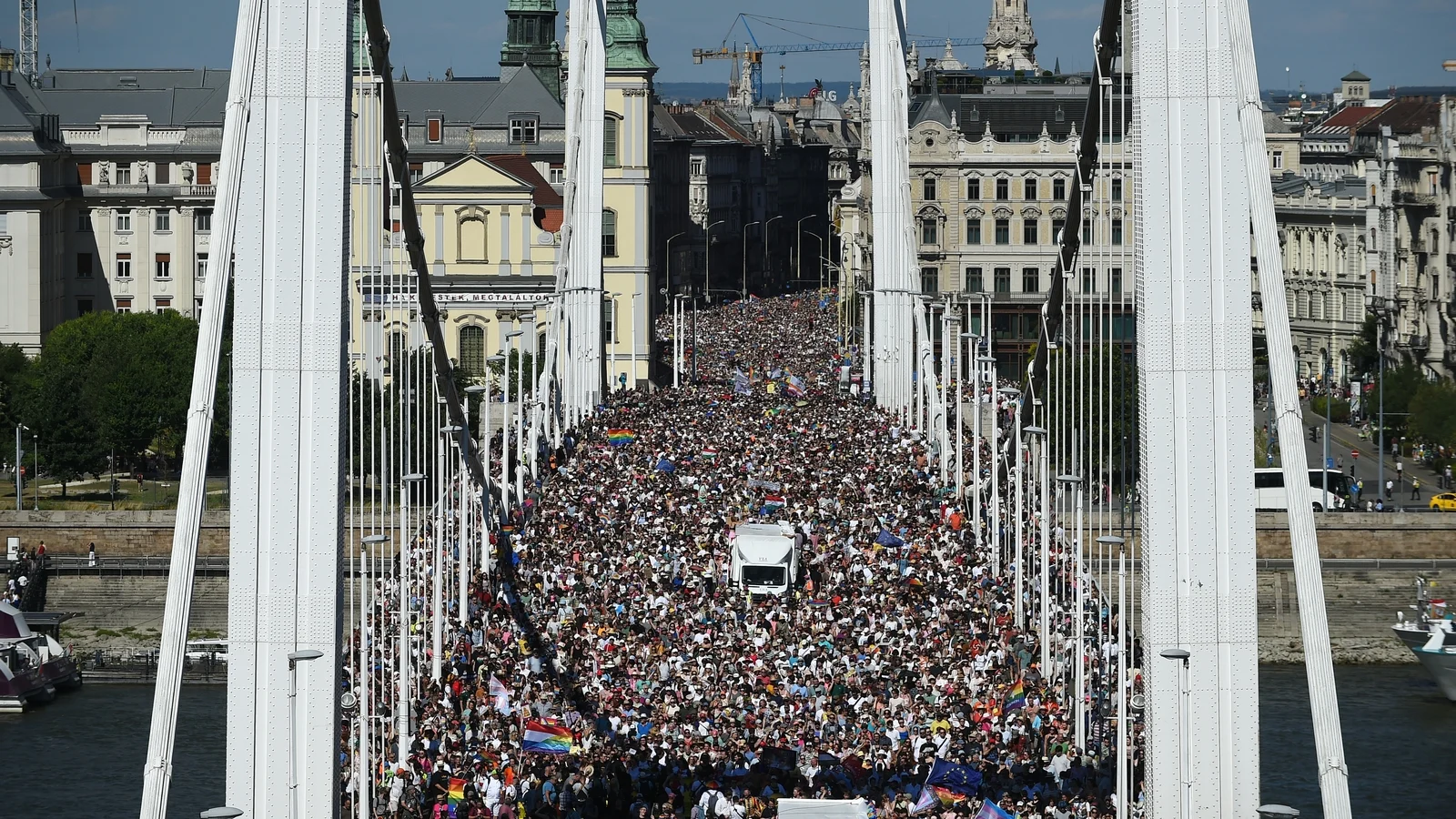
On a warm June afternoon, the city of Budapest looked like a living mosaic. Rainbow flags whipped along Andrássy Avenue, confetti clung to the cobbles near the Chain Bridge, and the scent of kürtőskalács—a chimney cake still steaming from a nearby stall—mingled with the laughter of strangers who had become comrades for the day.
More than 200,000 people, organisers would later estimate, swelled the streets in a single, defiant parade that felt less like a protest and more like a communal vow. This was not a fleeting holiday moment. It was a deliberate, full-throated pushback against a political tide that has been gathering over several years: Hungary’s steady erosion of LGBTQ rights under the government of Prime Minister Viktor Orbán.
Why This Moment Mattered
The atmosphere was ecstatic, but the stakes were starkly legal and deeply political. The Orbán administration had framed its restrictions as measures to “protect children.” Those words—soft, paternal, and persuasive to some—had been woven into the law and, according to critics, into constitutional changes meant to make the bans harder to overturn.
When Budapest city hall announced it would step in as a co-organiser, the move was a gamble. City officials said they hoped municipal involvement would blunt the effect of national statutes and provide legal cover to allow citizens to march. The state saw it differently: police issued a ban, prosecutors followed, and the national rhetoric grew sharper. “There will be legal consequences,” the prime minister warned at the time.
A Mayor in the Crosshairs
In the aftermath, prosecutors filed charges against Budapest’s opposition mayor, Gergely Karácsony, accusing him of organising and leading a public gathering despite the police ban. The district prosecutor’s office has asked that a court hand down a fine in a summary judgment—no full trial—though the precise amount sought has not been disclosed.
Karácsony, who once stood as a rising figure in Hungary’s opposition, responded to the charges on social media with the kind of defiant poetry that has become his public trademark: “I went from a proud suspect to a proud defendant,” he wrote. “They don’t even want a trial… because they cannot comprehend that here in this city, we have stood up for freedom in the face of a selfish, petty, and despicable power.”
Under the law, organisers could face up to a year in prison for convening a banned rally. Participants themselves risked fines—up to roughly €500 each—though police announced in July they would not pursue sanctions against attendees.
Voices from the Crowd
Walking the route after the parade, I spoke to people whose lives this moment touched in very different ways.
“I brought my sister,” said Zsófia, a 27-year-old teacher. “She’s only just come out. I wanted her to see she’s not alone.” Her voice was steady, but her hands trembled slightly around a paper cup of coffee. “They try to make us invisible with laws. Today was about being visible.”
An older man, white-haired and wearing a well-pressed coat, watched from a bench near the Danube. “When I was young, people hid,” he said. “My generation thought we’d go forward, not back. This is painful, but the city is brave.”
A legal scholar I met near Deák Square—Dr. Anna Kovács, a constitutional law professor—called the case a test of whether local democracy can hold its ground against national centralisation. “This is not simply about a parade,” she told me. “It’s about whether municipal autonomy has any force left in Hungary.”
Context: A European Struggle
Over the past decade, Hungary has been a flashpoint in Europe for debates over the rule of law, media freedom, and minority rights. International bodies, including parts of the European Union’s institutions and human-rights organisations, have repeatedly criticised Budapest for measures targeting independent courts, the press, and NGOs.
What distinguishes the recent chapter is how the language of “child protection” has been leveraged to curtail LGBTQ visibility and rights. It’s a frame that has been used elsewhere in the region, and it resonates with voters who worry about social change. Yet for many Hungarians, it reads as a thinly veiled justification for exclusion.
“They dress up discrimination as concern,” said Márk, a psychologist who volunteers with a youth support group. “That’s very effective politically—but it breaks trust in institutions. Young people see that and they get desperate.”
What This Says About Power—and Resistance
There is something almost cinematic about the image of a city that chooses to co-organise an event expressly to challenge national law. On one level it is a legal play; on another it’s a moral claim. It says: our city will not allow this to be defined in someone else’s words.
But legal games can be costly. The prosecutor’s move to seek a fine and avoid a trial signals an eagerness to close the matter quickly and quietly. It also sends a message to other local leaders: step out of line and face consequences.
“You can fine a politician,” Dr. Kovács said, “but you cannot fine away an entire movement.”
Global Echoes
Across the world, the Budapest story fits into broader narratives: the push-and-pull between national majorities and local minorities, the increasing use of constitutional amendments to lock in political priorities, and the politicisation of education and childhood as rhetorical battlegrounds. Democracies everywhere are contending with similar pressures—how to balance majoritarian rule with protections for minorities, how institutions can guard rights when political winds shift.
So I ask you: when a city stands between a citizen and the state, should it be applauded or punished? When the law and the conscience collide, who gets to say which wins?
What Comes Next
The prosecutor’s request for a summary judgment could result in a fine, leaving the issue unresolved in a larger legal sense. A full trial would have offered a more public airing of constitutional claims, municipal autonomy, and civil-society rights. Politically, the case will be a barometer for how far the central government will push and how much resistance is possible.
Back on the streets of Budapest, the mood has shifted from euphoria to a steady, resolute energy. People who marched say they will keep showing up—at town halls, in classrooms, at the ballot box. “This city has always been proud,” said Zsófia as a tram rattled past. “We’re not done.”
Whether that pride can withstand legal pressure, or whether it will be quietly eroded by fines and court decisions, is a question that reaches beyond Hungary’s borders. It is a test that concerns anyone who believes rights should be more than a bargaining chip in political theatre.
So look at the photos, read the headlines, but also listen to the voices. Ask yourself: what kind of city, what kind of country, do you want to live in? And when the law feels like it’s bending toward exclusion, what will you do—and where will you stand?