Night of Black Smoke: Inside the Deadly Mine Blast That Shook Shanxi
When the lights went out at 7:29pm on a cold Friday evening in late spring, the earth seemed to swallow a piece of a town. A thunderous boom, then pungent, invisible gas weaving through dark tunnels—then silence, broken only by the frantic crackle of rescue radios. By morning, the state news agency Xinhua would report at least 90 dead and dozens more scarred by smoke and shock. By then the scene at Liushenyu coal mine in Shanxi had become, quietly and irrevocably, a page in China’s long ledger of industrial tragedy.
This is not just a story of numbers. It is the story of bodies underground, of families who gather in hospital corridors under fluorescent lights, and of a province whose identity is braided with coal dust and the grind of industry.
The Immediate Toll: Facts from the Shaft
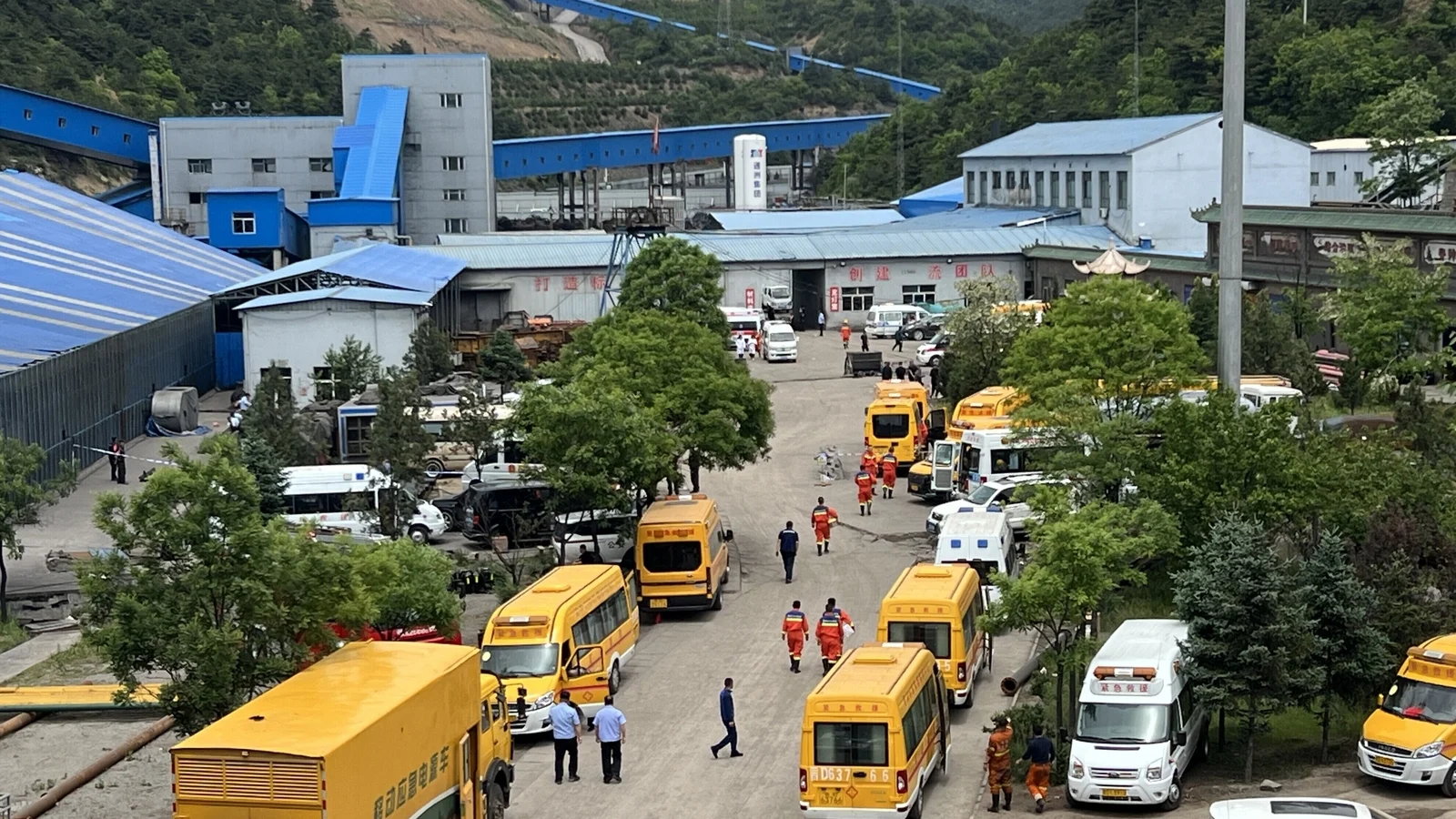
According to official accounts, 247 workers were underground when the explosion occurred at the Liushenyu mine. Rescuers managed to bring most miners to the surface; 345 emergency personnel were dispatched in the early hours, and teams searched “intensively” for nine people still unaccounted for, Xinhua said.
State broadcaster CCTV released footage of helmeted rescuers carrying stretchers across the site, ambulances idling nearby. Medics rushed the injured into emergency rooms; some were described as being in “critical condition.” A person linked to the company’s management has been detained, and President Xi Jinping called for “all-out efforts” to treat the wounded and a thorough investigation into the causes.
From Carbon Monoxide to Policy Questions
Early reports suggested that carbon monoxide levels in the mine had “exceeded limits”—a chilling detail because carbon monoxide is colorless, odorless and lethal. It has been the specter in many past underground disasters.
“When carbon monoxide spikes, the clock starts ticking,” said Dr. Li Mei, a mine-safety specialist at a university in Beijing. “Ventilation systems must be redundant, monitoring continuous, and drills routine. Failure usually isn’t a single point—it’s a chain of poor decisions and omissions.”
Shanxi: Heartland of Coal, Heartache of Workers
Shanxi province sits at the center of China’s coal map. Its rolling hills hide an industrial choreography: conveyor belts, slag heaps like small moons, villages whose rhythms are dictated by shifts underground. The province’s economy has been built on coal for generations—so much so that “black gold” is both a source of livelihood and a constant hazard.
“My husband has worked in the mines for 17 years,” said a woman who gave her name as Zhang Xia, who waited outside the hospital with a thermos of tea and a plastic-wrapped sandwich. “We have always been told the company will look after safety. When things like this happen, you are left with questions, and no one who can answer them.”
Mine safety in China has improved over the past decades—official statistics show a steady decline in fatal accidents per unit of coal produced compared with the early 2000s—but disasters still erupt with deadly regularity. Last year, for example, a collapse at an open-pit mine in Inner Mongolia killed 53 people; in 2009, a blast in Heilongjiang province claimed 108 lives. Each headline reminds a public that progress has limits.
Beyond the Immediate: What This Means Nationally and Globally
China remains the world’s largest consumer of coal and the planet’s single biggest emitter of greenhouse gases. It accounts for roughly 30% of global CO2 emissions while also installing renewable energy capacity at record speeds. This dual reality—rapid green deployment alongside persistent fossil-fuel dependency—creates pressure to squeeze more output from mines, sometimes at the expense of safety.
“There is a brutal arithmetic in energy transitions,” said Thomas Adler, an energy economist who has studied mining communities. “China needs enormous, reliable power for industry and households. In the near term, that means coal plays an outsized role. But that reliance creates incentives—economic, political—to keep mines operating, sometimes stretching oversight thin.”
Human Costs, Institutional Questions
The human cost of that calculus often lands squarely on the shoulders of miners, many of whom are migrant workers from rural areas. They work long hours in cramped conditions, often for wages that are modest relative to the risk.
“We are told to be brave, to be grateful for any job,” said a former miner from a nearby town. “But bravery does not fix broken ventilation shafts or accounts that favor profit over inspection.”
Regulatory frameworks exist; the Ministry of Emergency Management and provincial safety bureaus conduct inspections. Yet enforcement can be uneven. Local governments, especially in regions that rely on coal revenues, face the uncomfortable balance of economic growth versus strict oversight.
What Comes Next: Investigation, Reform, Remembrance
As investigators move into the mine and forensic teams comb through equipment, two parallel processes will matter: accountability and prevention. Will those responsible be held to account? Will the inquiry produce reforms that prevent another night like this one?
“An investigation is only as meaningful as the changes it leads to,” said Li Mei. “We need transparent reporting of findings and a commitment to systemic change—better training, better technology, and corporate governance that prioritizes lives.”
At the same time, communities must be tended. Grief counseling, compensation for families, and long-term economic plans for towns dependent on coal will shape whether this tragedy leaves scars that fester or spur necessary healing.
Questions for Us All
As you read this from your city, your country, your corner of the world, ask: What is the true cost of the energy that powers your life? How much risk are societies willing to accept to keep factories running and lights on? Behind the abstractions of policy and GDP are workers whose lives are measured in shifts and paychecks.
This disaster in Shanxi is not merely regional—it is a mirror. It reflects the human toll at the intersection of energy, labor, and governance. It should prod citizens, companies, and governments to demand safer practices and clearer accountability.
Remembering the Fallen
Names have yet to be released for many of the dead. The families, the coworkers, the medics—each carries an individual story. In the days to come, small rituals will emerge: bowls of noodles shared at midnight, incense at a roadside shrine, the slow paperwork of compensation and funerals. These are the intimate, stubborn acts by which communities process horror and honor those who did not return.
For now, the mine is cordoned off and investigators move like a slow, deliberate tide. Rescue lights cut through smoke and the cold, and people gather not only to demand answers but to remind the world that every statistic is a life. Let that be the measure we use as we look at energy policy, corporate responsibility, and the fragile dignity of labor.
What changes would you demand if this were your town? How do we weigh our modern comforts against the everyday hazards faced by workers who make them possible? The questions are difficult. The answers must begin with truth, and they must end with action.