On a Cold Deck in the Mediterranean: What It Felt Like to Be Seized at Sea
The morning the sea turned against them was bright and ordinary in the way that mornings always are before history bends. Small vessels bobbed along a slate ribbon of water, tents and tarpaulins flapping, volunteers sipping tea and comparing manifests. They were bound for Gaza: a flotilla of people carrying blankets, medical supplies and a blunt, old-fashioned idea—that international waters and human dignity still matter.
What followed, according to those who lived it, was a lesson in how fast ordinary people can become evidence in a global story. Four hundred and thirty activists from more than a dozen countries were detained this week when Israeli forces intercepted the Global Sumud Flotilla. Among them were 14 Irish citizens, including Dr Margaret Connolly from Sligo, a physician whose calm voice on Irish radio cracked when she recounted what she and her comrades endured.
“Like a Horror of a Concentration Camp,” an Irish Doctor Says
“We were taken like cattle,” Dr Connolly told listeners, describing hours spent bent double on a metal deck, hands bound, cold and wet, with no access to basic first aid. Her description—sparse, clinical, and then explosive with detail—painted a picture of people in pain and without reprieve. “People screamed through the night. There was no pain relief. No dignity,” she said.
Her account included shocking allegations: multiple fractures, head injuries, burns from laser strikes, and what she described as sexual assaults. She said medical needs went unmet: no sanitary products for women, scant water, and bread tossed toward those held below deck as if sustenance were an afterthought. “They treated us like we were not human,” she said. “If this happens to Europeans in international waters, what happens to others who have nowhere?”
Voices from the Deck
Tom Deasy, another Irish activist who was on the first boat intercepted, described a scene of escalating aggression. “They came aboard fast and hard,” he said. “A rifle was shoved into my back. What began as force became a cascade of violence.” He spoke of being stripped of clothes, bundled into metal containers where he says beatings echoed. “You could hear it everywhere. It’s a sound you don’t forget.”
Not everyone returned with bruises that tell the story in visible ways—trauma lingers. “There’s a hollow quiet among us,” said Louise McCormack, a volunteer on the flotilla. “We feel relief to be home, yes. But there’s guilt. We went to be in solidarity and now we know, viscerally, what so many face every day.”
Numbers, Context, and a Longer History
The Global Sumud Flotilla is the latest chapter in a long, fraught history of attempts to breach the blockade around Gaza, enforced by Israel and Egypt since 2007. The most infamous earlier episode—the 2010 raid on the Mavi Marmara—left 10 activists dead and set international law and human rights debates alight. Since then, flotillas have repeatedly sought to draw attention to Gaza’s humanitarian plight.
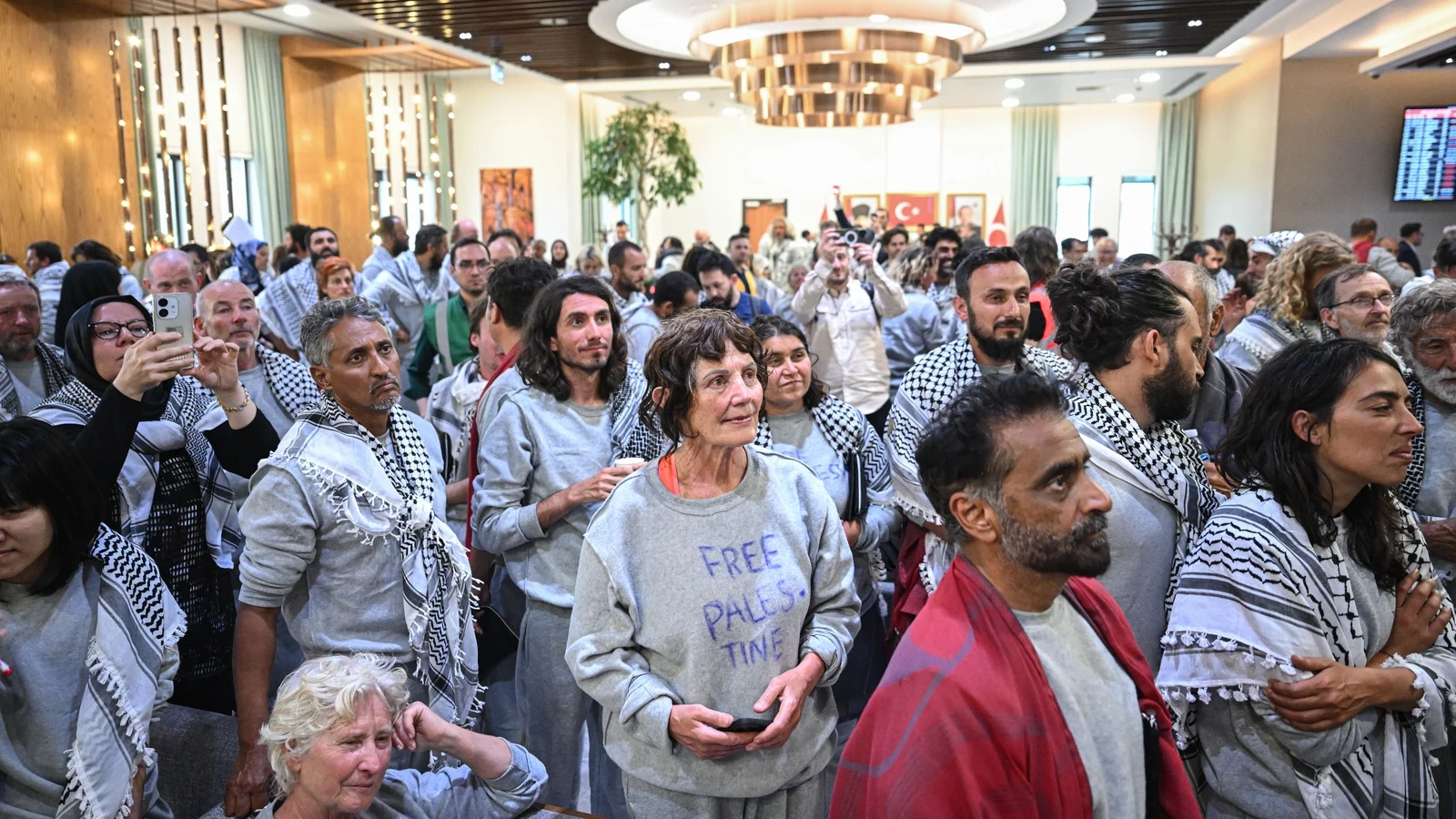
This year’s interception resulted in 430 activists detained, with those who were deported arriving in Turkey before many were flown home. The precise scale of injuries and allegations is still being documented; activists say dozens suffered fractures and serious injuries. On a broader level, humanitarian agencies have long warned of Gaza’s precarious situation: dense population, damaged infrastructure, and a civilian population heavily reliant on aid. For millions watching, the flotilla was both a symbolic gesture and a practical attempt to deliver relief.
What Officials Are Saying
Within hours of footage and testimony circulating online—showing restrained activists kneeling in tight rows—Irish political figures and EU representatives voiced outrage. “We demand explanations,” one Irish opposition politician said. “This cannot be left unaddressed.” An EU spokesperson, speaking on condition of anonymity, told reporters that the bloc had taken note and would seek clarification from Israeli authorities.
Activists filed formal complaints in Turkey, documenting medical injuries and what they labeled as torture. “There must be accountability,” Tom Deasy said. “Not only for us, but for the thousands who face these conditions daily in the Occupied Territories.”
Local Color: Sligo to Istanbul—Small Towns, Big Hearts
Back in Sligo, Dr Connolly’s hometown, neighbors describe her as the sort of GP who keeps cookies in the clinic and remembers the birthdays of elderly patients. “Margaret’s the kind of person who goes where help is needed,” said a local teacher. “She’s a needle of compassion in a very prickly world.”
In Istanbul, where many of those seized landed after deportation, volunteers and lawyers gathered at a modest community center to catalogue injuries and statements. A Turkish activist who spoke over tea in a courtyard near the Bosphorus said, “We are a bridge. People come here because this is where aid meets law.”
Questions We Must Ask
What does it mean when people who sail in international waters to bear witness are met with force? When governments vote against sanctions while their citizens are detained abroad, what signal does that send about the limits of diplomatic protection? “There’s a moral calculus here that governments seem unwilling to engage,” said an international human rights lawyer who has monitored past flotillas. “You can’t separate immediate treatment of protesters from the wider matrix of occupation, blockade, and displacement.”
Readers might wonder: is civil protest on the high seas an effective tool, or a provocation doomed to end badly? Is international law keeping pace with the politics of the sea? These are not abstract queries. For the activists who returned—cold, bruised, and exhausted—answers matter not just in principle but in the shape of policies that could protect or imperil lives.
What Comes Next
The immediate next steps are painfully practical. The Irish activists are due to return home and undergo full medical evaluations; their testimonies will likely fuel calls in Dublin for investigations and for a re-examination of diplomatic posture. Legal teams in Turkey are preparing complaints. NGOs will sift through footage, extracting evidence. Politically, this is a spark—one that could be dampened, or fanned, depending on how governments respond.
For the global public, the episode is a reminder: conflicts filmed on a phone are not less real because they are widely watched. They become part of a living archive of how people on the margins—and those who stand with them—are treated. “We went to do a simple thing,” Dr Connolly said quietly. “To bring help and to witness. We came back with stories that we cannot simply put in a file. We must make sure they are heard.”
How will the international community answer that call? Will empathy translate into policy, and will accountability follow the footage? The sea, it seems, continues to be a mirror: it shows us who we are, reflected back in salt and motion. What do we want to see?