Smoke, Silence and a Long Line of Flowers: Inside Hong Kong’s Deadliest Residential Fire
On a gray morning in Tai Po, the air still tasted faintly of smoke. It wound through the narrow streets and over the canal where people had queued for hours, white chrysanthemums trembling in their hands. They came in droves—neighbors, colleagues, domestic workers, strangers—each one carrying a note or a memory for the 146 people now confirmed dead after a ferocious blaze tore across a cluster of high-rises at Wang Fuk Court.
“As of 4pm (8am Irish time), the latest death toll stands at 146. We cannot rule out the possibility of further fatalities,” Chief Superintendent Tsang Shuk-yin of the police’s casualty enquiry unit told reporters at a press conference, her voice steady against a backdrop of chokepoint roads and shuttered shops.
The scene: A canal bank, flowers and the smell that won’t lift
The ritual of mourning in Hong Kong is quiet and exacting: low voices, white flowers, folded paper offerings. A line stretched for more than a kilometre along the canal near Wang Fuk Court, people standing shoulder to shoulder. Some attached small handwritten notes to bouquets—”I will remember you,” “Come home safe”—and then released them into the custody of the city that had failed, in many people’s eyes, to keep its residents safe.
“I worked three nights a week for Mrs. Chan across the hall,” said a woman who would only give her first name, Rina, holding a candle that flickered like a tiny, stubborn star. “When I heard, my legs turned to water.” She is among thousands of migrant domestic workers whose presence is woven into the city’s daily life—and among the dead, the confirmed losses include seven Indonesian and one Filipino worker. Dozens more migrants remain unaccounted for.
How the flames spread so fast
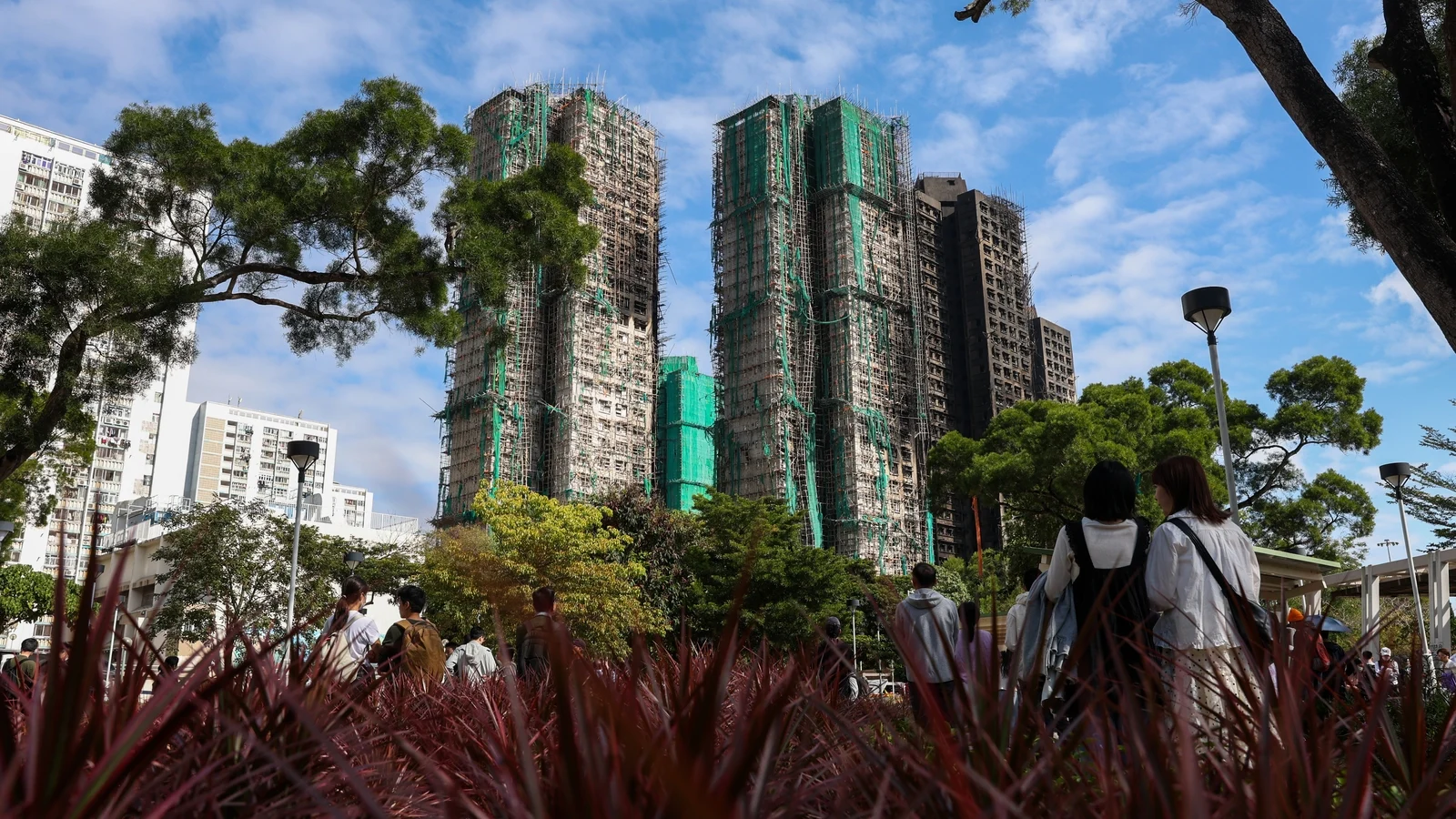
The fire swept with terrifying speed. It began on a Wednesday afternoon and climbed the exteriors of seven of the complex’s eight 32-storey blocks. Bamboo scaffolding, draped in the familiar protective green mesh used across the city during renovations, created a ladder for the flames. Foam insulation layers added to that combustible mix.
Authorities say the complex was home to over 4,600 people. Many residents later reported that the fire alarms were not working properly. Rescue operations concluded on Friday, but for weeks—months—questions will linger about why safeguards failed when they were needed most.
Key facts at a glance
- Confirmed deaths: 146 (as of the latest update)
- Buildings affected: Seven of eight 32-storey blocks at Wang Fuk Court
- Residents in the complex: Approximately 4,600
- Confirmed migrant worker casualties: At least 8 (seven Indonesian, one Filipino)
- People arrested in connection with the blaze: 11
- Petition signatures demanding independent inquiry: Over 10,000 (first petition), 2,700+ (second petition)
Anger, petitions and a call for accountability
Anger followed grief. An online petition demanding an independent probe into potential corruption and construction oversight lapses drew more than 10,000 signatures before it was closed. A second petition, started by a Tai Po resident living overseas, has more than 2,700 signatures and bluntly states: “The government owes Hongkongers genuine, explicit accountability.”
“We can’t accept platitudes anymore,” said Marcus Leung, a local shopkeeper who has lived in Tai Po his whole life. “People were telling the council for months that the mesh and scaffolding looked dangerous. They said alarms weren’t working. Nothing changed.”
Police have arrested 11 people so far. Among those detained is 24-year-old Miles Kwan, who was part of a group that launched the petition demanding an independent inquiry, according to two people familiar with the matter. For many, the arrests raise as many questions as they answer: are they a step toward justice, or a disruption of civic pressure?
National security meets public grief
China’s national security authorities issued a stern warning after the fire, saying they would apply the national security law to prevent what they described as “anti-China” forces from exploiting the disaster. The language evoked the tumult of 2019, when massive pro-democracy protests roiled the city and left frayed tensions in their wake.
“We sternly warn the anti-China disruptors who attempt to ‘disrupt Hong Kong through disaster’,” read a formal statement relayed by officials. “No matter what methods you use, you will certainly be held accountable and strictly punished.”
To many ordinary citizens, the warning read like an attempt to clamp down on civic grief that has a political sting. “We came to mourn,” said Leung. “We didn’t come to protest. But you cannot separate mourning from the reasons people have to be angry.”
Voices from the ground: Little gestures, large losses
An outdoor prayer meeting for the Filipino community drew hundreds this morning, a mosaic of languages and hymns. Men and women from different walks of life shared stories of those missing: the neighbor who cooked, the aunt who babysat, the cleaner who hummed in the elevator.
“She used to leave notes for my children on the fridge,” said one woman, clutching a laminated photo. “I can’t stop wondering if she was awake when it started. Did she hear the alarms?”
Dr. Helen Kwong, an emergency physician who has worked in Hong Kong’s public hospitals for two decades, notes the systemic vulnerabilities. “These kinds of exterior fires exploit the scaffolding and cladding systems that are increasingly common in redevelopment,” she said. “If alarms are nonfunctional and evacuation routes are impeded, you have a recipe for catastrophe.”
Wider meanings: Governance, migration and the urban condition
There is a structural story here, one that stretches beyond a single tragedy. Hong Kong is a dense, vertical city constantly remaking its skin—scaffolds and mesh, renovations and hurried retrofits. Migrant workers, who keep many households functioning, live and work in a city where regulations, enforcement and the informal economy intersect messily.
Ask yourself: in cities where space is at a premium and profits press against safety margins, how much do we tolerate? How many warnings must go unheeded before accountability becomes not only demanded but enforced?
What comes next
The immediate rescue operations have ended, but investigations are intensifying. Criminal and corruption probes are under way into the fire’s cause and whether unsafe materials or shoddy renovation practices played a role. For families who lost someone, these investigations are not abstract; they are the thin thread that may lead to answers and, perhaps, some measure of justice.
“We are exhausted, but we will not let this die in the paperwork,” said one community organizer who preferred not to be named. “This is about our neighbors. It is about whether a city that calls itself modern can keep people safe.”
Hong Kong has weathered riots, pandemics and economic shocks. Today it mourns. The line of white flowers along that canal is a public ledger of grief, and a private demand for change. Will the reactors of policy and law move swiftly enough to honor both the dead and the living? Cities around the world would do well to watch—and to ask, honestly, whether they are doing enough to protect their own vertical neighborhoods where millions continue to live, work and sleep, sometimes perilously close to danger.