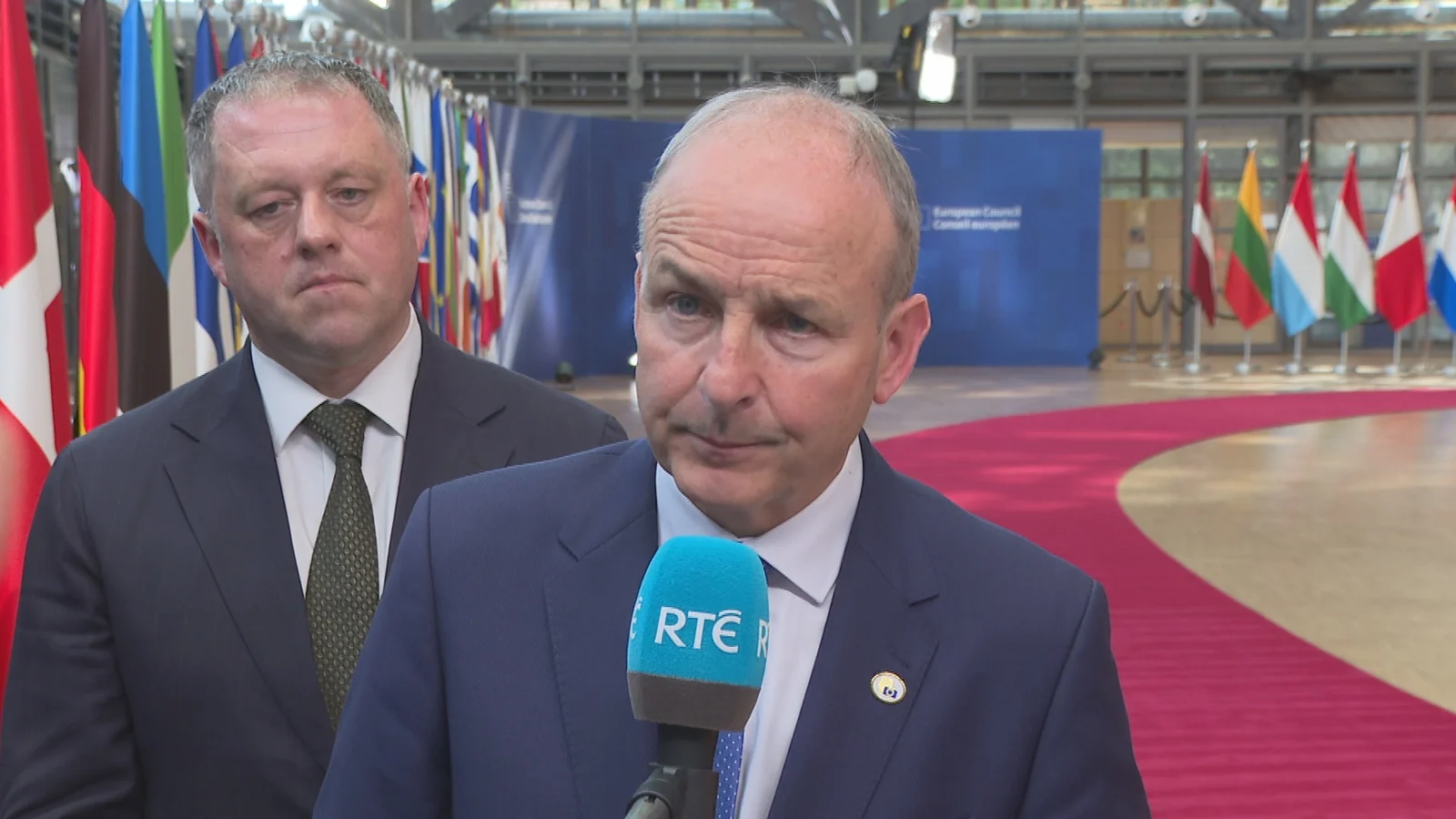
With the war in Gaza and tensions across the region continuing to dominate Europe’s agenda, Taoiseach Micheál Martin has warned that the European Union’s credibility hangs in the balance unless it takes robust action against Israel over breaches of international law and what he described as war crimes on multiple fronts.
Mr Martin made the remarks ahead of a summit of EU leaders in Brussels, where member states will again face pressure including from Ireland to consider sanctions against two far-right Israeli government ministers, Itamar Ben-Gvir and Bezalel Smotrich.
Leaders are also expected to examine forthcoming European Commission proposals that could pave the way for an EU-wide ban on goods produced in illegal Jewish settlements in the West Bank.
Sanctions would require unanimous backing from all 27 EU member states support that is not currently in place — while a ban on settlement goods could be approved by a weighted majority. Against that backdrop, the Taoiseach said the issue should be put to a vote among EU foreign ministers.
A number of EU countries have said they do not support any punitive sanctions against Itamar Ben-Gvir
“The credibility of Europe is undermined by a failure to take a strong stance in terms of what has been a breach of international law … war crimes on a number of fronts,” he said.
He said Israel appeared indifferent to the consequences its actions were having on the wider region.
Speaking to reporters, Mr Martin argued that allowing member states to formally state their position through a vote could shift the political landscape. “There comes a stage when people should be allowed to vote as member states to articulate their positions. If it’s put to a vote at some stage, then that might create its own dynamic in terms of member states’ positions in respect of Israel’s behavior in Lebanon, in Gaza, and indeed in the West Bank, in particular,” he said.
He also linked the EU’s stance on Israel to its broader foreign-policy messaging, saying inconsistency risks weakening Europe’s authority when addressing other conflicts. “When we go to other countries and say to them, in terms of Ukraine and the Russian invasion, or what’s happening in Sudan, I think our credibility is damaged by our failure to act.
“I understand fully that not everybody is on the same page, and countries for historical reasons have different perspectives. We look at it in terms of fairness, justice, human rights, and by any standard, by any objective assessment, what has happened in Gaza.”
Mr Martin said he had written to the President of the European Council, Antonio Costa who chairs summit meetings after Mr Ben-Gvir’s harassing of the Gaza Flotilla detainees, requesting that the incident be placed on the agenda for this evening’s meeting.
Earlier this week, the EU’s foreign policy chief, Kaja Kallas, said member states still had not reached unanimity on sanctioning Mr Ben-Gvir.
Under EU rules, sanctions targeting any individual or entity must be agreed by all member states.
Several countries, including Czechia, have said they oppose punitive sanctions against Mr Ben-Gvir in connection with the flotilla issue.
Mr Martin confirmed this month that Mr Ben-Gvir and Mr Smotrich have been barred from travelling to Ireland, saying the ministers’ words “amount to a desire to see the elimination of Palestinians from Palestine”.