After weeks of disruption in the Gulf, the United States has ended its blockade of Iranian ports, a move triggered by President Donald Trump’s newly signed agreement to conclude the Middle East war.
U.S. Central Command announced the change on X, saying: “Today, U.S. forces lifted the blockade on all maritime traffic entering and exiting Iranian ports and coastal areas.”
Central Command said American warships would stay nearby, adding they “will remain in the general area to make sure that all aspects of the agreement are adhered to”.
Today, U.S. forces lifted the blockade on all maritime traffic entering and exiting Iranian ports and coastal areas, in accordance with the President’s direction. American forces are not impeding the transit of vessels to or from Iranian ports on the Arabian Gulf and Gulf of…
The announcement came as doubt hung over talks planned in Switzerland that were expected to build on the accord.
Mr Trump’s signature alongside Iranian President Masoud Pezeshkian launched a 60-day window for broader negotiations between the longtime adversaries, including talks focused on Iran’s nuclear programme.
Still, the next steps were uncertain. It was not clear whether the two sides — with no diplomatic relations since the 1979 Islamic revolution — would proceed with a signing ceremony and discussions in Switzerland tomorrow, as previously announced.
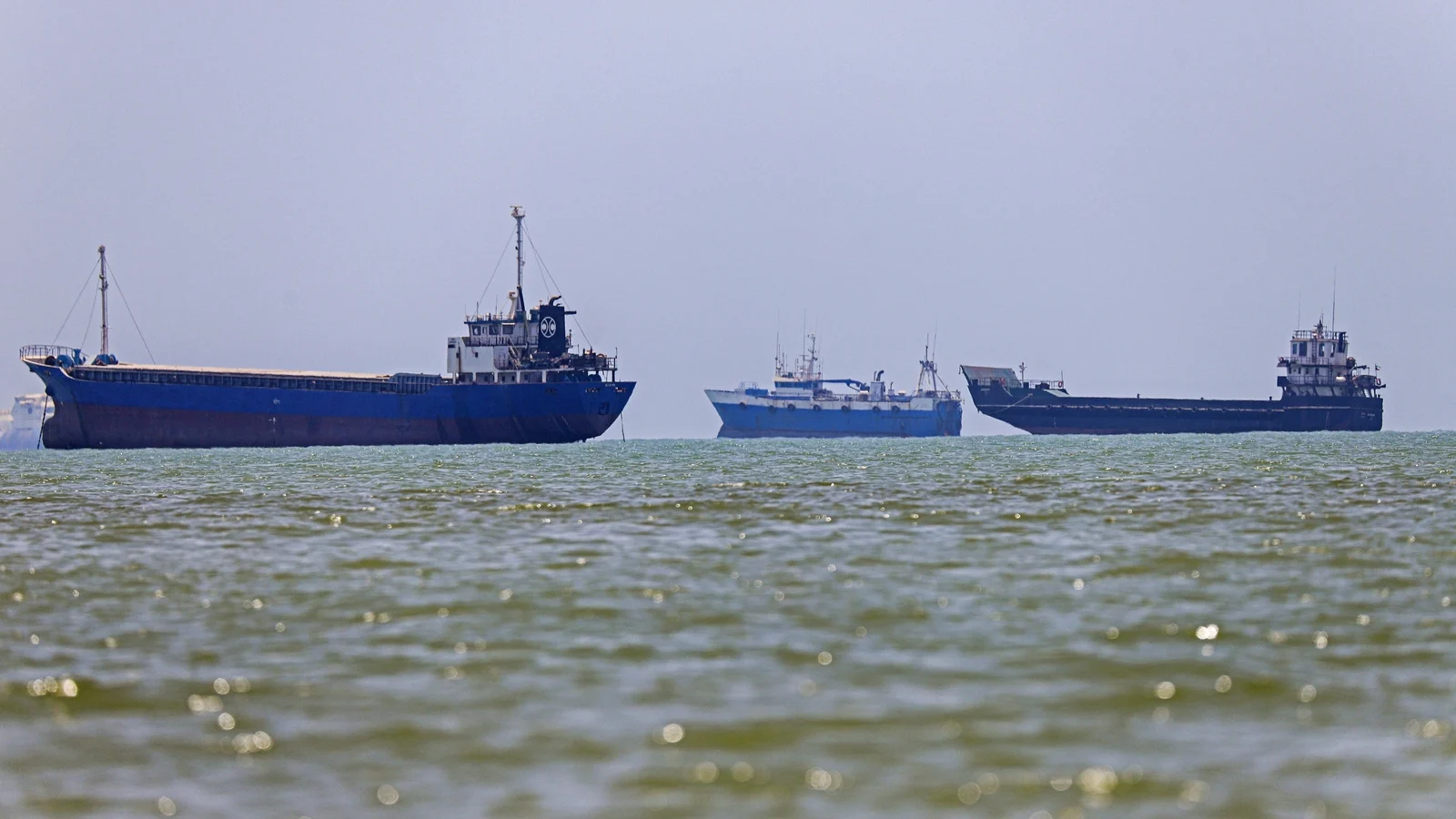
Oil prices slid after the agreement was concluded, even as shipping remained sluggish through the Strait of Hormuz, the vital chokepoint for energy supplies that Iran blockaded during the war and which, under the terms of the deal, is to reopen immediately.
The US military said it has now ended its own parallel naval blockade of Iranian ports — measures that had stopped vessels sailing to or from the Islamic republic — while reiterating that American warships “will remain in the general area”.
Maritime trackers reported that three Saudi oil tankers exited the Gulf through the strait today. They also said the laden liquefied natural gas vessel (LNG) Mraikh became the first such French ship to make the passage since the conflict began.
The U.S. blockade had followed Iran’s closure of the Strait at the outset of the war, and the US has since permitted at least 12 ships to transit, US Vice President JD Vance said.
Before the war, about 120 vessels moved through the strait each day, according to the shipping journal Lloyd’s List.
Mr Vance said he now expects to travel to Switzerland for “technical negotiations” with Iran “this weekend” rather than tomorrow, while stressing that the schedule “could change”.
In Tehran, the Tasnim agency reported that “nothing has been confirmed” regarding the Iranian delegation’s trip to Switzerland.
‘Maybe they start fighting again’
The agreement is meant to halt the current US-Israeli conflict with the Islamic republic, a fight that escalated into five weeks of all-out war before a ceasefire took hold in early April.
Yet some Iranians voiced little confidence that the calm will last.
“I have no hope that this is a lasting agreement. Maybe after the 60 days they start fighting again,” said Mina, 54, a psychologist from Tehran.
Under the text, Washington agrees to immediately waive oil sanctions that have battered Iran’s economy.
The deal also states that once a final agreement is secured on Iran’s nuclear programme, the United States will facilitate the release of a $300 billion reconstruction fund backed by regional nations.
US officials said Iran would dilute its stockpiles of enriched uranium, potentially by “down-blending on site” under the oversight of the UN nuclear watchdog.
Iran’s ballistic missile programme does not appear in the agreement, despite Israel’s long-running demand that it be dismantled.
US Vice President JD Vance said that he will go to Switzerland for ‘technical negotiations’
‘Either jealous or stupid’
Mr Trump’s decision to end a war that killed 13 US service members and depleted a vast share of US ammunition stockpiles has rattled some allies at home.
US Senator Bill Cassidy, a Republican, called it the “worst foreign policy blunder in decades”.
“Iran’s nuclear ambitions were not curbed, and they have learned that threatening the Strait of Hormuz works,” he said.
At the G7 summit, Mr Trump appeared to pre-empt such criticism by saying he was ready to “bomb the hell” out of Iran if it broke the agreement.
“These fools, who think I haven’t been tough enough on Iran, when the Stock Market Just Hit A RECORD HIGH, and Oil prices are ‘tumbling’ down, are either jealous, bad people, or stupid,” Mr Trump wrote on social media.
The deal has also drawn pushback from hardliners in Iran, where the conflict was labelled an “imposed war” and likened to the 1980-1988 war with Saddam Hussein’s Iraq.
But parliament speaker and chief negotiator Mohammad Bagher Ghalibaf said the agreement amounted to a US “failure”, while Pezeshkian described it as “historic”.
Mr Vance, meanwhile, attacked Israeli critics of the deal, arguing that Mr Trump is Israel’s only ally — a pointed rebuke that referenced the billions in US defense aid Israel receives.
Asked about a report claiming Israeli Prime Minister Benjamin Netanyahu was furious over the agreement, Mr Vance said he had not heard those remarks directly from Mr Netanyahu. He nonetheless criticised members of the Israeli leader’s cabinet, saying they had criticised the deal and personally attacked Mr Trump.
“My message to them would be twofold. No. 1: Donald J. Trump is the only head of state in the entire world who is sympathetic to the nation of Israel at this moment in time,” Mr Vance told reporters at the White House.
“If I was in the cabinet of the Israeli government, I might not be attacking the only powerful ally that I have anywhere left in the entire world.”
‘Just one thing’
Agnes Lavallois, president of France’s Institute for Research and Studies on the Mediterranean and the Middle East, said the prevailing view was that the Americans “wanted just one thing – the reopening of the Strait of Hormuz.”
“The other issues that were put forward to justify this war are no longer relevant at all,” she told AFP.
Israeli Merkava tanks driving along a road past destroyed buildings in southern Lebanon
Although the agreement says Lebanon should be included in the broader equation, it remains uncertain whether the war between Israel and Hezbollah on that front will feature in the coming 60 days of talks.
Following reports of strain with Washington, Mr Netanyahu highlighted the need to keep close ties with the United States, saying “the struggle is not yet over, and further challenges lie ahead.”