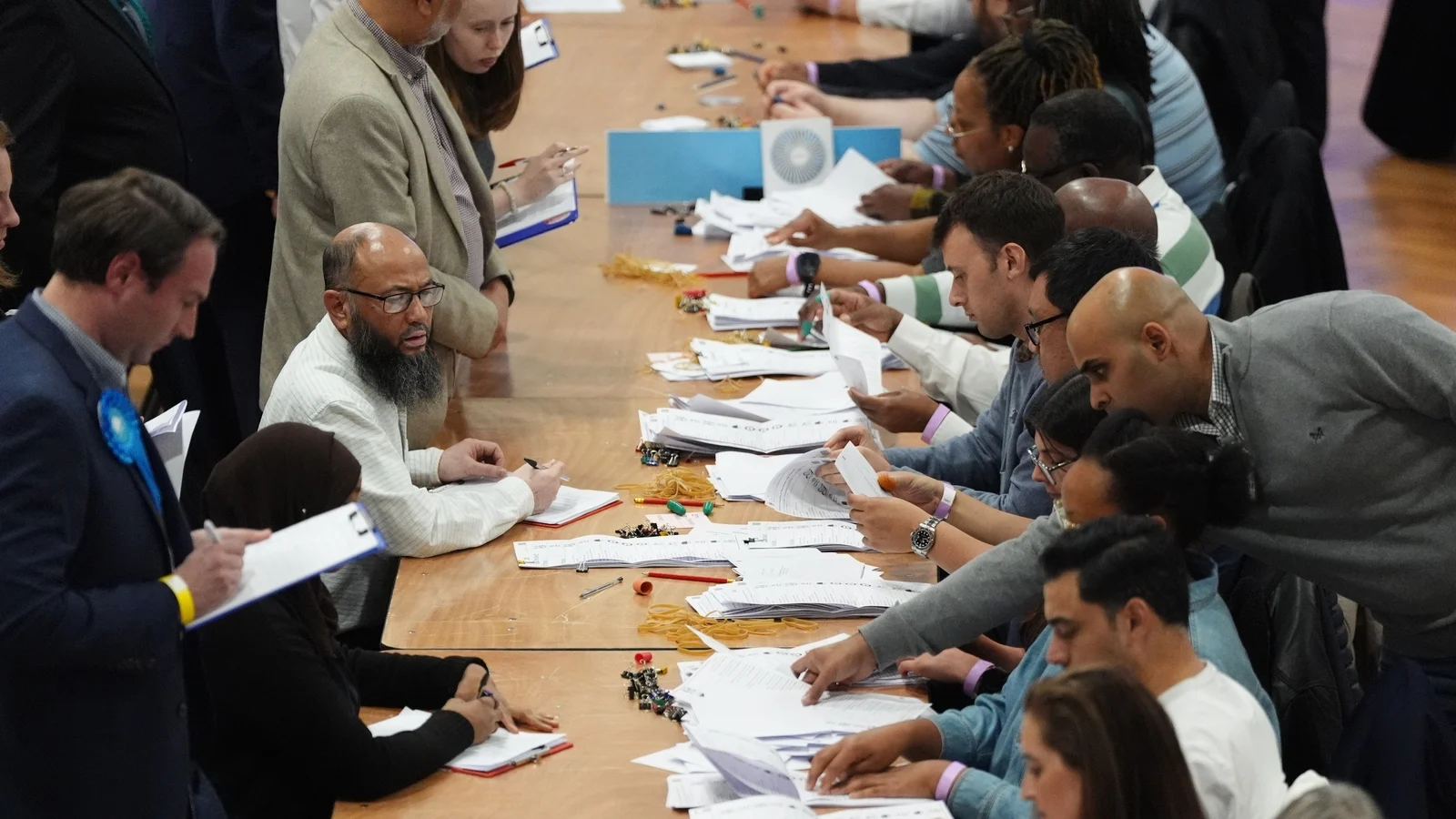
Dawn in the Count: A British Political Night That Felt Like a Turning Point
When the fluorescent lights came on in community halls from Cheshire to Greater Manchester in the small hours, they found more than bundles of ballot papers and folding chairs. They found a mood change: unease, elation, confusion—depending on which table you stood behind.
Early returns from England’s local elections read like a political weather report with gusts coming from the unexpected. Reform UK, the party that only a few years ago was a marginal force, was celebrating a wave of gains. Labour—Keir Starmer’s party—saw stumbles in places it once treated as comfortable. Across dozens of councils there were new colours on the political map, pockets of blue and turquoise replacing long-standing red.
The big numbers, early and loud
By the time results from 37 of 136 English councils had been reported, Reform UK had added more than 210 council seats to its tally, while Labour lost over 160 in the same batch of counts. Those are early, partial figures; they do not paint the whole night, but they were enough to send ripples—and headlines—through Westminster.
To put that in perspective: almost 25,000 candidates stood for more than 5,000 council seats in England alone, with votes also being cast in mayoral contests and national devolved elections in Scotland and Wales on the same day. Scotland’s parliament has 129 seats, Wales’ Senedd 96, both due to be counted later and carrying the potential to heap further pressure on national politicians depending on how those ballots fall.
Where the map changed
Small towns supplied the drama. In Halton, near the Mersey, Labour went into the evening defending 17 seats and emerged holding just two. Reform UK walked away with 15, some of them won with more than half the vote in wards where a year earlier its victory had been decided by six votes. “It’s a seismic swing,” said one local activist, wiping condensation from a takeaway coffee cup. “People are voting with their pockets and their worries.”
Hartlepool, a former Labour stronghold that has turned into a political chessboard since its by-election upheavals, saw Reform sweep every seat it contested—12 in all—leaving the council without a clear controlling party. In Tameside, within the constituency of Labour deputy leader Angela Rayner, Reform captured 18 of 19 seats up for grabs, pushing the authority to no overall control. Chorley and Wigan delivered similar shocks; Redditch, Tamworth and Exeter slipped from Labour hands.
Meanwhile, London offered a mixed picture. Labour held onto boroughs such as Ealing, Merton and Hammersmith & Fulham, but lost Wandsworth—a symbolically charged area—after holding it since the last turn of the electoral wheel. The Conservatives, for their part, managed to cling to Harlow and Broxbourne even as their national share looked shaky.
Voices from the counting halls
Nigel Farage, speaking with the buoyancy of a man who has just cleared a hurdle many thought he could not, framed his party’s surge as more than a tactical win. “We’ve jumped the hardest fence,” he told supporters, smiling. “Now we’re ready for the whole race.” His language was triumphant; the crowd’s turquoise scarves flashed like flags in a chill wind.
Opposition voices were sharper. “This is a night of very hard questions for our party,” one Labour backbencher murmured soon after the first lists were published. Some in the party privately urged the prime minister to consider his position if the losses deepened—an idea flatly rejected by senior figures who cautioned against panic. Deputy Prime Minister David Lammy urged steadiness: “We must answer the questions these results raise, but changing our leader is not the instant remedy,” he said on national radio.
What this might mean—and what it might not
Local elections are tricky beasts. They measure the mood of streets and communities more than they forecast a Westminster outcome. Political scientists stress context. “Local ballots are often a protest vote,” said Dr. Amina Chowdhury, a lecturer in British politics. “People punish national governments locally without necessarily directing that anger at the ballot box in a general election. Yet repeated patterns do matter: sustained erosion of support creates narratives that become self-fulfilling.”
Reform UK’s continued rise—the party claimed to be building on nearly 700 councillors won last year and the control of numerous local authorities—speaks to a fragmentation of Britain’s traditional two-party system. One of Reform’s strategists described what they hope is a “turquoise tide” across former Labour heartlands: a re-mapping of post-industrial towns where working-class voters feel their anxieties about jobs, immigration, and public services are not being heard.
For Labour, there were still bright signs. Lincoln and Salford held fast, and some councillors won tough fights. Historically, local defeat has not always foretold national disaster—Tony Blair’s Labour was humbled in 1999 local battles only to return in 2001 with sweeping strength. But the optics are powerful; narratives about leadership and direction form in hours and harden over weeks.
A crowded political landscape
The night was not solely a two-horse race. The Greens signalled gains in London boroughs and beyond, with party officials promising what they called “record-breaking results” in some urban wards. The Liberal Democrats celebrated taking full control of Stockport and Portsmouth councils and lamented losing their majority in Hull where Reform made double-digit gains. The Conservatives, even with party leader approval nudging higher in some polls, face a fight to resist being squeezed by Reform on the right and tactical voting on the left.
Across the towns and council chambers, the underlying concerns felt familiar: rising living costs, stretched social services, potholes that never seem to disappear, and local hospitals and schools creaking under demand. One pensioner in Hartlepool summed up a sentiment shared at multiple counts: “I don’t hate anyone,” she said, tearing into fish and chips on a bench outside the hall. “I just want someone to sort things out. If that’s a new team, I’ll give them a chance.”
Questions for the country—and the reader
So where does this leave Britain? Are we witnessing a short-term outburst of frustration, or the start of a permanent realignment? Is the fracturing of the political center a symptom of deeper economic anxieties, or a consequence of a media and social media environment that amplifies the loudest voices?
And for readers outside Britain—what does this moment tell us about representative politics in an era of rapid change? When traditional party loyalties fray, new forces can surge, for better or worse. The challenge for any democracy is to ensure that change leads to better governance, not merely to spectacle.
As counts continued and ballots from Scotland and Wales were still to be tallied, one thing was clear: the country was in a season of political recalibration. The question that will hang over Westminster in the coming days is not only who won or lost but what those results will mean for the next national conversation about leadership, policy and the future direction of Britain.
What would you change about how your local government works—if you could? Think about that as ballots are folded, boxes are sealed, and the next chapter begins to be written.