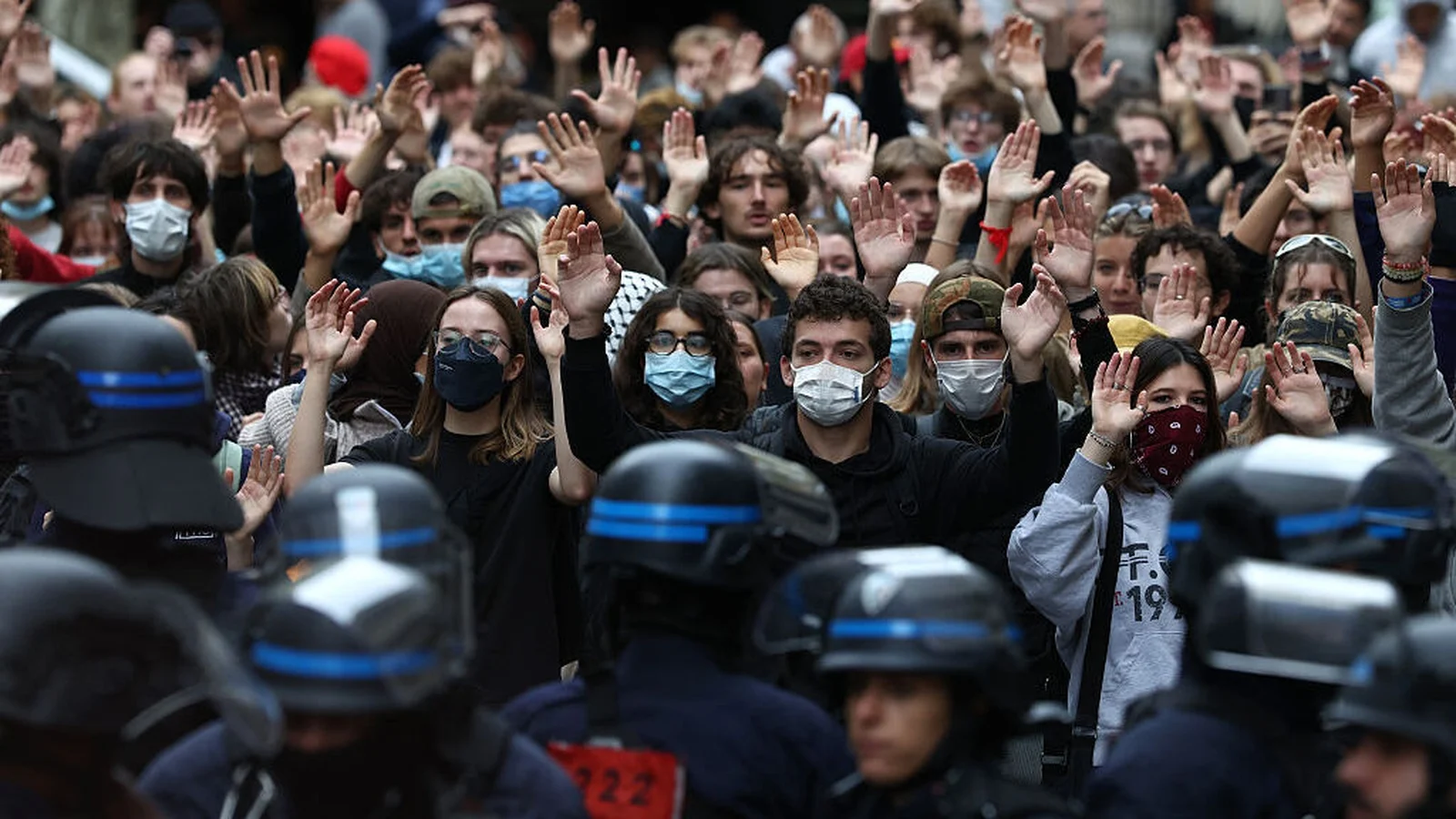
France’s student protest movement escalated again this week — and the government has now put a controversial crowd-control weapon on hold — after a 15-year-old boy lost his hand during a confrontation with riot police, intensifying demonstrators’ claims of police brutality.
There was little sign the unrest was fading. A day after protests surged nationwide, more than 500 schools were closed, and unions representing high-school students, teachers and other workers said more marches were planned for tomorrow.
The protest wave has stretched beyond two weeks, laying bare deep public frustration just six months before an election to succeed President Emmanuel Macron.
In central Paris, students at Lycee Lamartine turned their blockade into a show of resolve, singing the Marseillaise, shouting slogans and rippling through the crowd in Mexican waves as they held the school entrance.
“We saw there were lots of crumbling walls, a shortage of teachers in public schools, absent teachers,” said Gabriel Fillieule, who used to attend a public school but now goes to a private one.
He and other students said their goal was straightforward: improved learning conditions for everyone.
Students blockade a school with a banner reading ‘Fewer cops, more money’
Police’s use of force being investigated
Most blockades today unfolded without incident. But tensions flared outside Sciences Po university in central Paris, where police used tear gas and forced protesters back from a street barricaded with rubbish bins.
Rights groups, labour unions, students and some opposition politicians say police have responded with disproportionate force as they try to contain the protests.
Interior Minister Laurent Nunez said he had ordered a suspension of stun grenades after Monday’s incident in Lens, in northern France, where there was a “strong possibility” that a stun grenade firing caused a teenager to lose his hand.
“I am suspending their use for the high-school students’ movement until light has been shed on what happened in this case,” said the minister, adding that 18 incidents overall had been referred to the police inspectorate for investigation.
Hundreds of schools are at least partially closed as students block doors with bins
Protesters argue that deteriorating school conditions have helped drive a steep decline in French teenagers’ performance in reading and maths over the last decade.
According to the OECD’s Programme for International Student Assessment, French 15-year-olds scored 43 points lower in reading in 2025 than in 2015 — the largest drop among OECD countries.
Their maths results also fell by the greatest margin.
Yet with the government under pressure to rein in public debt amid weak economic growth, officials have limited room to meet demands that include addressing teacher shortages, renovating ageing school buildings and narrowing gaps between well-off and disadvantaged areas.
Schools damaged by fire or vandalism
Prime Minister Sebastien Lecornu has said students’ demands are “legitimate” while also describing the current unrest as the most violent student demonstrations in decades.
Education Minister Edouard Geffray told parliament that 24 secondary schools had suffered damage from fire or vandalism severe enough to keep them shut for weeks — leaving about 30,000 students without in-person classes until they reopen.
Students blockade Sciences Po Paris university on Boulevard Saint-Germain in Paris
Geffray put the repair bill at €20-€30 million.
Marine Le Pen, the far-right presidential candidate and current opinion-poll frontrunner, said those responsible for damaging schools should cover the cost rather than taxpayers.
The government has taken a similar line, with legislation moving through parliament that would create such a mechanism.
Across Europe, where public finances have been squeezed as governments deal with successive cost-of-living and energy crises, students in parts of Belgium have mounted comparable protests.
In Liege, in Belgium’s southern French-speaking Wallonia region, at least 107 people have been arrested in connection with student protests this month, Belga news agency reported.
Students march from Central Station to the Federal Parliament in Brussels, Belgium
Teachers, too, are walking out.
In Portugal, the main teachers’ union FENPROF began an indefinite strike in mid-September over working conditions, with teachers declining to perform any unpaid work beyond the 35 hours a week required by law.
In Spain, teachers’ unions have also been protesting conditions in state schools.
Teachers in Madrid are planning a strike on 14 October, pressing demands that include fewer hours, smaller class sizes and higher pay.