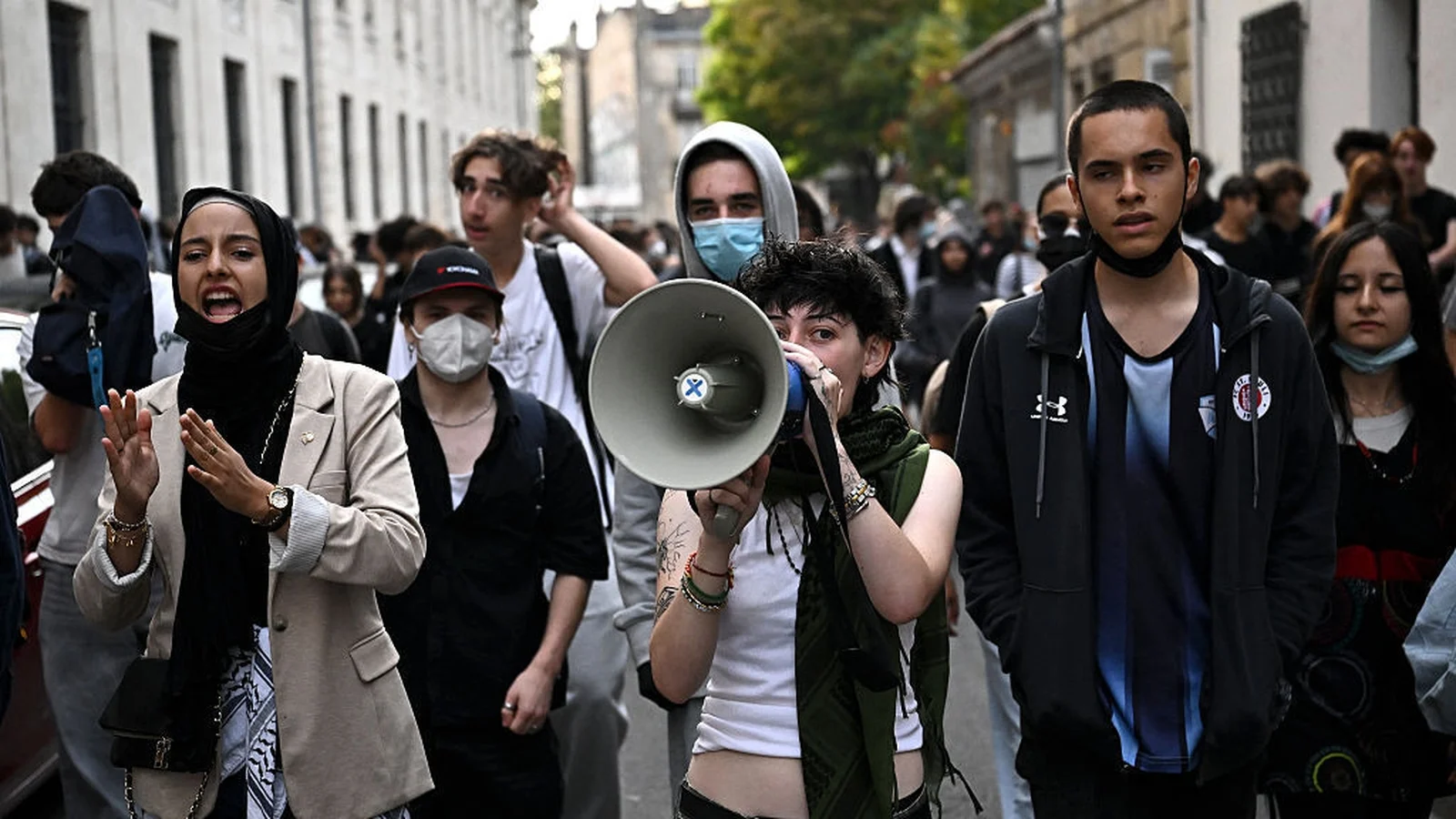
A nationwide wave of student protests over deteriorating classroom conditions has taken a shocking turn in France, after a 15-year-old reportedly lost a hand when a police grenade exploded.
The injury came as disruption continued across the country’s high schools, with some pupils heading back to class while others kept up blockades and demonstrations ahead of larger protests expected on Tuesday.
Authorities said the teenager was hurt in the northern town of Lens.
According to a police union source, he appeared to have picked up a sting-ball grenade fired by riot police, which then detonated in his hand.
Since late September, students have been blocking entrances at hundreds of schools, saying they are being forced to learn in worsening conditions — citing teacher absences, overloaded timetables, rundown classrooms and buildings poorly suited to higher temperatures, among other complaints.
The unrest has flared with just months remaining before the 2027 elections that will decide who succeeds centrist President Emmanuel Macron.
While the government has moved to respond to the concerns, it has also argued that hard-left activists have seized on the student-led movement.
On Monday, the French Human Rights League (LDH) accused security forces of responding with disproportionate tactics against demonstrators, many of whom are legally minors.
“We can see that in the instructions given to the police, there is no directive to show restraint, even though they are dealing with children,” LDH president Nathalie Tehio said.
Dustbins ablaze
By Monday morning, more than 400 of France’s 3,700 high schools — known as lycees — were partially or fully closed, the education ministry said.
Officials said closures were expected to affect a third of the 468 lycees serving 15- to 17-year-olds in the Paris region.
In central Paris, dozens of teenage students gathered outside a school as passing motorists honked in support. Some of their classmates went inside for lessons.
“We’re missing our lessons to give you one,” read a cardboard sign posted outside Turgot high school in Paris’s 3rd arrondissement.
In Bordeaux in the southwest, scenes were mixed: some students returned to class while others stayed outside to protest, watched by riot police.
Outside Gustave Eiffel high school, some protesters set off fireworks toward police, AFP reporters said. Officers responded sporadiacally with tear gas, though the overall atmosphere remained calm.
In the northern city of Lille, masked protesters smashed bus shelters and set dustbins on fire, while police fired tear gas in the direction of demonstrators.
The protest movement began on September 17 at a high school in the Paris suburb of Creteil, where students rallied behind teachers striking over staff shortages and a lack of resources.
From there it accelerated and spread nationwide, at times tipping into vandalism — including bus shelters destroyed, school entrances burned and clashes with security forces.
Education authorities say 24 schools have been burned or ransacked since the movement began.
More than 5,000 people have been arrested, 85 percent of them minors.
Protesters have also alleged excessive policing, and internal investigations have been opened into at least three cases of alleged police brutality.
How a high school blockade movement spread across France
‘Parental responsibility’
Prime Minister Sebastien Lecornu outlined a timetable on Sunday calling on local authorities to prioritise replacing long-term absent teachers and filling vacant posts.
He has also convened a meeting for Tuesday with regional presidents to discuss plans to overhaul France’s often dilapidated school buildings.
Alongside those measures, the government is advancing legislation aimed at making those responsible for damage to public property cover the cost of repairs themselves, rather than relying on public funds.
Government spokeswoman Maud Bregeon defended the proposal.
“When you have 14-, 15-, 16-year-olds who, at 9 am, are burning bus shelters or — perhaps even more seriously — the high school where they study, that raises the question of parental responsibility,” she told the Europe1/CNews broadcaster.
Lecornu has said the draft law could enable compensation to be recovered from family allowances and housing benefits, while maintaining a minimum income threshold.
Sophie Binet, the head of the main CGT labour union, denounced what she called a “populist announcement”, warning it would “end up targeting the most vulnerable families”.