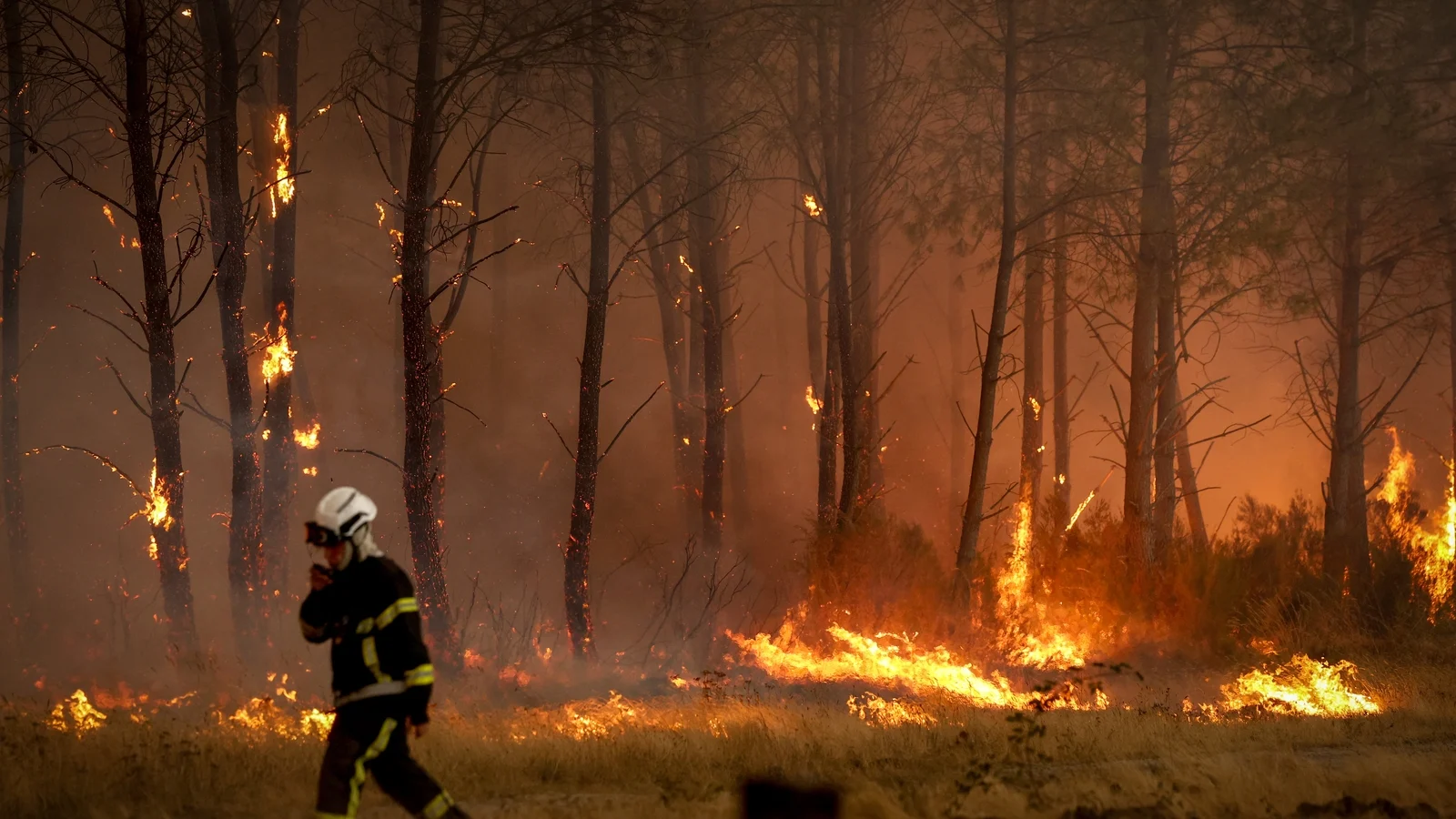
August is typically when France’s wildfire season reaches its most dangerous point.This year, though, the country is already reeling and the scale of the destruction has left firefighters and affected communities wondering how much more they can withstand.
So far in 2026, the amount of land burned is 40% higher than the previous record set in 2022, and officials have recorded 13,550 separate fires since the season began.
The worst stretch, however, has come in just the last 10 days, when blazes surged to levels not seen before.
“Completely unprecedented,” is how French President Emmanuel Macron summed up the massive wildfire that tore through the south-west Gironde region.
The fire pushed across an area four times the size of Paris, burning so fiercely it generated a powerful, fire-driven thunderstorm — the first such event ever observed in France.
NASA satellites measuring the fires’ energy output found it was double the previous July record.
Those extreme flames arrived in a summer already defined by punishing heat, with repeated heatwaves drying out vegetation and turning forests into fuel for fast-moving blazes.
France logged its hottest June since record-keeping began, as temperatures in several regions climbed above 40C.
During that period, the French national health agency reported more than 5,700 excess deaths.
Clouds of smoke rise into the sky from the Gironde wildfire
Scientists say the numbers should serve as a stark climate reckoning.
Researchers with the World Weather Attribution group concluded that human-driven climate change made the extreme conditions feeding the wildfires in southwestern France twice as likely.
One of the report’s co-authors, Clair Barnes, called the findings “extremely scary.”
“What’s unique about this case is that it’s still early in the season.”
Forests stand blackened and bare
In south-west France this week, the reality behind the statistics was impossible to miss.
Stretches of once-thick pine forest have been stripped to scorched trunks, with the ground beneath still smouldering in places.
In Le Porge a town that normally has about 3,500 residents heavy smoke continued to hang in the air.
Authorities describe the area as the epicentre of the damage, saying 183 homes were gutted by the blaze.
Their charred remains now stand as a blunt warning of the dangers confronting Europe, the world’s fastest-warming continent.
Further inland, Bordeaux usually busy with summer visitors felt oddly subdued.
Last weekend, smoke blanketed the city and ash drifted down, as officials warned the fires had reached within 15 kilometres of the suburbs.
Residents look at the sky illuminated by wildfires in Le Porge, south-western France
Even after the immediate danger eased, anxiety lingered in the streets.
“It’s pretty scary,” said Dundalk man Logan Murphy, who has been working in a Bordeaux bar for the past year and a half.
He said the bar was “noticeably quieter,” and added that “a lot of people are leaving Bordeaux because they want to avoid the smoke”.
“I think it’s an absolute indication that climate change needs to be addressed, and it’s not being addressed currently.”
For some, the smoke and ash were enough to reconsider a visit to Bordeaux. For others, the city became a destination out of necessity a place to escape to as flames closed in.
At the height of the emergency, more than 220,000 people were forced from towns, villages and campsites across parts of Gironde in what amounted to one of France’s largest peacetime evacuations.
Many ended up at Bordeaux’s large exhibition centre north of the city, repurposed as a temporary shelter providing food, clothing and counselling.
Inside, families with small children sat on rows of camp beds near elderly evacuees, some accompanied only by their dogs.
The atmosphere shifted between worry, irritation and monotony, all centred on the same hope: confirmation that their homes were still standing and they could go back.
But for some, that message would never come.
Across Europe, the 2026 fires are likely to be remembered for the records they broke and the devastation left behind.
Scientists say they also underline a widening reality: the climate crisis is no longer a far-off prospect, but a force already altering how people live across the continent.