Myanmar Calls International Court’s Genocide Ruling Unjust and Biased
 Caalamka
Myanmar’s government lashed out at a landmark decision from the United Nations’ highest court, calling it unfair and a “great disappointment” after judges concluded the country perpetrated genocide against its Rohingya minority.
The International Court of Justice (ICJ) yesterday set out evidence of atrocities committed against the mostly Muslim Rohingya during a 2017 crackdown in western Rakhine state.
In its findings, the court said Myanmar’s security forces killed thousands of Rohingya civilians, carried out “widespread sexual violence” against women and inflicted “extreme violence” on children.
Speaking at a press conference in the capital Naypyidaw, presidential spokeswoman Khaing Khaing Soe stressed that the nine to six ruling was not unanimous and insisted the decision was “not fair”.
Myanmar’s foreign ministry later echoed that position, saying in a statement that the judgment came “as a great disappointment to Myanmar”.
For years, Myanmar has rejected accusations of genocide, maintaining that its military response was aimed at a security threat after a series of attacks left a dozen security personnel dead.
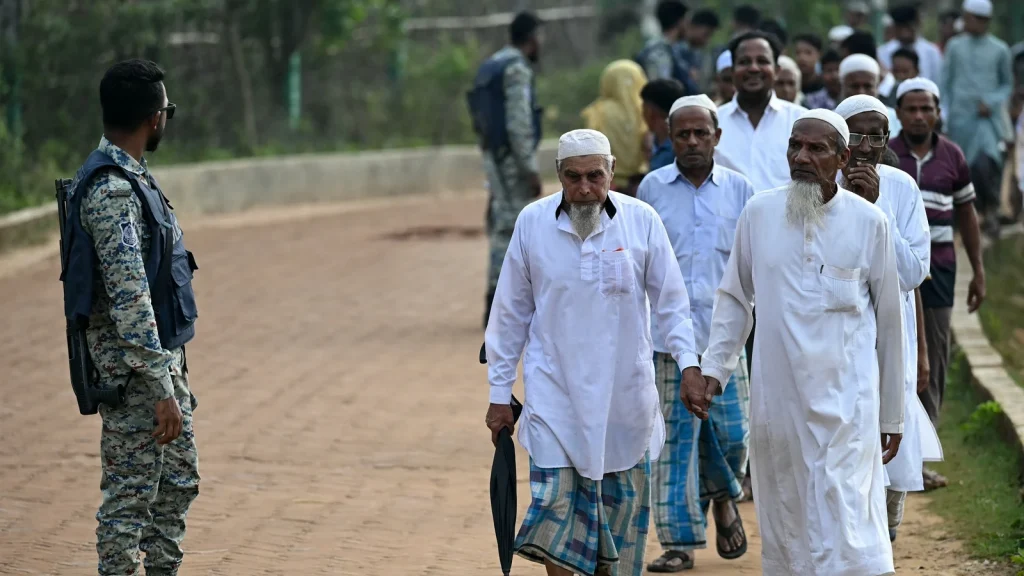
Rohingya refugees watch the International Court of Justice (ICJ) ruling over whether Myanmar committed genocide against Rohingya Muslims
The ICJ, however, rejected Myanmar’s portrayal of the operation as counter-insurgency.
“There is no evidence before the Court that, in the conduct of the clearance operations, Myanmar distinguished between civilians and alleged (Rohingya) fighters,” the judgment said.
The decision marks the first time in the ICJ’s 80-year history that judges have determined a state committed genocide.
During the violent campaign, hundreds of thousands of Rohingya fled into neighbouring Bangladesh, the court said.
Rohingya villages were “systemically destroyed” and later replaced with non-Rohingya inhabitants, the ruling said, concluding that the “only reasonable inference” was Myanmar intended to destroy the population — a central requirement for a genocide finding.
Safe passage
The court ordered that refugees be granted safe passage home and that compensation be paid, though the precise amounts will be determined later.
Today, the head of the United Nations General Assembly visited a refugee camp in Cox’s Bazar in Bangladesh and urged Myanmar to take back hundreds of thousands of displaced Rohingya.
“A judgment on paper is not justice in life – now it must be given effect,” said Khalilur Rahman, pressing for the Rohingya’s safe, voluntary and dignified return.
Read more: ICJ ruling on Myanmar hailed as ‘milestone’ for Rohingya
Inside Rakhine yesterday, 31-year-old Pyay Lynn said repatriation of Rohingya refugees to his state “has to happen”.
Yet he warned that sending people back to a conflict-scarred region is fraught with danger.
“In Rakhine state, many civilians are dying from military airstrikes” amid Myanmar’s ongoing civil war, he said.
“Such mass killings of civilians also can be viewed as genocide,” he added.
The conflict, sparked by a 2021 coup, has killed more than 100,000 people on all sides, according to estimates from conflict monitor ACLED.
Malaysia, meanwhile, appeared to retreat from an announcement today that it was seeking to resettle 10,000 Rohingya refugees in Turkey, after Ankara’s foreign ministry noted Malaysia had removed the post from social media.
In September, Malaysia repatriated around 1,500 Myanmar nationals under a programme that rights advocates warned could place migrants at risk by returning them to a country at war.
The court ordered refugees be given safe passage home and awarded compensation
Myanmar’s foreign ministry said the government would keep providing “humanitarian assistance” to displaced people in Rakhine and would pursue the repatriation of those in Bangladesh “as and when situations permit”.
‘Nothing to do with us’
The case at the ICJ was filed by Gambia under the 1948 UN Genocide Convention, which allows any state to take another to court if it suspects violations of the post-World War II treaty.
Khaing Khaing Soe said today that the African country had “nothing to do with” Myanmar.
ICJ rulings are binding and cannot be appealed, but the court lacks direct enforcement powers.
Even so, the decision is likely to intensify international scrutiny of Myanmar’s leader Min Aung Hlaing, who led the military during the Rohingya crackdown before toppling the elected government of Aung San Suu Kyi in the 2021 coup.
Min Aung Hlaing, a former general, was installed this year as civilian president after tightly restricted elections.
China — one of Myanmar’s few steady partners since the putsch — voiced concern over what it described as judicial overreach following the ICJ ruling.
The United States has sanctioned Min Aung Hlaing, but has recently pushed back on a case at the court accusing US ally Israel of genocide in Gaza, while emphasising the need to avoid “politicisation” of the tribunal.