When the Sky Breaks: Gaza’s Displaced Children, Tents and the Turning Rain
Rain is supposed to be cleansing. In Gaza this week it has felt like an accusation.
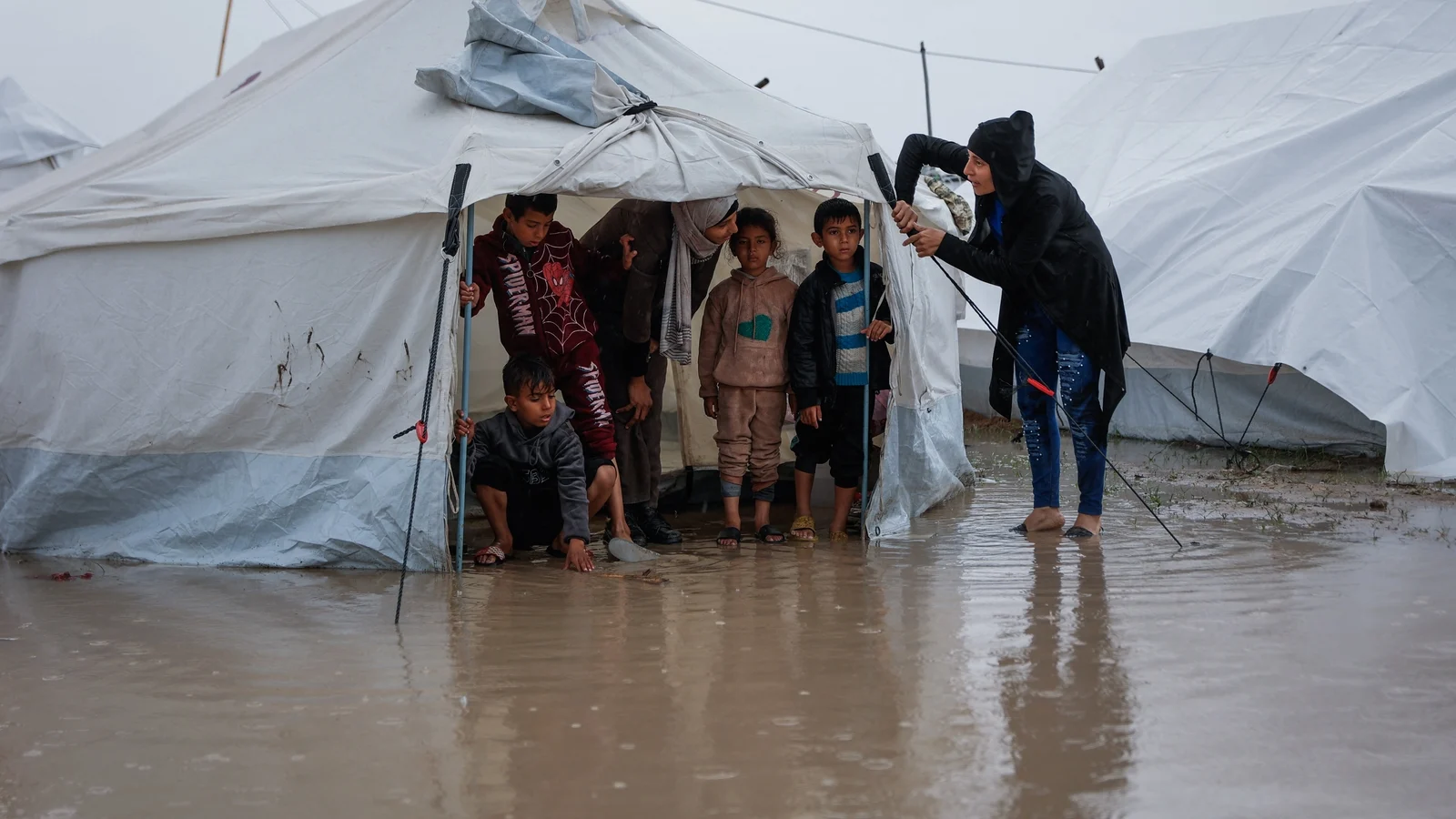
For thousands who have already lost homes, family photographs and the little predictability war allows, a series of heavy downpours did something more practical and cruel: it turned flimsy shelter into swamp. Tents made of tarpaulin and hope—rows of them pressed up against rubble-strewn streets—filled with water, mud and cold. Children slept in damp clothes. Families who had been moved from one shelter to another, sometimes more than once, woke to find what little they had left sodden and ruined.
“We are used to the noise of bombing. We were not prepared for the sound of water,” said Zahra, a mother of three who now lives in a crowded compound in eastern Gaza City. “My boy woke up and his feet were black. There was no dry place for him to sit.”
Humanitarian reality: tents are fragile, supplies are thin
UN agencies and aid workers on the ground are sounding the alarm. The UNICEF office in the region has warned that what was already a precarious displacement crisis has become a catastrophe in places where tents and makeshift shelters line the landscape.
“We’re seeing extremely simple and fragile structures—tarps, plastic sheeting, a thin groundcover to keep out the worst of it. It is not shelter. It is still a trap,” an aid worker who has been coordinating winter relief efforts told me over a call from Gaza. “Children are sleeping wet. Hygiene is collapsing. When you mix those things you get disease.”
Recent field reports describe clogged drainage, contaminated puddles and latrines overflowing in some informal settlements. Health workers are watching for spikes in respiratory infections and waterborne illnesses; even as they try to distribute blankets and dry clothing, supplies are outpaced by need.
Numbers that matter
Rough figures underline the urgency: almost the entire population of Gaza—around two million people living in a dense coastal strip roughly 365 square kilometers in size—were already dependent on humanitarian aid during and after the fragile ceasefire that paused wider hostilities. Thousands remain displaced, crammed into makeshift camps or relatives’ homes. UNICEF and other agencies have reported that current winterization supplies, while arriving in larger volumes than months prior, are still insufficient to protect everyone at risk.
“We have sent blankets and tarps,” said one logistics official for an international NGO. “But when it rains across hundreds of sites, boxes of supplies become a trickle.” She paused. “The scale here swallows supplies.”
Personal loss, public grief
The human toll is not only material. Aid workers have reported cases of infants suffering from exposure and, tragically, the death of very young children—reports that local health workers describe as being connected to hypothermia and worsening hygiene conditions.
“I held a baby today who could not stop shivering,” recounted a pediatric nurse stationed at a community clinic. “Her clothes were wet, and the family had nowhere to put her. This is not a number on a page. This is a child.”
A father named Omar told me he felt crushed by the layering of crises: “First the bombing took our home, then we were moved, and then the rain. Where is the shelter for the most vulnerable? Where is the life we had?”
What aid workers say is needed
- More tarpaulins and heavy-duty shelter kits that can withstand wind and prolonged rain.
- Warm clothing and blankets, especially for infants and young children.
- Improved water, sanitation and hygiene (WASH) services to prevent disease outbreaks.
- Unhindered access for humanitarian staff and supplies into all parts of the enclave.
“We need corridors, not just promises,” urged a UN relief official. “Entry points must be open and staff must be able to move in and out safely. Repairing a tent is not the same as rebuilding a life.”
Politics in the rain: an international force, and unanswered questions
As negotiators and diplomats discuss the next phases of peace planning and stabilization, so-called International Stabilisation Force proposals are being floated—multinational contingents intended to create secure space for relief and governance. Reports say countries have expressed interest; one government even offered tens of thousands of personnel for non-combat tasks such as medical and infrastructure work.
“Any deployment must be paired with clear humanitarian objectives,” argued a former UN peacekeeping adviser. “Stabilization is meaningless if people are still drowning in their tents.”
But the politics are messy. Who disarms armed groups? How will demilitarization be verified? Who controls the checkpoints between Gaza’s neighborhoods and the outside world? These are not technicalities. They matter to whether aid can reach someone like Zahra’s family before another storm arrives.
Beyond emergency relief: why reconstruction must start now
Relief is urgent. Reconstruction is necessary. Families cannot live indefinitely under tarps soaked through by winter rain. Yet reconstruction requires security, sustained funding and political will.
“We need a road map for rebuilding schools, homes and healthcare facilities—steps that are practical and do not wait on perfect politics,” said a civil engineer who has worked on reconstruction projects across conflict zones. “Modular shelters, water treatment kits, and community-driven repairs can be started even while higher-level talks continue.”
There are also deep psychological wounds to tend. Children who have lost not only their homes but the basic comfort of dry clothes and a warm blanket will carry those memories into adolescence. Psychosocial support must travel with the tarps and trucks.
What can we, the global audience, do?
When we read dispatches like this, it can be tempting to look away. What if we instead ask: how do we make our concern useful?
Consider supporting established humanitarian organizations with transparent spending records. Keep pressure on governments and international bodies to ensure humanitarian corridors remain open. And maybe—most importantly—listen to the voices of those inside Gaza, treat them not as passive recipients of aid but as people with agency, ideas and courage.
“We have lost so much, but we are not invisible,” said a schoolteacher who now runs informal classes in a damaged community center. “When it rains, we all notice it more. Perhaps then, the world will notice us, too.”
When the sky breaks over Gaza again, will it find the people there better protected than they were this week? The answer depends on more than weather—it depends on decisions made in conference rooms and in cargo yards, and on whether the shared humanity that floods our feeds can be turned into the sustained, muddy, unglamorous work of keeping a child warm and dry.