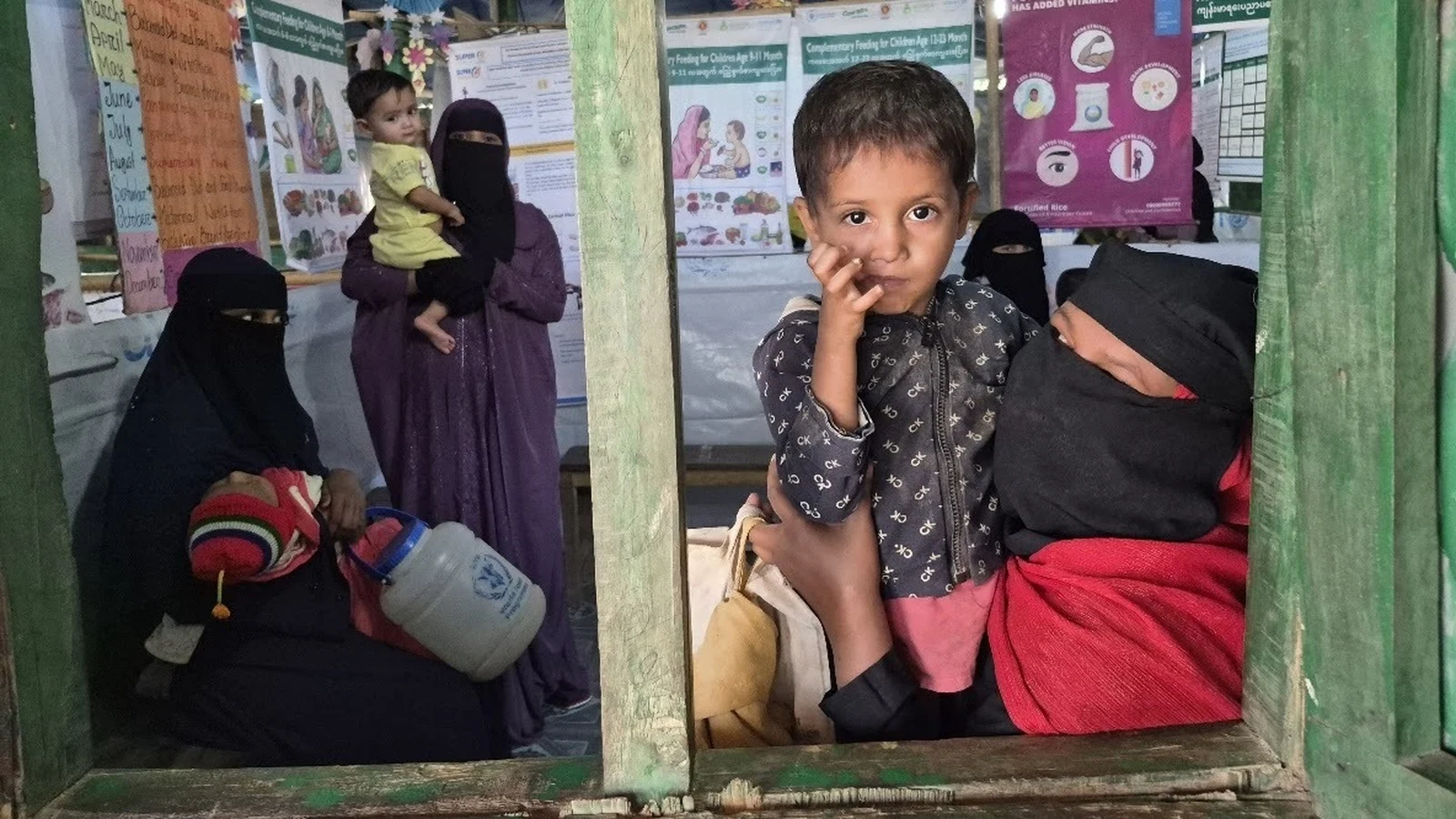
Where the world’s headlines grow thin: a morning in Cox’s Bazar
The dawn in Cox’s Bazar is a soft, anxious thing: tarpaulin flaps shiver in seaside winds, goats bleat somewhere between narrow lanes of bamboo poles, and the chatter of children threads through the air like a fragile promise. Walk a few dusty minutes from the main road and you stand before rows upon rows of makeshift shelters — the largest concentration of displaced people on earth — where the ordinary mechanics of life have been reduced to survival and small rituals of hope.
Inside a low, corrugated nutrition centre run by an Irish aid agency, a tiny infant clenches a fist and refuses to sleep. Her name is Ahshiya; she is seven months old and, at her last weigh-in, barely tipped the scales at 4.7 kilograms — the weight of a newborn in many parts of the world. Her mother, 21-year-old Sajida, sits beside her, fingers folded around a thin cup of tea, eyes someone else’s age.
“She was born after everything burned,” Sajida tells me in quiet Bengali broken sometimes by a Rohingya dialect. “We left our village with only what we could carry. Here, food comes from trucks. Doctors are kind, but kind does not feed. I am sick too — the fever comes and I sleep all day. When she cries, it is like a drum in my chest.”
Not just another statistic: faces behind a looming funding cliff
There is a political story behind this intimate scene. In recent years, international donor priorities shifted; budgets tightened and emergency accounts were drawn down. The result: a funding shortfall for the Rohingya response in Cox’s Bazar estimated at roughly 50% for the year — a fiscal chasm that becomes a moral crisis when turned into rations, medicines and classrooms.
“When donors turn away, the most vulnerable are first to feel it,” says Sheikh Shahed Rahman, Programme Director for Concern Worldwide in Bangladesh, wiping dust from his trousers as he gestures toward the intake room filled with mothers and infants. “We are bracing for a higher rate of malnutrition that will cause the death of young children if immediate action is not taken. That is not rhetoric — it is what the data is warning us about.”
UN Secretary-General António Guterres has called Cox’s Bazar “ground zero for the impact of budget cuts,” and the numbers behind that phrase are stark. Between January and September of the referenced reporting period, UNICEF recorded an 11% rise in children with acute malnutrition. Meanwhile, the World Food Programme warned it might have to reduce food assistance from the equivalent of roughly $12.50 per person per month to about $6 — a cut that turns a ration into a life-or-death lottery for families already skirting the margins.
What a cut in dollars looks like in daily life
Imagine a family with three children. A reduction in food support means fewer lentils, less oil, diminished rice. Parents rotate scarcity: the old eat last, pregnant mothers coin meals into bites for their babies. Immunization and pregnancy clinics stretch their hours and their supplies, and a nutrition centre that keeps infants like Ahshiya gaining weight might be forced to close its doors.
“School protects the kids,” Rana Flowers, UNICEF’s representative to Bangladesh, explained. “It is not just books. It is safety, structure, and a place where child marriage and recruitment can be prevented. Close the schools and these children are suddenly exposed to risks that will scar them for life.”
Children with futures on hold
Thirteen-year-old Nur Hares loves history. He dreams — as children in any part of the world do — of becoming a pilot, a teacher, an engineer. His classroom, a cluster of bamboo frames with corrugated sheeting, is funded only until the end of December. After that, if funding isn’t renewed, up to 300,000 children in Cox’s Bazar could be without access to learning services, UNICEF warns.
“I read whenever I can,” Nur told me, his fingers tracing a worn page. “When someone asks me what I want, I say many things. I want to fly above the hills where I used to live. I want to teach others what I learn.”
Beyond the camp: a mirror for global choices
This is not merely a localized emergency. It is a mirror reflecting a global tension: competing political narratives about immigration, aid budgets, and the meaning of responsibility in a world of climate shocks and protracted displacement. Donor fatigue, the politicization of aid, and the pressure on national budgets all feed into decisions that play out in places like Cox’s Bazar.
“The politics of compassion is complicated,” says Dr. Lina Ahmed, a humanitarian policy expert based in Dhaka. “But the arithmetic is simple: when funding declines, services decline, not abstractly, but in real bodies and real children. It is the most marginalized who bear the brunt.”
Local colour, small mercies
And yet, amid the sobering figures, there are constellations of resilience. Community health volunteers who once taught under a mango tree now lead nutrition screenings, local Bangladeshi women queueing to hand over a bowl of muri (puffed rice) as an act of neighborliness. At sunset, the prayer calls from makeshift mosques thread through the camp. Children play cricket with broken bats and flattened tins, their laughter a stubborn refusal to be erased.
“We are tired, but we have each other,” an elder named Rahim said to me while sipping sweet tea. “If the world gives less, we will find ways to do more. But there are limits. We are not magic.”
What can readers do — and what does this ask of us all?
Stories like these force a question into the reader’s hands: when the choices of distant capitals ripple into the daily life of a child like Ahshiya, what responsibility do we carry? Policy shifts, donor decisions, and budget tables may seem remote, but their consequences land in the most intimate of places — the hand that tries to warm a small, hungry infant.
If you want to act, consider supporting reputable relief agencies working on the ground, raise your voice with elected representatives about the human cost of aid cuts, or learn more about the systemic drivers of forced displacement. Names you’ll read about in reporting — UNICEF, WFP, Concern Worldwide and local Bangladeshi NGOs — are among those doing the heavy lifting, though their work becomes harder each time a funding cheque is reduced.
The long view
The camp at Cox’s Bazar is a testament to endurance and a warning about neglect. The crisis there is a concentrated example of a global problem: when short-term politics trump long-term commitment, emergencies calcify into crises that multiply across generations.
So when you picture a child in a tarpaulin hut, consider not just the image but the policy that frames it. Ask yourself: are we willing to let entire childhoods be determined by a budget line? Or will we choose, collectively, to keep the lifelines open?
For Sajida and Ahshiya, the answer will be written in the coming months — in the queues at nutrition centres, in the hours a classroom stays open, in the ration card that keeps a pot of rice warming on a stove. They are waiting, as the rest of us must, to see whether the world’s promises will outlast the headlines.