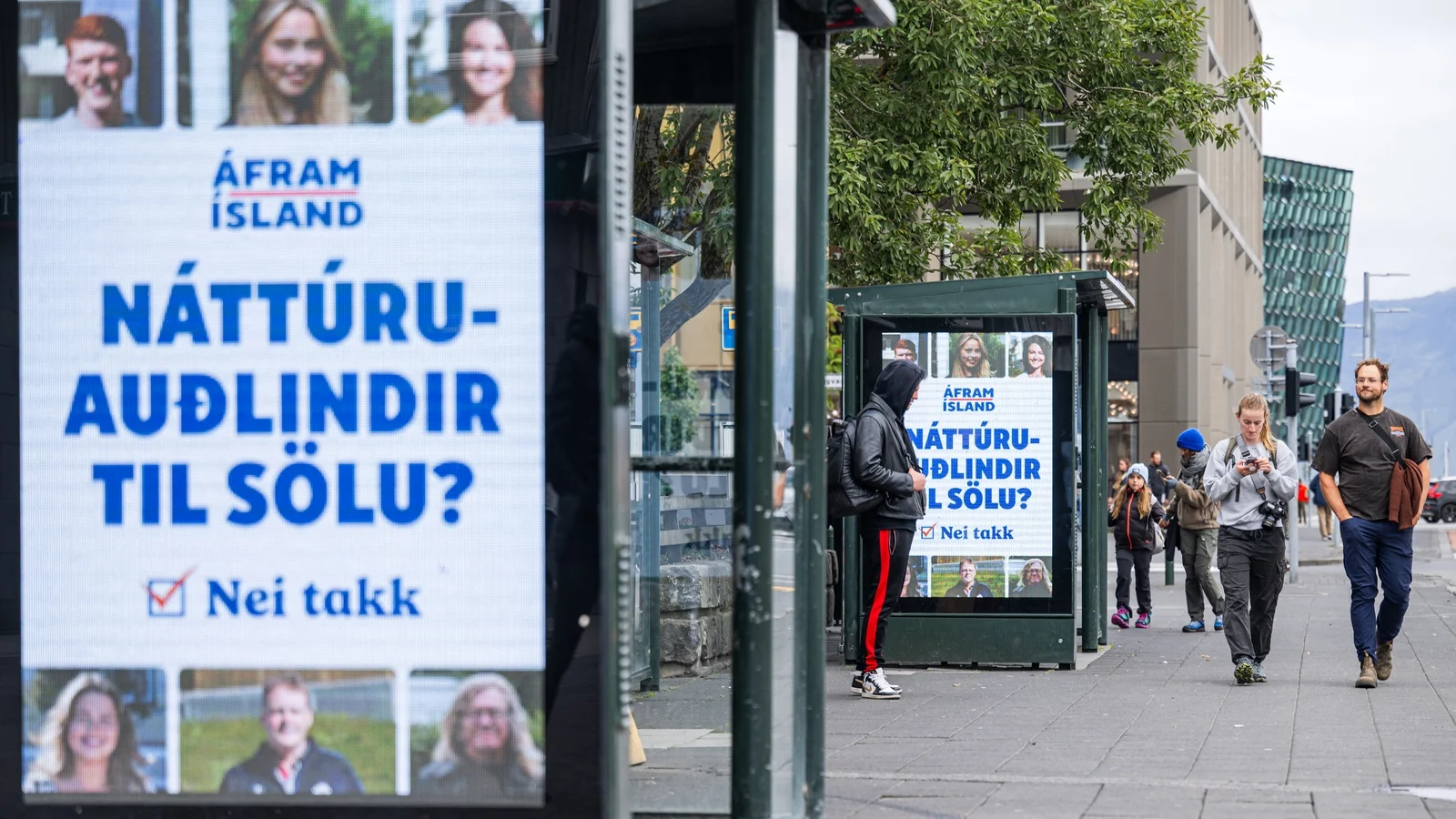
Iceland heads to the polls Saturday for a knife-edge referendum that could reopen talks with the European Union — a decision sharpened by a more unsettled world and renewed debate over the country’s place in Europe.
Voters are not being asked to decide now whether Iceland should join the 27-member bloc. Instead, the ballot will determine whether the government should resume negotiations on possible membership terms — including the politically explosive question of fishing rights.
“This is an opportunity, it’s not a final decision,” Prime Minister Kristrun Frostadottir told AFP, pitching the vote as a “risk-reducing ‘Yes'”.
“This way you get a deal on the table, you’re able to see all the questions, the answers to all the questions we get here,” she said.
Frostadottir spoke after a “listening meeting” in Selfoss, part of a series of visits to smaller communities where the Social Democratic leader has been hearing residents’ concerns and fielding questions about what renewed EU talks would mean.
On Saturday, Icelanders will be asked to answer ‘Yes’ or ‘No’ to the question: “Should Iceland resume accession negotiations with the European Union?”
Behind that wording lies a broader choice for the island nation of 400,000 people: whether to keep steering fully on its own, or begin charting a course that could eventually tie it more closely to Brussels.
The European Union Delegation to Iceland offices in Reykjavik
If voters back ‘Yes’, any accession agreement eventually struck with the EU would still face another referendum in Iceland. The process would likely require a change to the country’s constitution, and it would also need ratification by EU member states.
Iceland first applied to join the bloc in 2009, in the aftermath of the 2008 financial crisis that toppled its banks and battered the economy.
Negotiations opened in 2010, but the effort was put on ice in 2013 when a eurosceptic government took power and halted the talks.
Much has shifted since that pause.
“The EU is looking around, it’s finishing deals with India, with Mercosur. We’re seeing changes in the global climate when it comes to how people are using tariffs as weapons,” Frostadottir noted.
Divisive question
At home, Iceland’s economy has regained its footing, though its currency remains volatile. Many households, however, have been squeezed by rising inflation and sharply higher borrowing costs. The central bank has raised rates three times so far this year, to eight percent — a trend that has made the euro more appealing to indebted families looking for stability.
Internationally, Russia’s invasion of Ukraine has brought war back to Europe and upended longstanding security assumptions.
Concerns have also been stoked by US President Donald Trump’s threats to take over neighbouring Greenland. Iceland sits in a strategic sub-Arctic location, has no military of its own, and relies on NATO along with a 1951 bilateral agreement with the United States for its defence.
“The geopolitical upheaval that we have seen recently is not the root cause of this referendum. But obviously, those concerns are impacting the debate,” Bifrost University Professor Eirikur Bergmann told AFP.
“Mainly the aggression towards Greenland has caused great concern in Iceland and caused many people here to pause and reassess where Iceland belongs,” he added.
Surveys indicate the electorate is closely split, turning the vote into a deeply polarising test.
Office worker Vilborg Inga Magnusdottir said she did not see a compelling case for altering Iceland’s current arrangement.
“Why would we want to enter the European Union? What would we benefit from it when things are already good?” the 33-year-old told AFP.
Hrafnkell Gudnason, by contrast, said he intends to vote ‘Yes’.
“It’s getting more dangerous for a small country to stand outside the EU,” the 59-year-old consultant and horse-breeder said.
“I think it’s safer to be a part of a bigger family.”
Compromise on fishing?
Few issues cut closer to Iceland’s sense of sovereignty than fishing. With seafood products accounting for around 40 percent of exports of goods, control of the seas is both an economic pillar and a core element of national identity — and it would almost certainly dominate any renewed negotiations.
Even now, half a century after the last “Cod Wars” with Britain, many Icelanders remain wary of surrendering even a sliver of authority over their hard-won waters to Brussels.
Foreign Minister Thorgerdur Katrin Gunnarsdottir, despite being firmly pro-European, has underscored that any future talks would have to preserve Iceland’s “sovereign control over all fisheries”.
That position would be hard to square with the EU’s existing Common Fisheries Policy.
The EU has avoided stepping into Iceland’s domestic debate ahead of the referendum, though it has signalled goodwill, including on the contentious fisheries question.
For Brussels, Iceland would represent a wealthy and stable potential member already largely integrated into the single market through the European Economic Area — an enlargement success story that could also bolster the EU’s presence in a strategically prized region.