Iran’s Revolutionary Guards say they have fired on a tanker they accuse of trying to skirt Tehran’s restrictions in one of the world’s most strategically important waterways, escalating tensions as diplomacy to end months of fighting remains stalled.
In a statement carried by state news agency IRNA, the Guards said Iranian forces “have taken control of the administration of the strait” — a reference to the Strait of Hormuz, which Iran has sought to blockade since the start of the Middle East war.
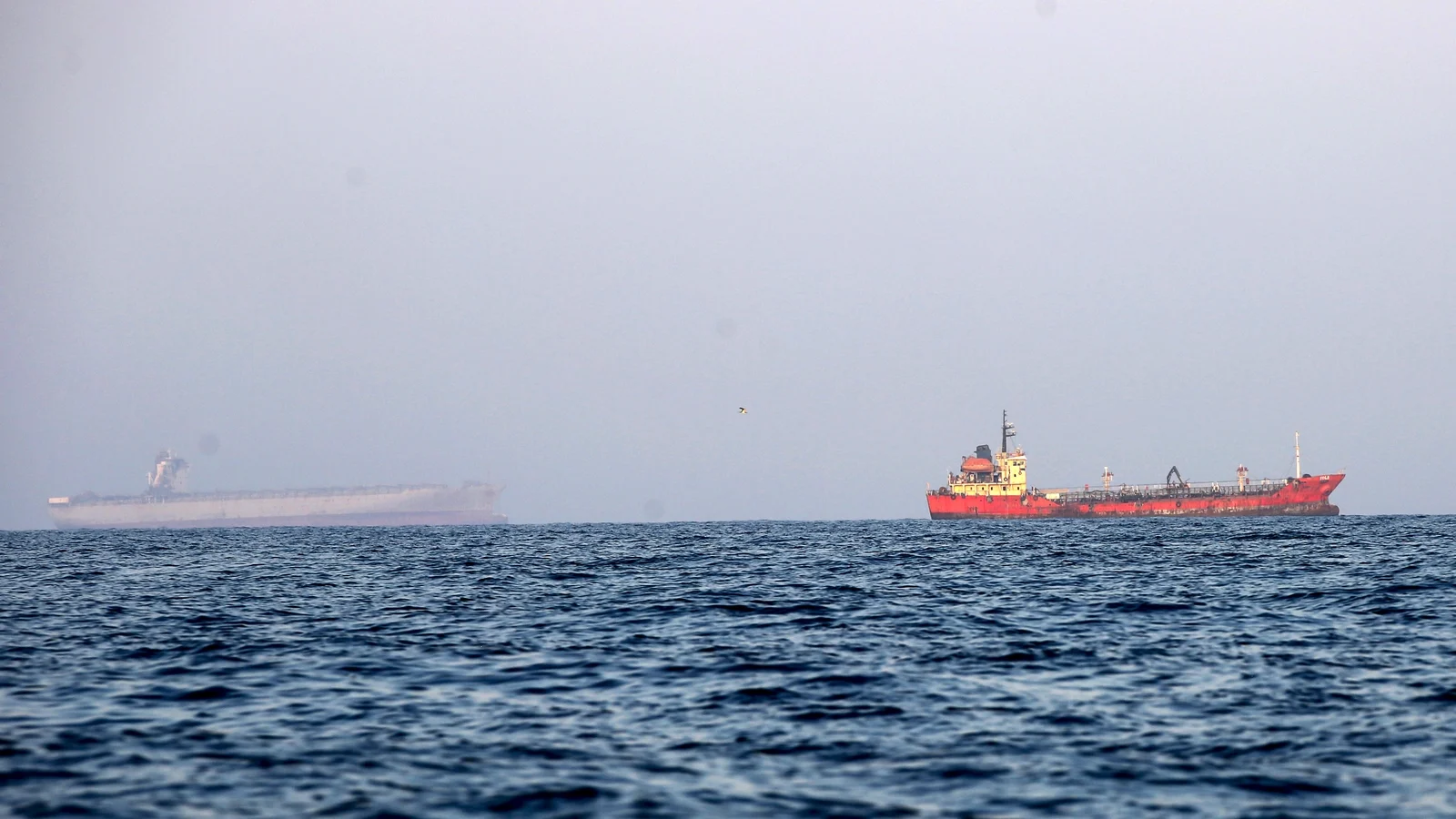
The statement said the action targeted “a giant LPG carrier named NV Sunshine, owned by NatWit,” alleging the vessel was “attempting to transit via the illegal route south of the Strait of Hormuz” when it was struck “a few hours ago.”
Earlier today, Iranian President Masoud Pezeshkian argued that any peace process would fail if pursued under coercion, saying negotiations could only succeed without “pressure and threats”.
His comments come as efforts to halt the conflict in the Middle East remain deadlocked.
Diplomatic attempts to end the seven-month war — sparked by US-Israeli strikes on Iran in February — have been mired in stalemate since the summer.
Iranians walk past an anti-Trump billboard along a street in Tehran
Washington and Tehran reached a memorandum of understanding in June outlining a framework for ending the conflict, but Iranian attacks on ships in the Strait of Hormuz led the United States to resume military operations.
More recently, indirect US-Iran discussions on the margins of the UN General Assembly failed to deliver a breakthrough.
“Dialogue holds meaning and a chance of success only when based on mutual respect and mutual commitments, and when devoid of pressure and threat,” Mr Pezeshkian said while addressing a summit of the Commonwealth of Independent States (CIS) in Turkmenistan.
“Negotiation conducted in the shadow of force is not negotiation, it is imposition and coercion,” he said, warning that sanctions on Iran would ripple across “regional trade, connectivity, energy, and order.”
Mr Pezeshkian also said talks with the United States aimed at ending the war had brought no benefit to Iran and instead preceded fresh attacks.
“With an enemy that everyday resorts to assassination, sanctions, pressure and threats, and that breaks its commitments, negotiations are meaningless,” he said.
The United States has, in recent weeks, reduced military operations in favour of economic pressure and has not struck Iran since 1 September.
The United States and Israel have said the war was necessary to prevent Iran from obtaining nuclear weapons — an ambition Iran has long denied.
Negotiating attention has increasingly centred on reopening the Strait of Hormuz, the vital Gulf shipping corridor for oil that has effectively been closed since the fighting erupted.
Putin, Pezeshkian meet
Russian President Vladimir Putin said yesterday he would “do everything” he could to help bring the war to an end, during a meeting with Mr Pezeshkian ahead of the summit, Russian media reported.
“We are ready to do everything that is in our power to contribute to the settlement of this situation,” Mr Putin said.
According to Russian news agencies, he said Iran had made “real efforts to end the war” since the US-Israeli attacks began on 28 February.
Russia’s President Vladimir Putin and Iranian President Masoud Pezeshkian hold a meeting in Turkmenbashi
Mr Putin also pointed to what he described as a “positive evolution” in ties between Moscow and Tehran.
Both nations, facing heavy Western sanctions, have deepened diplomatic and military cooperation since Russia launched its offensive in Ukraine in February 2022, with each becoming more reliant on the other.
Ukraine and Western governments have accused Iran of providing Russia with Shahed drones and short-range missiles used in strikes on Ukraine.
US media outlets have reported that Russia has supplied data to Iran for attacks on US targets in the Middle East.
“We are engaged in dialogue, but every time we negotiate with the United States, they attack again,” Mr Pezeshkian said during talks with Mr Putin, according to Iranian state media.
Iran wanted to see a “final framework” to end the war, Mr Pezeshkian said.
He also accused the United States of “trying to impose its policies and views on all countries”.
“If the United States insists on pursuing a unilateral approach, a resolution will not be possible,” he said, according to state media.
US President Donald Trump told the UN General Assembly in September that he faced a choice of whether to “annihilate” Iran if it failed to make a deal.
However, Mr Trump has since said he would not attack Iran again before the US midterm elections on 3 November, while describing “productive discussions” with the Islamic republic.
The CIS was created in 1991 as a forum for dialogue among former Soviet republics.
Several states have since exited: Georgia left after its 2008 war with Russia, Ukraine halted participation following Russia’s 2014 annexation of Crimea, and Moldova departed in 2023 as it sought closer ties with the European Union.
The summit is taking place as diplomatic initiatives aimed at resolving Russia’s war in Ukraine also appear stuck, with both sides stepping up attacks.