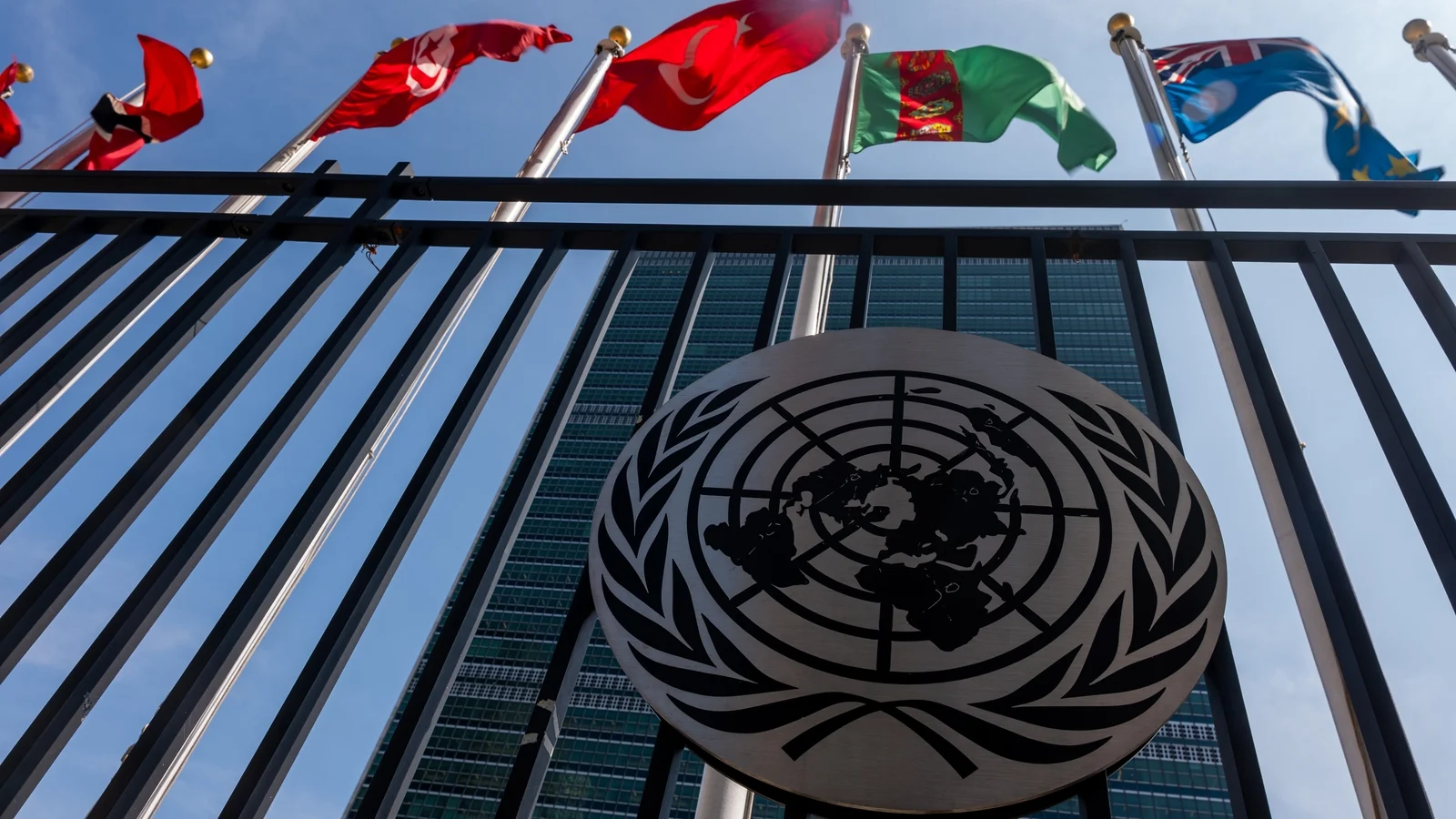
As war rages on multiple fronts and diplomatic fault lines widen, world leaders are heading to New York this week for the 81st United Nations General Assembly, with the organisation itself facing intense scrutiny and a deepening cash crunch.
The UN has warned that the world is now confronting more than 120 conflicts, even as it struggles with a serious funding crisis of its own.
UN Secretary-General António Guterres sounded the alarm earlier this year, saying the organisation was facing “imminent financial collapse”.
The Taoiseach and senior Government ministers, including Foreign Affairs Minister Helen McEntee, will travel to New York for a packed programme of meetings and events.
Micheál Martin will be among nearly 130 heads of state and government attending High-Level Week.
Across the week, leaders are expected to step up to the podium for national statements that typically outline each country’s international priorities and diplomatic red lines.
Micheál Martin will be one of nearly 130 heads of state and government attending
This annual assembly of presidents, prime ministers and senior officials is taking place amid war and instability in the Middle East, the continuing war in Ukraine and renewed debate about the United Nations’ role, relevance and capacity to act.
One of the main diplomatic flashpoints will be the conflict between the US and Iran, with attention on its knock-on effects for regional stability, the humanitarian toll and concerns around shipping routes and energy security.
Focus will also fall on the Iranian delegation — including President Masoud Pezeshkian and Foreign Minister Abbas Araghchi — who have been granted US visas to attend.
Observers will be watching closely for any opening for engagement with the Americans, and for signs of efforts to ease pressure on the Strait of Hormuz and de-escalate tensions between Washington and Tehran.
For Ireland, the week carries particular political weight as the country holds the Presidency of the Council of the European Union, increasing the Irish Government’s diplomatic visibility.
Irish-led events are expected to centre on the Middle East and Ukraine, while Dublin also plans to underscore its support for the United Nations system at a moment when the organisation’s authority and effectiveness are under strain.
That message is set to extend to the broader multilateral architecture, including bodies such as the International Criminal Court, and the humanitarian system, which is facing rising demand alongside reduced funding.
Ireland’s appearance at UNGA follows US President Donald Trump’s visit last week, during which the Irish Government showcased internationally how it manages its close relationship with Washington.
Before the Taoiseach delivers Ireland’s statement to the General Assembly on Thursday evening, the Government will again be required to balance ties with Washington, London and Brussels, as issues from trade to foreign policy press in from multiple directions.
Ireland’s participation comes off the back of US President Donald Trump’s visit to last week
The volatility in relations between the EU and the Trump administration was thrown into sharper relief this week when President Trump threatened to impose further tariffs on the European Union — shortly after announcing the removal of tariffs on Irish whiskey in Doonbeg, Co Clare.
Attention is also expected to turn to President Donald Trump’s anticipated first meeting with British Prime Minister Andy Burnham, as strains grow within the so-called “special US/UK relationship” on topics including migration, energy and President Trump’s recent headline-grabbing comments about a United Ireland.
Another issue looming over UNGA is the endgame for the United Nations Interim Force in Lebanon (UNIFIL), long a defining element of Ireland’s overseas peacekeeping contribution.
The UN Security Council has decided that UNIFIL’s mandate will end on 31 December 2026, with a withdrawal planned over the following year.
European and Arab military chiefs met in Paris last week to consider the approaching close of the mission and what might follow, amid concerns about renewed attacks in southern Lebanon.
While discussions in New York may explore what comes next, the Taoiseach has said any Irish role in a post-UNIFIL force would require a UN Security Council mandate.
The UN Security Council has decided that UNIFIL’s mandate will end on 31 December 2026
Underlying many of the conversations is the shifting balance inside the UN itself, financially and operationally.
This year’s theme reflects that debate: “Restoring Trust, Managing Transformation: A United Nations That Delivers for All”.
It also comes as the process to choose António Guterres’s successor begins, with the next Secretary-General due to take office in 2027.
For the UN, the week will serve as a measure of whether it can still deliver in a world that is increasingly fractured.
For Ireland, it will be a tightly choreographed stretch of diplomacy on several fronts — and a test of how it navigates competing relationships.