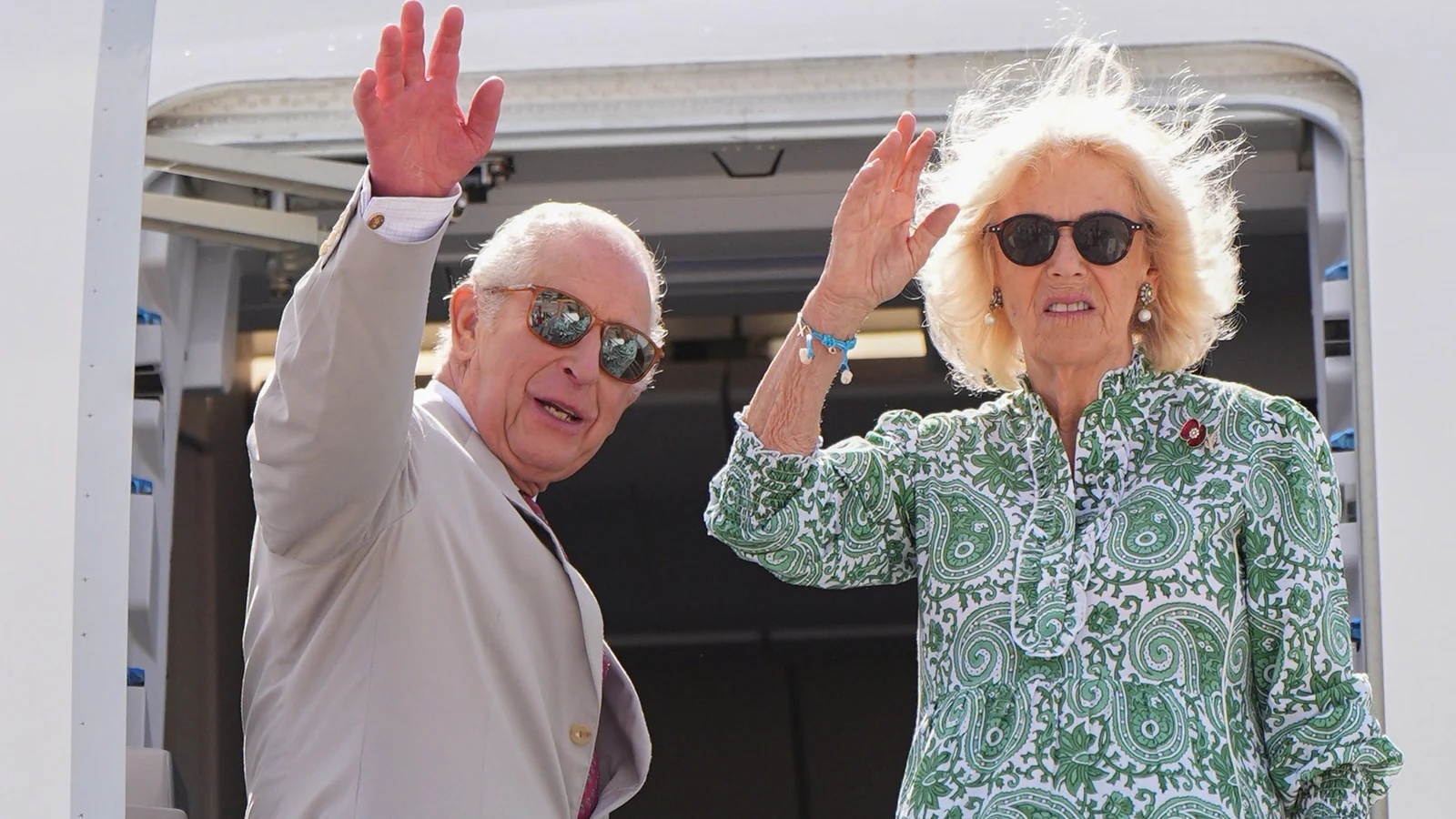
A global political drama may have dominated headlines after the Republican Party’s epic defeat in the US midterm elections, but in Britain a slower-burning controversy pushed its way back into view — helped along by the combined presence of Britain’s King Charles and Prime Minster Andy Burnham.
At the heart of it is a growing campaign within the Commonwealth — the grouping of many former British empire territories — demanding a formal apology and reparations for slavery.
The UK government signalled it was open to an apology, said it was boosting the money it directs to some Commonwealth states, and indicated it would consider proposals such as access to third-level education in Britain for certain Commonwealth citizens, specifically those from the Caribbean.
Yet the pressure for reparations has not eased.
For Ireland, the debate carries an awkward edge.
During the era of the “Atlantic Trade”, Ireland was part of Britain — and Irish people, too, benefited from slavery.
That is not guesswork; it is documented in the mechanism Britain used to end slavery — not by repression, but through a taxpayer-funded buyout.
Because it was a formal financial operation, it produced an extensive paper trail: a database, essentially, recording those who sought compensation and those who received it — the beneficial owners of 800,000 enslaved people in Britain’s colonies.
Britain’s King Charles III delivers a speech next to Antigua and Barbuda’s Prime Minister Gaston Browne
Among them was Christopher Owens of Co Cork, who received £1,704, 3s, 11d for 127 enslaved people owned by his aunt in Antigua; he was her executor.
Owens was also a steam-shipping pioneer. Along with his partner Michael O’Brien, he built the City of Cork, a wooden paddle steamer, in 1815 — the year Napoleon was defeated.
A searchable database of claims, created by University College London, indicates that roughly 30,000 enslaved people were owned in some form by Irish-born or Irish-resident individuals. Collectively, those claimants sought almost one million pounds under the compensation scheme.
The UK government paid Irish claimants about £800,000.
Not every application succeeded. Some were rejected where enslaved people had been mortgaged — borrowed against as assets — meaning claimants were, in effect, trying to be paid twice for the same individuals.
One unsuccessful claimant was John Burke of Tuam, Co Galway, whose £61 bid for two enslaved people failed.
In total, the British government set aside £20m for slave-owner compensation in 1833.
That liability was bundled into the same bond issuance used to deal with the massive Napoleonic War debt, as a share of GDP.
It represented, by far, the largest debt accumulation the British state had ever taken on. War spending in Ireland produced the biggest building boom in the country’s history before the Celtic Tiger era; when that spending stopped, a deep recession began in 1816.
Those bonds, known as consols, were finally cleared by a Conservative government in 2015 — the bicentenary of the Battle of Waterloo.
The final bill was £300m, a fraction of Britain’s overall budget and less than the annual profit of Ireland’s National Treasury Management Agency.
It stands as a textbook case in long-term debt management: a fortune when created, a trifle by the time it was extinguished.
By one estimate, the original £20m slavery compensation package equates to about £1.6 billion (€1.9 billion) today.
Even so, in an age when a relatively small country such as Ireland can allocate €2.4bn to a children’s hospital, £1.6bn would not stretch far if intended as reparations for the descendants of Britain’s Atlantic slave trade.
That reality helps explain why the UK government has explored other forms of redress — scholarships, for example, or measures aimed at easing the debt burden of Caribbean nations.
And the broader context has shifted dramatically.
Opposition Conservative leader Kemi Badenoch has been strident in her opposition to the notion
In 1833, Britain sat at the centre of European colonial power, expanding influence through trade, purchase, sale and, at times, invasion — building the largest empire the world had seen.
Investors and financiers were willing to lend, confident the state would ensure someone, somewhere, would do the work necessary to service the debt and interest.
Modern Britain operates under different constraints: it must rely on its own economy, while markets remain wary of extending more credit to a country already carrying high debt.
In Westminster politics now, reducing the debt ratio is the driving ambition — not piling on borrowing to fund anything, even defence, let alone an open-ended reparations programme.
Opposition Conservative leader Kemi Badenoch has been among the most forceful critics, arguing that Mr Burnham’s flirtation with a formal apology made Britain look “weak”.
Speaking as a politician of Nigerian heritage, Badenoch posed a challenge few other Conservatives could credibly voice: “If Caribbean countries are asking Britain for a formal apology for Britain’s role in the transatlantic slave trade, will they also be asking the same of the descendants of African kingdoms, rulers and merchants who captured, sold and profited from the trade?”
If reparations claims widen beyond Britain alone, Ireland could be drawn in — not least because the UCL database provides a detailed map of historical involvement.
For now, the Irish State’s financial link to slavery remains relatively modest: a few million euro in public spending, via the State and its agencies, supporting an annual festival that draws international attention to Ireland’s slaveholding past.
Ireland’s history, of course, includes slavery long before the Atlantic trade. St Patrick was kidnapped by Irish raiders from his family settlement in Britain and sold into slavery.
In ancient Gaelic society, slave owning was commonplace, as it was across much of the world.
The practice of Irish people enslaving each other for profit continued into the Viking era, when foreign raiders took control of the trade.
Britain’s King Charles III (front, centre) stands next to Antigua and Barbuda’s Prime Minister Gaston Browne (Centre, L) and Commonwealth Secretary-General Hon. Shirley Botchwey (Centre, R) and other heads of state
By around the 10th century, Dublin had become one of the biggest — some argue the biggest — slave markets in western Europe.
Thralls — from the Old Norse term for enslaved people — were seized in Ireland, Scotland and Wales and sold widely to whoever could pay.
Iceland, according to some estimates, was at one point as much as 40% populated by Irish slaves, with women particularly sought after.
The Normans ended the Viking/Irish slave trade, though enslavement did not disappear entirely.
In 1630, Baltimore in Co Cork was attacked by African slavers — Barbary pirates — who carried off 230 captives to be sold in the slave markets of Algeria.
Two or three, it is said, later made their way back to Ireland.
During the Cromwellian era, Irish prisoners of war were transported in large numbers to Barbados to labour on plantations, followed by other indentured servants.
Irish people profited by shipping these captives to the Americas on behalf of the protectorate and the commercial interests that financed it.
High mortality among white labourers on tropical plantations helped spur a shift towards enslaved Africans — and the Atlantic trade took shape.
Liverpool and Bristol amassed fortunes, as did London.
But Co Cork also saw a number of slave expeditions depart for west Africa and then on to the Caribbean.
Irish merchants gained from provisioning such voyages.
Irish sailors crewed — and in some cases captained — slave ships.
Some made substantial wealth from trafficking in human beings.
And many more benefited indirectly, even without direct involvement.
Charleston’s Hibernian Hall is a short stroll from the main slave market, now a museum
By the 18th century, slave ownership had begun to resemble a modern investment boom, with shareholding structures distancing owners from the brutality of whips and shackles.
In the way investors today can profit from artificial intelligence without understanding the technology, people could live in 18th century Cork or Galway and own enslaved people in the Caribbean they never saw, through shares in slave-owning entities such as the Royal Africa Company or smaller ventures created to finance voyages — taking captive Africans from west African ports to sugar plantations in the Caribbean and to American ports, especially Charleston, South Carolina, where close to half of all enslaved people imported into the United States were landed.
Charleston’s wealth was built on the Atlantic trade, including profits that flowed to its Irish residents.
Hibernian Hall — one of the city’s landmark buildings — stands a short walk from the main slave market, now preserved as a museum.
The hall later hosted the doomed Democratic Party National Convention of 1860, where a party split over slavery failed to unite behind a single candidate to oppose Abraham Lincoln of the newly formed, anti-slavery Republican Party.
The first shots of the US Civil War were fired at Fort Sumpter, guarding Charleston harbour.
Today the city stages one of the oldest and largest St Patrick’s Day celebrations in the United States.
An Irish Government minster often attends.
Britain’s parliament abolished slavery in the British Caribbean, Mauritius and the Cape colony in South Africa in 1833
Reparations are also fiercely contested in the US, though typically framed in uniquely American terms.
There, reparations tend to mean an internal wealth transfer — most likely from federal taxpayers — to the descendants of enslaved people taken from Africa.
The issue has been pulled into the broader “culture wars” that have shaped American politics for decades, adding another layer of conflict to an already volatile debate.
In Britain’s case, parliament abolished slavery in the British Caribbean, Mauritius and the Cape colony in South Africa in 1833.
The slave trade itself had been outlawed in 1807, barring ships owned by British or Irish individuals or companies from trading enslaved people.
Even so, emancipation took another 26 years.
Under the negotiated settlement, parliament awarded £20m in compensation to former slave owners — funded by British taxpayers.
Those records, compiled by the Slave Compensation Commission established to distribute the £20m, amount to a near-complete census of slave ownership across the British Empire in 1833.
They include figures such as Galway merchant Thomas Hynes, whose executors received £2,928 from the taxpayer for 150 enslaved people held in Jamaica.
But turning that history into a workable reparations system raises daunting questions: who should receive payments — descendants of those taken from Africa — and who should fund them — descendants of those who profited from transporting and exploiting enslaved labour in the Caribbean and American colonies?
Even tracing families to the present day would be a monumental task, and separating intergenerational wealth into neat shares is notoriously difficult.
Consider Simeon Henry Hardy Junior, who kept homes in Cobh and at No 15 Fitzwilliam Square, Dublin.
He received £269 in compensation for 13 enslaved people — but the compensation entry captures only a portion of the commercial web.
His father, a merchant and ship owner from Cork, travelled to Martinique in 1796, married Mary O’Brien — the daughter of a business partner — and returned to Cork in 1810.
Two years later, his younger brother went to Barbados and established a business trading Irish goods for Caribbean sugar, among the era’s most valuable commodities as tea and coffee consumption surged.
Sugar, of course, depended on slave labour.
The family later shifted capital into the signature technology of the mid-19th century: railroads.
According to the UCL database, Simeon Hardy Jr invested in the following Irish rail projects:
He also relocated the family merchant enterprise to London, where it ultimately collapsed and was wound up over a 27-year liquidation that ended in 1902.
So how would compensation be extracted from a story like that? And if reparations were funded by taxpayers, which taxpayers would be chosen — British, Irish, or a mix? How would liability be divided between states whose histories are deeply intertwined?
Another example appears in the record of John Kelly, listed with an address at Newtown House, Abbeyknockmoy, Co Galway.
The property remained in his family for three generations during the 19th century.
In 2017, it was advertised for sale in the Irish Independent for €1.25m.
The UCL database notes that, in his will, Kelly — who also lived in Greencastle, Jamaica — left £4000 in trust to be invested in land “and that only” in Ireland, Scotland or the counties of York or Middlesex, for the benefit of his natural child Mary Kelly by Sarah Edwards Innis [or Innes], described as a free woman of colour from St Thomas-in-the-East.
He named as Mary Kelly’s guardians Hugh O’Connor of Dublin, his cousin Thomas Reddington of Galway, and his brother James Kelly of Gower Street.
The database states: “He left £1400 to Sarah Edwards Innes and £1000 each to his niece and nephew, Mary Taaffe and Christopher Kelly Taaffe, the children of his sister Mary, widow of Patrick Taaffe of Roscommon.
“His residuary heir was his brother James Kelly.”
James Kelly, also of Newtown House, Co Galway, received more than £6,000 through the scheme for 316 enslaved people held across two plantations in Jamaica.
That compensation appears to have fuelled later family tensions, with James Kelly leaving the Jamaica estate and £3,000 to his son — but only if he accepted it as a full settlement of his claim to the entire £6,000 compensation sum.
John Kelly may also have struck gold through investment in a London venture — the West India Dock company — which built the first modern, purpose-built dock complex in the city.
It was designed specifically for sugar, coffee, rum and timber from the West Indies — goods produced through enslaved labour and central to roughly a quarter of British trade at the time.
Once the biggest docks in the world, they were eventually overtaken by container shipping in the 1960s and 70s and closed in 1980.
The site later underwent another transformation: it became Canary Wharf, London’s skyscraper-lined financial district.
King Charles III attends the annual Independence Ceremonial Parade at Sir Vivian Richards Stadium
Irish construction firm Ballymore has played a role in developing several residential towers there, continuing an Irish connection to land shaped by wealth from the West Indies trade.
David Olusoga, a British historian specialising in this history, argues reparations are justified because Britain accumulated lasting wealth from the Atlantic slave trade, including in ways illustrated by cases such as these.
He also points to a blunt precedent: reparations, in one form, were already paid — to slave owners.
Olusoga estimates the current value of the compensation paid to slave owners at about £16bn.
Measured as a share of GDP, the £20m provided in 1833 amounted to roughly 5% — implying a value in today’s far larger economy of somewhere north of £100bn.
It is a huge figure — and it assumes that matching cash between enslavers and the enslaved is an adequate response.
Set aside, for a moment, the question of how recipients might spend any funds and focus instead on how such a cost might be shared.
Newspaper report on King Charles III’s speech at the Commonwealth Heads Of Government Meeting
That, in particular, raises the issue of whether — and how, and to what degree — Ireland could find itself “on the hook”.
Membership of the British empire, and later the United Kingdom, carried heavy costs for Ireland.
But it also brought financial upside for some Irish people, directly and indirectly, including through slavery-linked commerce.
The legacy remains visible.
Dublin’s 18th-century boom — when it ranked among Europe’s ten largest cities — coincided with the high-water mark of the Atlantic slave trade and the returns from sugar and tobacco plantations in the Americas.
So where does responsibility land? Should Ireland be considering contributions? Or should it seek compensation from Algeria or Norway for Irish people enslaved there? What about prisoners of war and indentured servants transported to the Americas?
Who, ultimately, owes what for slavery — or is the more practical path to draw a line under historic accounting and focus on development models that can assist Caribbean states in particular, and that remain affordable not only for Britain but also for Spain and the Netherlands?
And if such approaches emerge, might Ireland make a modest contribution — or claim exemption on the basis that it, too, was a British colony?
Then again, so were the 13 colonies that became the United States.
Complicated.
The next Commonwealth Heads of Government meeting is due in two years.
Expect the reparations argument to return — and to do so loudly — as that gathering approaches.
It’s head-wrenchingly complex stuff.
No wonder it was overtaken in the daily news agenda here by the US elections and Russel Brand’s rape conviction.
They end with clear outcomes.