A tentative plan to shift control of parts of southern Lebanon from Israeli troops to the Lebanese army is now on the table, as Israel and Lebanon weigh a US-backed proposal aimed at easing tensions after months of cross-border war.
Officials on both sides said the idea—described as a pilot project—has surfaced during the latest round of Israeli-Lebanese discussions taking place in Washington.
Israel’s ambassador to the United Nations, Danny Danon, told reporters in New York that Israel is considering turning over some of the Lebanese territory it currently holds to Lebanon’s military.
“Eventually, we want to pull back to the river and to allow the Lebanese military to take over those positions,” said Mr Danon, referring to the Litani River about 30 km north of the border with Israel.
The remarks come even as Israeli Defence Minister Israel Katz insists the United States has not pressed Israel to withdraw from southern Lebanon—an outcome Lebanon has set as a condition in the ongoing ceasefire negotiations.
“We have announced that in any case we are not withdrawing and as of this moment – and this is a diplomatic achievement – there is no American demand for Israel to withdraw from Lebanon,” Mr Katz said in an interview at a convention of local leaders in Tel Aviv.
Asked whether Israel would comply if Washington did make such a request, Mr Katz said he conveyed to US Defence Secretary Pete Hegseth—and Israeli Prime Minister Benjamin Netanyahu told US President Donald Trump—that Israeli forces remain in place because “we are there to protect the residents of the north” of Israel.
As a fifth round of Israel-Lebanon talks opened in Washington on Tuesday, Lebanese President Joseph Aoun restated his rejection of Israel’s occupation of the south and of foreign interference in Lebanon’s affairs—an apparent reference to Hezbollah’s backer, Iran.
Tehran has also repeated its position that stability in Lebanon is a core element of any definitive agreement with Washington intended to bring the wider Middle East war to an end.
Washington and Tehran signed a memorandum of understanding last week aimed at reaching a permanent settlement between the two countries, following the war launched by the US and Israel on Iran on 28 February.
Hezbollah drew Lebanon into the Middle East war on 2 March with rocket fire at Israel to avenge the killing of Iran’s supreme leader in US-Israeli strikes.
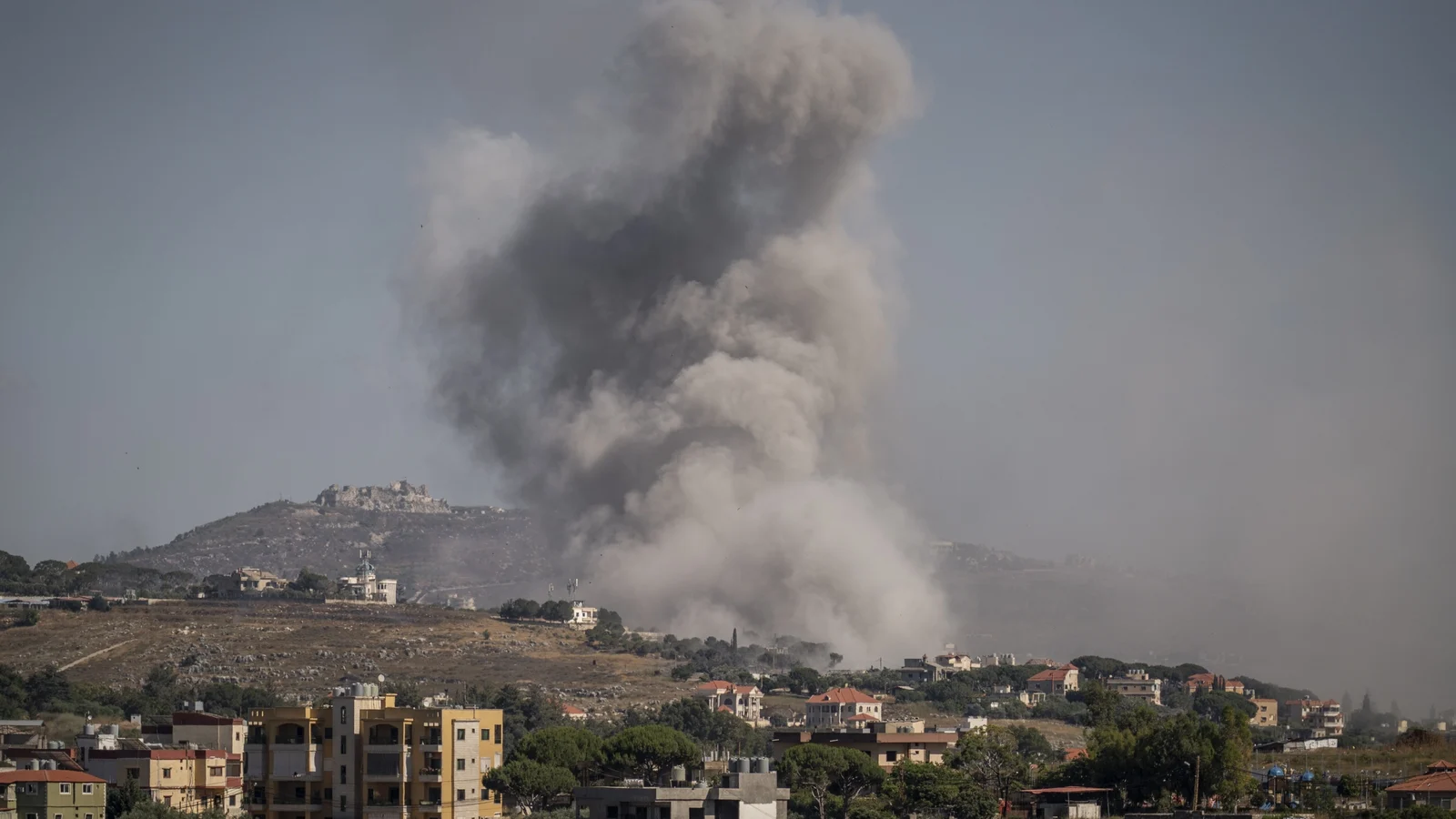
Israel responded with airstrikes and a ground offensive that Lebanon says have killed more than 4,100 people, which led to the occupation of a 10-kilometre security zone in southern Lebanon along the border with Israel.
Hezbollah accuses Israel of ‘blatant violation’ of ceasefire
On Monday, Mr Netanyahu said Israeli forces in Lebanon retained “full freedom of action to thwart any direct or developing threat”.
Israel and Lebanon are currently involved in a US-mediated round of talks in Washington to seek a diplomatic solution to the conflict and the disarmament of Hezbollah and the withdrawal of Israeli troops.
Despite this, Lebanese security and medical sources told Reuters that an Israeli drone strike on a car in southern Lebanon has killed at least two people.
Hezbollah accused Israel of a new ceasefire “violation” after the attack, which came a day after two people died in Israeli gunfire.
“For the second time in less than 48 hours, the Israeli enemy army deliberately targeted Lebanese citizens who were inspecting their homes” near the town of Kfar Rumman, the Iran-backed group said in a statement.
Hezbollah said it “reiterates that the enemy’s actions constitute a blatant violation of the ceasefire to which it has adhered thus far, and that it is monitoring and documenting these violations”.
Nuclear inspections
Meanwhile, the head of the United Nations nuclear watchdog said inspections at Iranian atomic sites were inevitable, though he declined to put a date on when they would begin.
The preliminary deal agreed by Iran and the US with the aim of ending the Middle East war cited the involvement of International Atomic Energy Agency (IAEA) in next steps on Tehran’s programme.
IAEA chief Rafael Grossi told reporters during a visit to Japan that the agreement “explicitly” states “nuclear activities that are going to be carried out with regards to nuclear material facilities will be supervised by the IAEA”.
“Obviously, to do that, we will have to inspect,” Mr Grossi said.
Talks continue over where and when any inspections would take place, with a decision expected soon “in collaboration and in cooperation with the government of Iran”, he said.
“Whether this happens today, after tomorrow, or in one week, or in 10 days, it’s important but not essential. This is going to happen.”
Iran said yesterday that the nuclear watchdog would not be allowed to inspect sites bombed by the United States and Israel last year, rejecting Vice President JD Vance’s claim that Tehran had agreed to allow inspectors there.
Mr Trump, meanwhile, said that Iran had “fully and completely agreed” to allow nuclear inspectors to return to the country.
However, the Iranian official overseeing technical discussions in negotiations with the US reiterated today that no agreement had been reached on IAEA inspections.
Iran has “no plans to grant access to the targeted facilities or to nuclear materials”, Deputy Foreign Minister Kazem Gharibabadi said, referring to sites attacked by US and Israeli forces.
Mr Gharibabadi also said Iran had refused to meet with Mr Grossi in Switzerland despite his requests.
Since US-Israeli bombardments in June 2025, uncertainty has surrounded the status of hundreds of kilogrammes of Iran’s highly enriched uranium stockpiles.
Iran has consistently denied seeking to acquire an atomic bomb, while remaining adamant about its right to operate a full-scale civilian nuclear programme.
Under a law passed by the Iranian parliament in the wake of last year’s 12-day war, Tehran suspended cooperation with the IAEA in July.
However, Iran agreed in September to allow inspectors to return after settling on a new framework, and IAEA officials have visited the country in recent months, including a visit to the Bushehr nuclear power plant early this month. Yet, inspectors were denied access to the bombed sites.
‘Declaration of America’s defeat’
Iran has portrayed the deal to end the Middle East war as “a declaration of America’s defeat”, as the top US diplomat renewed Washington’s pledge to safeguard UAE security during a tour of the Gulf.
The US and Iran signed the agreement last week and launched a process aimed at reaching a permanent settlement – with the Islamic republic’s leadership transformed but the system of rule firmly in place.
“The Islamabad understanding was not the result of pressure and coercion, but rather the result of the resistance and authority of the brave Iranian nation,” Iran’s top negotiator Mohammad Bagher Ghalibaf has said of the deal, which was finalised through Pakistan’s mediation.
“That is why, the Islamabad Memorandum of Understanding became a declaration of America’s defeat,” he said, adding that security in the Middle East must be ensured by the countries of the region.
The US maintains troops in military bases across the Middle East, notably in the Gulf where US Secretary of State Marco Rubio kicked off a tour on Wednesday in a bid to reassure allies.
Mending ties
Qatar’s Prime Minister Sheikh Mohammed bin Abdulrahman Al Thani has travelled to Oman to initiate talks between the Gulf states, Iraq and Iran on the Strait of Hormuz, a diplomat briefed on the discussions told AFP.
“The Qatari prime minister travelled to Muscat in preparation for talks between Iran, the Gulf nations and Iraq on the operation of the Strait of Hormuz,” the diplomat told AFP, saying the discussions were separate from US-Iran negotiations.
A separate summit was also expected between the Gulf countries and potentially with other regional neighbours with Iran to mend ties in Saudi Arabia.
The Strait of Hormuz, through which roughly 20 percent of the world’s crude oil and liquefied natural gas normally transits, was closed by Iran after it came under fire from the United States and Israel at the end of February.
But Iran has lifted its blockade as part of an accord signed with the US last week which extended an ongoing ceasefire by 60 days and set in place a Memorandum of Understanding aimed at permanently ending the war.
Under the 14-point MOU, Iran and Oman, which border Hormuz, must hold talks “to define the future administration and maritime services” in the key waterway with other Gulf states.
The diplomat explained Gulf countries would push for freedom of navigation through the strait and no imposition of fees for transit while Iran was expected to ask for an environmental and security service fee for crossing the vital waterway.
Pakistan, which has mediated US-Iran talks alongside Qatar, was also expected to be involved in the regional Hormuz discussions.
The separate talks on reconciliation between Gulf countries and Iran expected in Riyadh could also include other regional neighbours, the diplomat said, without specifying a date for the summit.