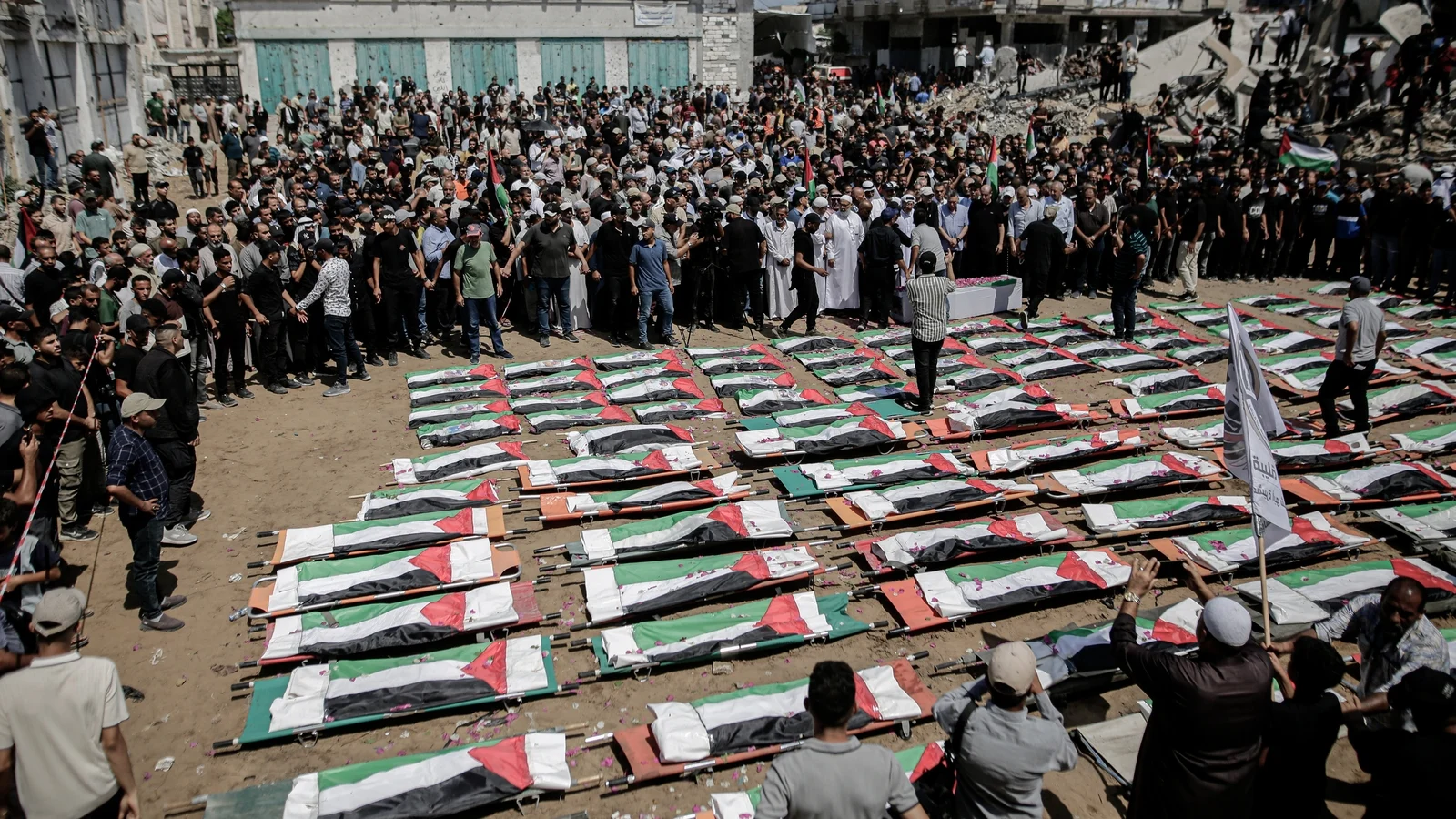
Under a stripped-bare patch of ground in Gaza City, flanked by buildings shattered by airstrikes, rows of Palestinian flags were set out carefully over the remains of dozens of people brought together for burial.
Hundreds gathered for the funeral ceremony as music played from speakers at the site where Israeli strikes in late 2023 killed the 112 people now recovered from the rubble, according to Gaza’s civil defence.
Ahmed Abu Sharia, who belongs to the extended family of those being buried, said the long-delayed funeral would finally give relatives a measure of closure.
“We came to mourn our martyrs, children, women and the elderly,” he said.
“This is a funeral for the Palestinian people, because they are victims. People are under the rubble, and they did not fight or bear weapons,” he added.
The war was ignited after Palestinian militant group Hamas launched an attack on Israel on 7 October 2023 that killed 1,221 people, according to an AFP tally based on official Israeli figures.
Militants also took 251 hostages to Gaza.
Israel’s retaliatory military campaign in Gaza has killed more than 73,000 people, according to the territory’s health ministry, which operates under Hamas authority and whose figures are considered reliable by the United Nations.
A ceasefire took hold in October, but efforts to reach a permanent end to the war have stalled, and Israeli forces now control nearly 70% of the territory.
Digging with bare hands
Civil defence spokesman Mahmoud Bassal said that 44 of the bodies recovered during two weeks in July were those of children, and that all were members of the same extended family.
“Our crews worked continuously for 17 days in an effort to recover these 112 bodies and remains from beneath the rubble,” said Mohammad Al-Mughayyir, the civil defence director of operations.
He said teams frequently had to “dig through concrete and twisted steel with their bare hands”.
“In some cases, complete skeletons remained intact, held together only by clothing.”
Mr Bassal said more than 8,000 bodies remain trapped beneath Gaza’s rubble.
Men lined up on the sand in silence for prayer during the mass funeral
Two excavators
The civil defence, which functions as a rescue force under Hamas authority, said much of the recovery effort depended on two excavators rented by the International Committee of the Red Cross (ICRC).
Pat Griffiths, an ICRC spokesman in Jerusalem, confirmed to AFP that the organisation had hired “two of the only excavators available for this work in Gaza” from the territory’s private sector to support the operation.
For years, Gaza’s civil defence and groups including the ICRC have said Israel — which controls all entry points into the Palestinian territory — has not permitted enough construction tools and heavy machinery to enter for body recovery work.
Despite the ceasefire, near-daily Israeli airstrikes and artillery fire continue to shake Gaza.
At least 1,252 Palestinians have been killed since the truce, according to the territory’s health ministry.
At the mass funeral — described as one of the largest ever organised in Gaza — men stood in a silent line on the sand to pray.
The remains lay on stretchers beneath flags, with photographs placed for those who could be identified.
Mixed with rubble
A member of the Al-Husayneh family, relatives of those being buried, told AFP he no longer expected the rest of the missing to be recovered.
“The rest of the victims’ bodies were vapourised, and their bones and flesh became mixed with the concrete rubble,” said the man, who declined to give his name for security reasons.
“Why did Israel kill so many young children? There was nothing about them that could have justified targeting them.”
The Gaza Rapid Damage and Needs Assessment, published in April by the World Bank, the EU and the UN, estimated that 68 million tonnes of rubble from destroyed or damaged buildings are scattered across Gaza.
More than 60% of Gaza’s 2.1 million residents have lost their homes in the nearly three years since the war began, the report said.
Restrictions imposed on media outlets and limited access in Gaza by Israel prevent AFP from independently verifying tolls or freely covering the violence there.