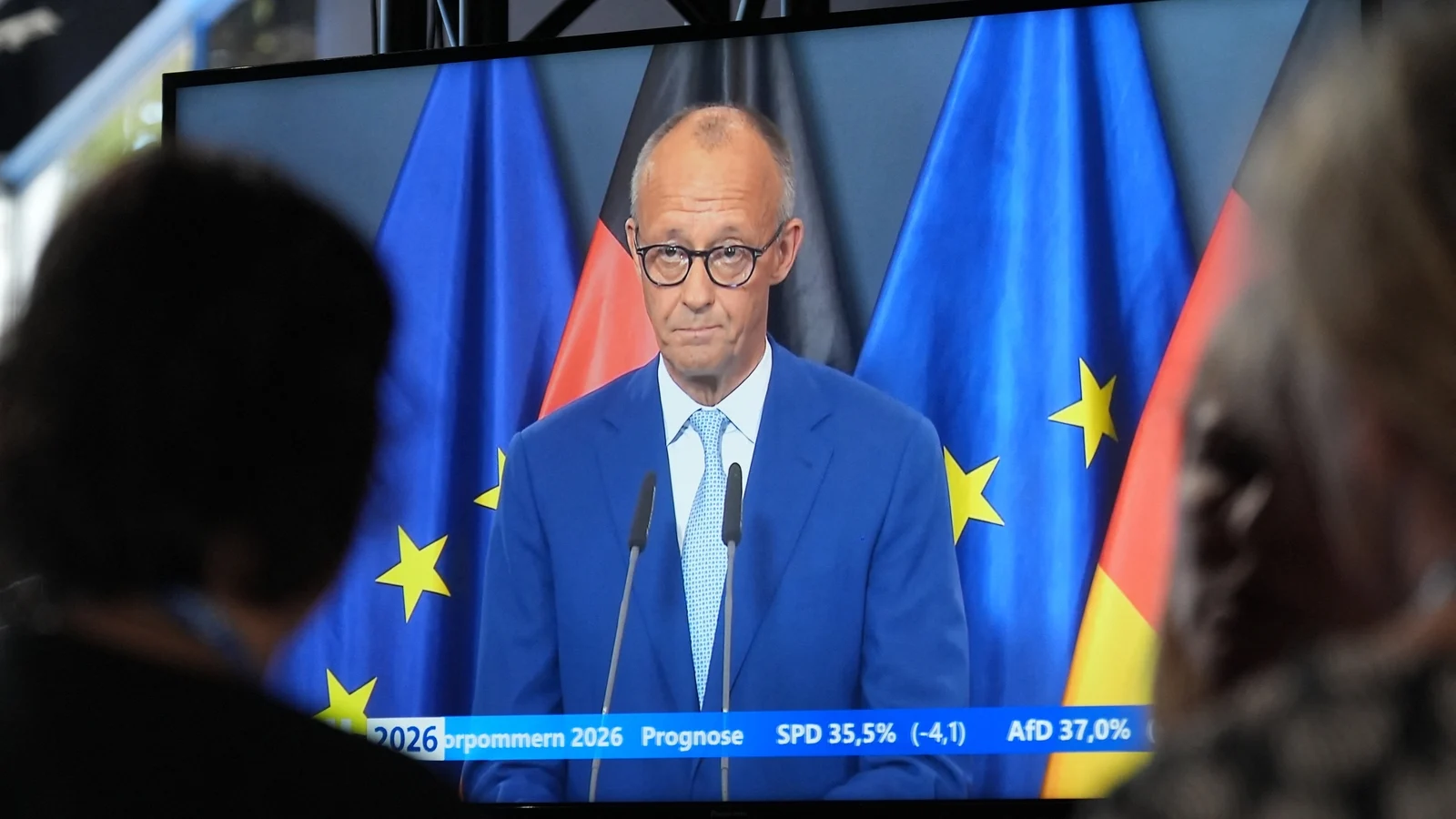
The Alternative for Germany (AfD) surged to the top in state elections in northeastern Germany on Sunday, exit polls showed — a result that also marked the worst performance for Chancellor Friedrich Merz’s conservative party in a state vote since 1949.
“It’s a disaster,” Mr Merz said after the exit polls were released, while signalling he intends to stay on as chancellor and press ahead with his reform programme, despite speculation that a heavy defeat could trigger his resignation.
In Mecklenburg-Western Pomerania, the AfD was projected to take 37%, ahead of the centre-left Social Democrats (SPD) on 35.5%, and well clear of Mr Merz’s conservatives, who were put at 5.5% — only narrowly clearing the threshold needed to enter the state parliament, according to exit polls broadcast by ARD public television.
The outcome positions the AfD for another first-place finish at state level within a month. The party leads national opinion polls, yet has remained outside government because other major parties have refused to cooperate with it.
Voters in the capital also went to the polls, where the far-left Linke party was on 24.5% and Mr Merz’s conservatives were on 20%.
Co-leader of AfD Alice Weidel (C) and AfD top candidate for Berlin Kristin Brinker (L) celebrate results
In Berlin, the AfD also improved its standing, reaching 16% in the liberal city.
The Berlin vote marked the first time the Linke led the polls in the state, where it is campaigning to nationalise housing from corporate landlords and introduce rent caps.
Merz vows to continue with reforms
Even so, the results may stop short of dealing Mr Merz a decisive political blow.
But the chancellor’s weak approval ratings, an unpopular reform drive, and the AfD’s earlier breakthrough in Saxony-Anhalt have heightened uncertainty over his political future.
In Mecklenburg-Western Pomerania, the SPD’s well-regarded state premier, Manuela Schwesig, had moved up in the polls in the run-up to election day by openly criticising both the AfD and the Merz-led federal government’s reforms.
Ms Schwesig said the AfD had also attracted support by attacking Germany’s backing for Ukraine.
She previously supported the Nord Stream pipeline project carrying Russian gas through her state into Germany — before the pipelines were blown up in 2022 — but later reversed her position.
“First, in my state, many people oppose support for Ukraine, both financial and military,” she said.
“And a second point: many people also wish to see energy flowing through Nord Stream again.”
Vice Chancellor Lars Klingbeil, who also leads the SPD, suggested the coalition should adjust course, pointing to voter anxiety over pension reforms.
Manuela Schwesig said the AfD had won votes by criticising Germany’s support for Ukraine
“As the federal government, we need to analyse why there is such great uncertainty in the country,” Mr Klingbeil told ARD.
Mr Merz, however, responded by reaffirming his reform agenda — which he argues is necessary to reignite growth in Europe’s largest economy.
“What needs to be done now requires backbone, steadfastness, and patience,” he said.
“I would go so far as to say that these reforms are the antidote to the authoritarian poison that is penetrating ever deeper into our society, driven by the allure of authoritarianism.”
The votes in Mecklenburg-Western Pomerania — a largely rural state in the formerly communist east — and Berlin follow the 6 September election in Saxony-Anhalt, where the AfD came close to the rare achievement of winning an absolute majority.
State elections in the two regions would not normally draw broad attention beyond Germany. But after the AfD’s strong showing in Saxony-Anhalt — which the party sees as a springboard toward federal elections scheduled for 2029 — the prospect of further gains has sent shock waves across Europe.
Over a little more than a decade, the party has shifted from a fringe eurosceptic force into Germany’s most popular party. It is calling for tougher action to deport foreigners without a right to remain in Germany, a restoration of energy ties with Russia, and an exit from the euro.
The exit polls highlight how far the AfD has advanced in recent years and revive questions about the so-called “firewall” — the strategy under which the other major parties rule out coalitions with it.
Merz has struggled
Merz, elected last year promising reforms to move Germany’s stagnant economy back into growth, has struggled to persuade voters. Public frustration over pension, tax and healthcare changes has been compounded by a series of communications missteps.
Discontent with his government has hung over campaigning in both Mecklenburg-Western Pomerania and Berlin, where voters have focused on pressures including high energy bills and rising housing costs.
On Friday, Mr Merz unveiled a consumer relief package that included tax cuts on gas and diesel.
In Mecklenburg-Western Pomerania, several voters said the cost of living weighed heavily on their choices.
“Here in Schwerin, with these wages, you can hardly afford anything anymore,” voter Carlotta Heick told Reuters in the state capital.
An elderly man also criticised spending on foreign aid. “We need our money here, for our country, for children and pensioners,” he said, asking not to be named.