When a Name on the Façade Changes the Music
The lights along the Kennedy Center’s limestone façade still glint off the Potomac at dusk, but the hum in the neighborhood has altered. Where seasonal crowds once gathered to trade scarves, programs and small-talk about opening nights, a different kind of conversation now threads through Foggy Bottom coffee shops and taxis: should art answer to politics, or does it have the right to walk away?
On a cold December evening, one of America’s most venerable jazz ensembles — the Cookers — quietly announced they would not perform their scheduled New Year’s Eve shows at the national performing-arts center. The reason: a name. Or, more precisely, the addition of a president’s name to an institution that many regarded as belonging to the culture of a nation rather than to any single politician.
A stage without its musicians
“Jazz was born from struggle and insists on freedom — of thought, voice, expression,” read a note from members of the septet, their words heavy with history. “We have carried that music through decades. To perform beneath a banner that redefines a national landmark feels like a contradiction we cannot accept.”
The Cookers, an all-star septet whose members are veterans of the post-bop tradition, were billed to “ignite the Terrace Theater stage with fire and soul.” Their withdrawal follows a string of departures. A Christmas Eve concert hosted by vibraphonist Chuck Redd was canceled last week; Redd told reporters the name change was the reason. New York’s Doug Varone and Dancers have also reportedly pulled out of performances in April. Each cancellation is a small fissure that, together, makes a public statement.
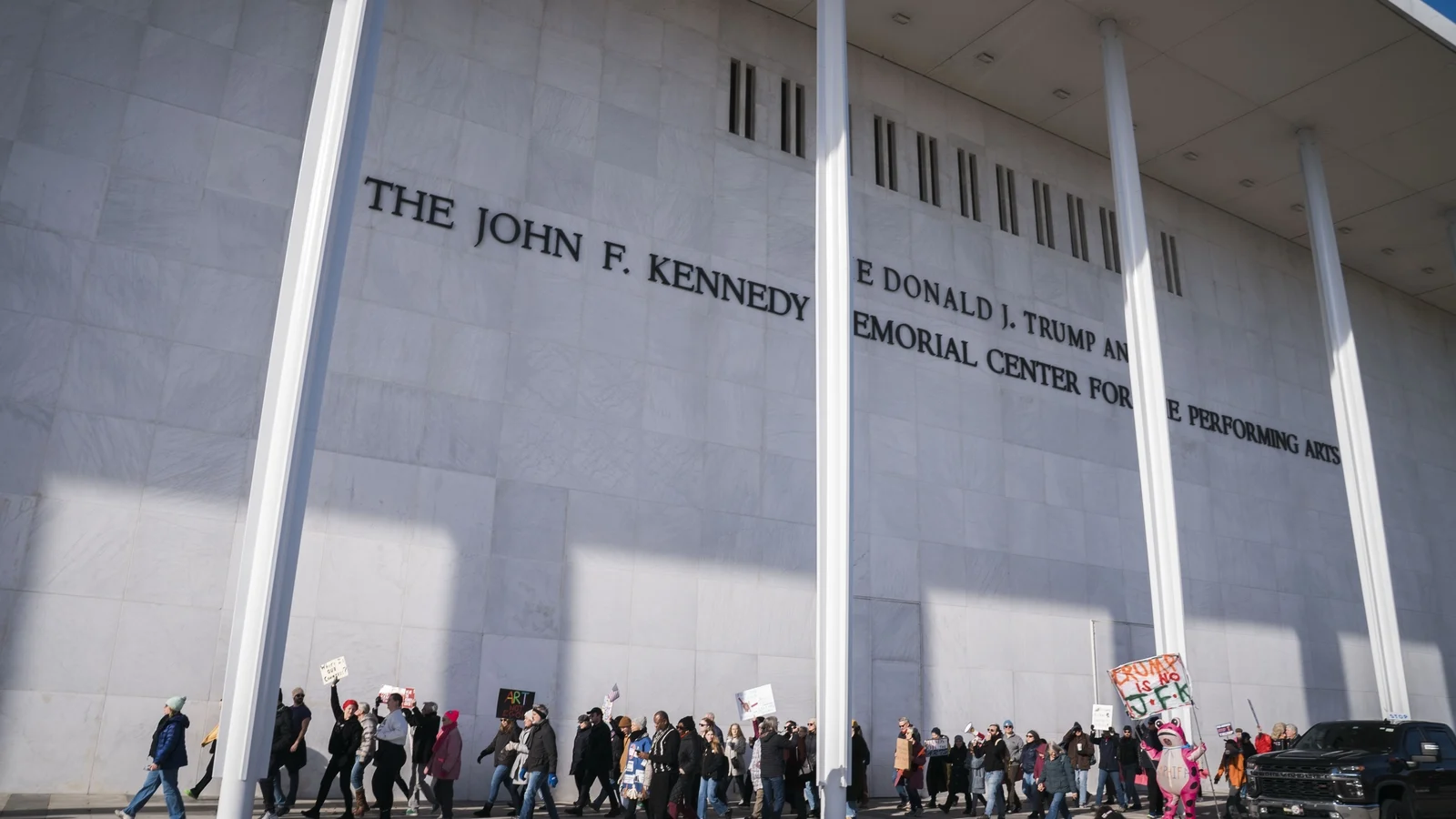
Inside the Kennedy Center’s marble and glass, work crews were pictured earlier this month affixing new signage: the board voted to rename the venue The Donald J. Trump and The John F. Kennedy Memorial Center for the Performing Arts — or, as detractors have called it, the Trump Kennedy Center.
What the naming means — and what it stings
To many Washington residents and the artists themselves, the change felt less like a rebranding than a takeover. “The Kennedy Center has hosted presidents from every party; its mission was never party-aligned,” said Maya Alvarez, who runs a small theater company in D.C. and whose troupe performs frequently at campus venues. “This suddenly feels like the institution has been weaponized.”
Democrats in Congress and cultural leaders have gone further, arguing the board’s vote was illegal. The family of John F. Kennedy publicly denounced the move as an affront to his legacy. Officials who backed the renaming say it honors a sitting president’s desire to be associated with national culture. But critics worry it sets a precedent: what becomes of public trust in cultural spaces when political names can be bolted onto them with one vote?
Richard Grenell, a longtime White House ally whom the president named president of the Kennedy Center earlier this year, dismissed the cancellations as a “political stunt.” “Art should be for all Americans,” he said in a brief statement. “We welcome back the artists who wish to continue.” That retort, however, has not soothed the simmering disquiet among musicians who feel their work is grounded in a lineage that predates any contemporary political contest.
Why musicians are walking — and why it matters
Jazz did not spring fully formed into the Terrace Theater. It emerged in the late 19th and early 20th centuries from New Orleans — from black churches, marching bands and the raw sweetness of community resilience. It is an art form that often reads its own history aloud: improvisation, call-and-response, a freedom to speak even when the world will not listen.
“When you put a name on a national venue that changes its meaning in people’s minds, you’re asking artists to tacitly endorse that meaning,” said Dr. Peter Lang, a cultural sociologist who has studied the politicization of arts institutions. “For some, that’s impossible. For others, staying seems like complicity.”
Beyond questions of principle, there are practical implications. The Kennedy Center draws roughly two million visitors a year, across performances, education programs and tours. Its calendar is a major driver of D.C.’s hospitality economy: restaurants, hotels and small businesses rely on audience traffic. When headline acts pull out, the ripple can be counted in canceled dinners and empty hotel rooms as much as in headlines.
“We had seven reservations for the evening the Cookers were supposed to play,” said Anton Yi, manager of a nearby bistro. “Now we’ve got no shows. People ask, ‘What happened?’ and I can see in their faces that this is about more than music. It takes years to rebuild that trust.”
A global echo
The dispute over a nameplate in Washington looks parochial, but it resonates globally. Around the world, cultural institutions are battlegrounds for identity: museums that confront colonialism; theaters that take stances on human rights; festivals that refuse to book artists complicit in abuses. Audiences are increasingly attentive to who sits on boards, who funds the programs, and what values inform programming decisions.
“It’s not just about Trump or the Kennedys,” said Lian Chen, director of an arts policy NGO that tracks governance in cultural institutions. “This is about transparency, independence and the conditions under which artists can create freely. When those conditions erode, other democratic values can too.”
Voices on the street
On the sidewalks outside the center, opinions collide. “I think art should be above politics,” said Robert Mills, a retired teacher who takes a yearly subscription to the Kennedy Center. “But names matter. A name signals who you’re honoring.” Across the plaza, a young trumpet player tuning up for a gig at a local jazz club said simply, “If music can’t be honest, why play?”
Community choirs and student groups that rely on the center for performance space find themselves caught between principle and opportunity. “We rehearse there,” said Carmen Soto, whose high-school chorus recently performed on the Kennedy Center’s Millennium Stage. “These places are training grounds. But we also teach our kids about civic responsibility. It’s complicated.”
What comes next?
For now, the Kennedy Center’s schedule still lists many events. But each artist’s decision carries symbolic weight. Will other ensembles follow the Cookers? Will audiences boycott? Or will pressure mount to reverse the name change, perhaps through legal challenges or new board appointments?
There are precedents for reputational damage. Cultural boycotts and withdrawals have shifted policy before — they once helped reshape museum practices around provenance and repatriation, for example. If artists and patrons coalesce here, the impact could be lasting.
Questions to sit with
As you read this from somewhere else in the world, consider the institutions in your own city: who governs them, and whose names are plastered above their doors? Do those names invite participation, reflection and critique — or do they silence it?
And for the lovers of music, theater and dance: how do you balance the desire to preserve cultural access with the imperative to stand by principles? Does the absence of a single performance change the larger conversation, or does it become the spark that reignites it?
Final notes from the plaza
The Kennedy Center façade gleams under winter lights, but the annual promise of New Year’s music feels fractious. In a country where symbols are freighted with meaning, a name is not merely a label; it is an argument. And for artists whose craft roots itself in the outspoken and the improvisatory, the choice to perform beneath that argument or to step away is both practical and profoundly ethical.
As one veteran saxophonist waiting in line for coffee put it, “We don’t want to be used as ornaments on somebody else’s banner. If music is to remain a place of truth, sometimes you have to leave the stage.”