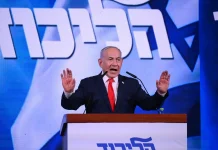
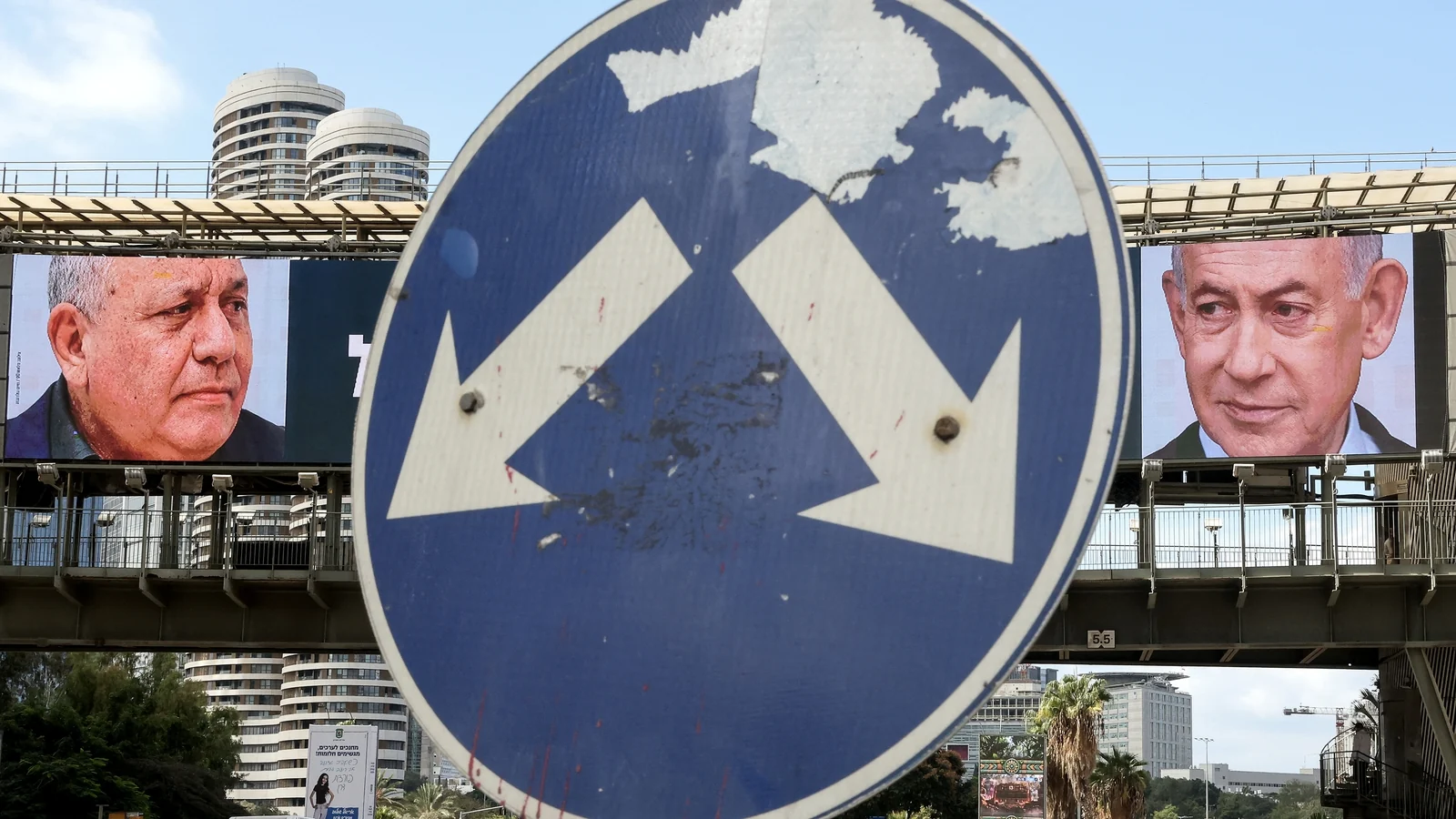
Israel woke up to an election result that looks, on paper, like a verdict on Benjamin Netanyahu — yet one that falls short of the decisive repudiation his opponents were banking on.
If the latest projections hold, Mr Netanyahu’s Likud will remain the biggest single party in the next Knesset, despite shedding between five and eight seats.
At the same time, the opposition — widely branded in Israel as the “change bloc” — appears to have edged close to parity with his right-wing camp.
For Gadi Eisenkot, however, the night brought disappointment: his Yashar party had aimed to top the table outright, a result that would have handed it a clear mandate to steer coalition talks.
Mr Eisenkot had warned repeatedly that Mr Netanyahu was angling for a tie, urging voters to ensure Yashar finished first.
The numbers now suggest that goal will not be met.
Benjamin Netanyahu has avoided heavy losses by pitching hard to the right
Few politicians have shaped Israel’s modern era like Mr Netanyahu, who has towered over national politics for three decades and served three separate stints as prime minister.
A seasoned tactician with a reputation for defying political gravity, he has built a career on surviving moments when rivals believed he was finished — and he cannot be written off until someone else is actually sworn in.
Still, the broader story only comes into focus by stepping back and looking in two directions at once: toward the far-right and toward Israel’s Arab parties.
Mr Netanyahu limited the damage this time by driving his campaign sharply rightward.
Throughout the race, he worked to ensure he was not overtaken by the far-right factions that have sat with him in government for the past four years.
By the early projections, that approach appears to have paid off.
Likud outperformed the final pre-election polls by several seats, while the parties to its right largely held their ground — and a new hard-right list led by former general Ofer Winter appears to have slipped below the threshold required to enter parliament at all.
But the strategy has had a price.
Much of Likud’s improvement came from within Mr Netanyahu’s existing base rather than by winning over his opponents.
As a result, even with Likud expected to lead the field, Mr Netanyahu and his allies on the far-right and in the ultra-Orthodox parties still fall short of the 61 seats needed to command a majority.
Gadi Eisenkot said before the election that he would not form a government with the Arab parties
The other major development is the striking rise of the Arab parties, which look set for a breakthrough — from 10 seats at the last election to as many as 17 or 18.
That would mark the strongest showing ever for Arab-led lists and reflects a surge in participation among Israel’s Arab citizens.
One exit poll indicates Arab turnout may even have exceeded that of Jewish voters.
The implications are straightforward.
Add the roughly 50 seats the “change bloc” is projected to secure to those 17 or 18 Arab seats, and there is a numerical majority opposed to Mr Netanyahu.
On those figures alone — unless he can persuade parties that promised before the vote not to work with him — Mr Netanyahu does not appear to have a clear route back to the premiership.
Viewed purely as a referendum, then, Mr Netanyahu has come out on the losing side — but by a narrow margin.
Yet the arithmetic does not settle the political reality, because opposition parties have ruled out joining a coalition with the Arab parties.
Last night, Mr Eisenkot reiterated that he would not form a government with them because they “do not meet our conditions” — above all, he said, because they do not recognise Hamas as a terrorist organisation.
There has been extensive discussion of an alternative arrangement in which the Arab parties back a government from outside — by voting for it or abstaining in the Knesset — effectively enabling a minority administration.
And Israeli politics offers many examples of leaders abandoning campaign-era red lines once the ballots are counted.
Politics, as they say, is a game of addition.
Expectations last night were that Mr Eisenkot, as head of the largest opposition party, would receive the most recommendations when President Isaac Herzog consults the factions — putting him first in line to try to assemble a coalition.
He will have four weeks to do so, with the option of a two-week extension.
Israel went into the election deeply split.
On last night’s projected outcome, it has emerged much the same — with a majority against Mr Netanyahu, but still no majority ready to govern without him.