A wave of bomb hoaxes has rattled European travel and newsrooms this week, prompting police responses from Copenhagen to Prague and forcing heightened security checks even as officials repeatedly stressed there was no danger to the public.
Police in Denmark and the Czech Republic have been investigating threats to air traffic, while a Romanian plane received a bomb threat following a string of hoaxes that have targeted flights and disrupted travel across Europe this week.
A flight from Prague to Bucharest operated by Romanian carrier Tarom received a bomb threat.
The plane landed at its intended destination, and airport administration officials said the bomb threat proved to be false.
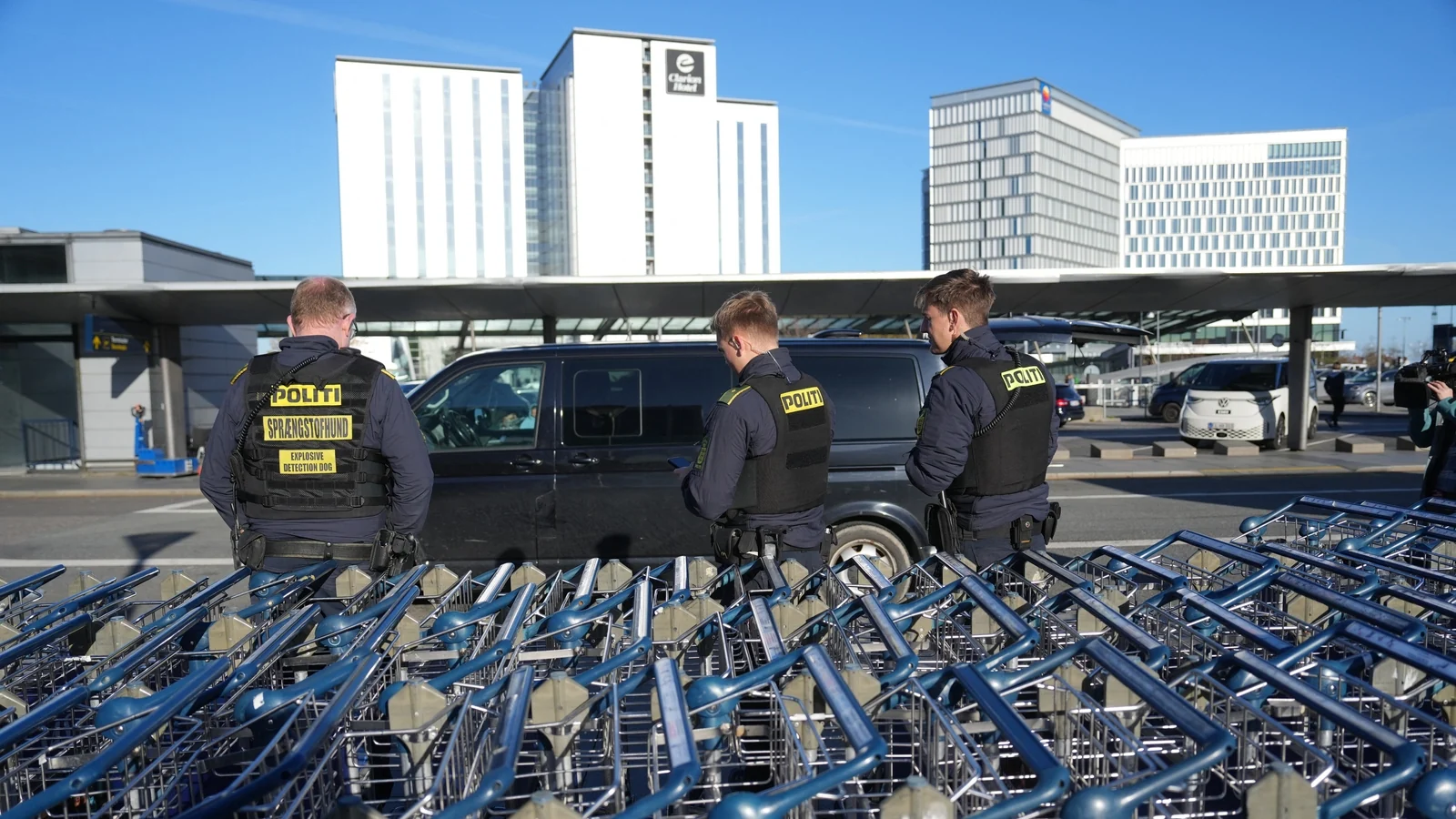
In the Danish capital, Copenhagen, police said they were present at the airport for a second consecutive day “in connection with threats directed at air traffic”.
They said their immediate assessment was that there had been no danger to passengers or to others at the airport. It added that air traffic was proceeding safely and without disruption.
Czech police also said they were again dealing with threats against planes today.
They said necessary security measures have been taken in co-operation with Prague’s Vaclav Havel Airport that have “a minimal impact on the normal operations at the airport”.
Meanwhile, RTÉ’s Donnybrook campus as well as other media outlets, were evacuated this morning after a bomb threat.
An Garda Síochána, said it was “aware of a threat made against media organisations here and in Europe”.
In Bulgaria, the newsroom at Nova TV also received a bomb threat, triggering an evacuation of offices and the suspension of programming.
Spanish Foreign Minister Jose Manuel Albares said Europe appeared to be facing “hybrid aggression and a form of psychological warfare”.
No explosive devices were found and all planes, including those threatened today, landed safely.
Security experts said yesterday that the threats might be intended to punish European nations that have armed or financed Ukraine as it resists the full-scale invasion Russia launched in 2022.
They also cautioned that other scenarios could be in play, including people planting false trails, copycat calls, or threats driven by personal grievances.
The scale of the disruption has been significant: around half a dozen flights were affected in some way on Tuesday, and more than two dozen yesterday, with some aircraft making unplanned landings and others escorted to their destinations by fighter jets.
An Italian airport authority source told Reuters that a Wizz Air WIZZ.L flight from Prague to Rome had been diverted to Venice but, despite more than a dozen hoax threats, overall there was far less direct disruption to air travel.
Even so, military aircraft were involved in some cases. Hungarian jets escorted airliners flying from Brussels to Sofia and from Prague to Bucharest and Cyprus through Hungarian airspace. Defence Minister Romulusz Ruszin-Szendi said NATO had ordered some air patrols in the area, marking the first report that the Western defence alliance had become involved.
While no country attributed blame for the threats, they come amid a wider backdrop of sabotage attacks and attempted strikes across Europe — from German electricity substations to defence-related facilities in the Baltic region, and supermarket refrigerators in France and elsewhere.
Germany blamed Russia directly for a drone attack on Leipzig airport.
Read more:
Aer Lingus plane among 27 flights hit by bomb hoaxes
Aer Lingus pilots ‘cooperated fully’ after flight diverted, says union