Few TV characters captured 1970s imaginations like Steve Austin, the crash-landed astronaut rebuilt in The Six Million Dollar Man with pricey “bionic” limbs and dispatched as a super-spy to take down villains.
The premise turned Lee Majors into a household name, stretching across 99 episodes and six TV movies — and, in celebrity folklore, even coinciding with his marriage to Farrah Fawcett.
British politics now has its own version of a “six-million-dollar man” in Nigel Farage — except there are no bionic upgrades and no Farrah Fawcett. This time, it’s simply the money.
$6.73m, to be precise — Friday night’s conversion rate for £5m.
That is the sum Farage received shortly before the 2024 UK general election from a previously little-known billionaire, Christopher Harborne, a gift that came just ahead of the election that finally delivered Farage a Westminster seat.
Yet where Steve Austin’s expensive enhancement helped him outrun trouble, Farage’s windfall appears to be dragging it closer.
He is facing mounting political and media scrutiny over the £5m payment — a spotlight that has become a wedge for wider questions about how UK politics is funded and policed.
Those questions may now draw in not only rivals and reporters, but also the Metropolitan Police, the National Cyber Security Centre and the Parliamentary Standards Commission, described by Politico as Westminster’s “anti-sleaze” unit.
The trail begins in April, when The Guardian reported that Farage had received £5m from Harborne, described as a Thailand-based cryptocurrency billionaire.
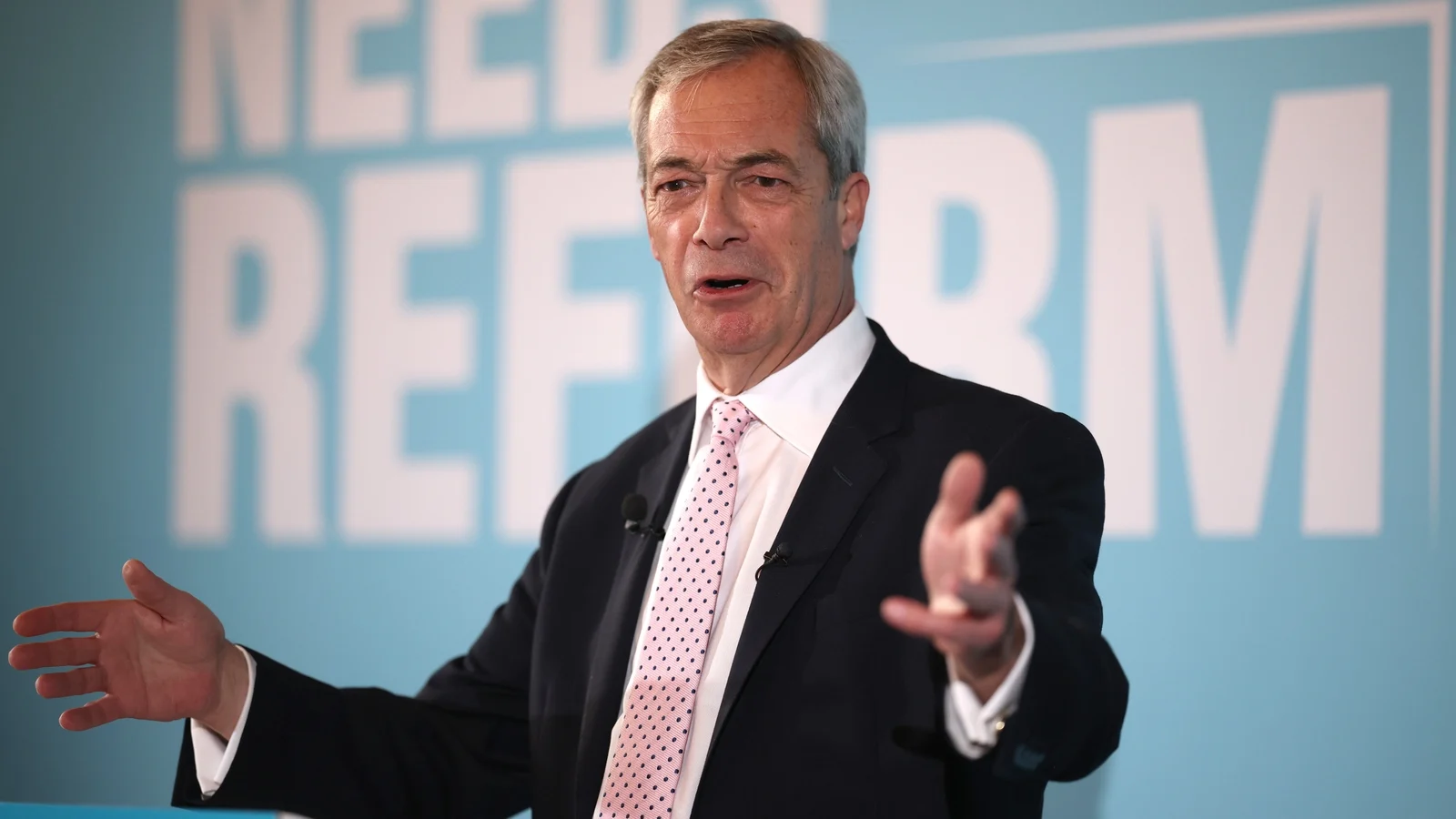
Nigel Farage said the £5m was a gift to pay for his personal security arrangements
At the time, the money was not listed in Farage’s entry in the register of MPs’ interests.
Farage argued he was not required to declare it because he was not an MP — or an active politician — when it was received. But within months he returned to frontline politics to lead the Brexit party and went on to win the Clacton seat, succeeding on his eighth attempt to enter parliament after seven previous unsuccessful runs.
Parliamentary rules say gifts received in the 12 months before an election must be declared within one month of a member being elected.
The Conservative Party referred Farage to the Parliamentary Standards Commissioner.
The commissioner, Daniel Greenberg, said in early May — after local election results were out — that he would investigate.
Farage and Harborne have maintained the £5m was a no-strings gift intended to cover Farage’s personal security costs, and Harborne said there was no expectation of anything in return.
The explanation only intensified interest in Harborne, as it quickly emerged he had also given Reform UK £9m in a single donation — making him, by a wide margin, the biggest single living donor in British politics.
That £9m was not the full picture. Other donations brought Harborne’s total support to £22.3m — around two-thirds of all the money Reform UK and its predecessor, the Brexit Party, have raised since they were created. Reform UK is structured as a private limited company with not-for-profit status.
The largest cheques landed in 2019 — the year Boris Johnson won his election victory — when Harborne gave £9.7m, and again last year, when he donated £12m. Harborne has also donated £1.6m to the Conservative Party since 2012.
In 2015, 1% of donations were for £1m or more
Transparency International UK said Harborne’s contributions fit a broader trend toward ever-larger political donations. The organisation noted that in 2015, only 1% of donations from individuals or companies reached £1m or more.
By 2024 — the most recent election year — that share had risen to 35%.
Last year also produced Britain’s highest election spending on record, at £90m — an 80% increase since 2015. Over the same period, cumulative inflation was 38%.
TI warned that if the trajectory continues, roughly half of UK political spending could come from about a dozen individuals — less than 0.00002% of voters.
Farage responded angrily to The Guardian story, implying the details of the £5m gift had surfaced through an unauthorised leak of personal information and hinting that the “deep state” was targeting him.
The attention also spurred questions about how Farage paid for a £1.4m Surrey house, purchased in cash in May 2024. Reform has said the money came from Farage’s appearance fee for the TV show I’m a celebrity get me out of here. A tax accountant’s analysis for the Financial Times challenged that account, pointing to published accounts for Farage’s media company, Thorn in the Side Ltd, which show its cash holdings rose from £300,00 in 2023 to £1.7m in 2024 after the TV appearance, and then to £2m by May 2025.
The analysis said the property was purchased by Farage personally, not by Thorn in the Side Ltd.
Russian spies
Then Farage’s public explanation shifted. In an interview with The Sun, he said the gift recognised 27 years of campaigning for Britain to leave the EU.
Former Brexit Party leader Nigel Farage poses for a photo while taking a break during a session of the European Parliament ahead of a Brexit deal back in 2020
Last weekend, he escalated matters in The Mail on Sunday, claiming hackers broke into his mobile phone and stole his data — the route, he suggested, by which information about the £5m gift became public.
“My phone was hacked by Moscow says Farage”, declared the paper’s front page, adding: “deeply concerned Reform leader claims Russian spies leaked details of £5m gift that could lead to ban from Commons”.
The report quoted a party source saying “only four people in the world knew” about the £5m, and said Farage handed his phone to unnamed “cyber security experts” who concluded that “hostile state actors almost certainly linked to Moscow” were responsible.
Farage was quoted as saying: “these actions by Russia are deeply concerning and highlight the threat they pose to British security”.
The claim immediately raised a basic question: had Farage reported the alleged hack to the UK’s counter-espionage and cyber authorities? A Reform spokesperson said the matter had been reported to the relevant authorities, adding that further comment would be inappropriate while an investigation continued.
Labour seized on the assertion. Party chair Anna Turley called on Farage to confirm he had formally reported the incident to the Metropolitan Police, which is responsible for political security, and the Nationals Cyber Security Centre, which addresses hacking and online security threats.
She said she would file the report for him if he could not confirm by Friday lunchtime that he had done so.
“Quite apart from the implications for you personally, the alleged crime is an incredibly serious one with potential wider implications for Britain’s national security, the integrity of our politics and public confidence in our democratic system,” she wrote in a letter later made public.
“Please confirm when the report was made and to which authority,” she asked.
When Friday’s deadline passed, Turley published a second letter — this time formally reporting the incident herself to the Met and the NCSC and asking whether they were already investigating.
The NCSC told the BBC it “stand ready to support with any suspected cyber incident that is reported to us”.
Tax implications?
Separately, commentators have begun probing the possible tax treatment of Harborne’s gift — including podcaster and former Conservative politician Rory Stewart, who pointed out that someone would usually need to earn about £10 million to take home £5m after tax.
Because the money from Harborne was a gift, it is tax free.
Tax Policy Associates, a non-profit tax law research group, has assessed the case using publicly available information and said it believes Farage is probably in the clear.
In their analysis they say:
“We would summarise the basic principles broadly like this
– Gifts can be subject to inheritance tax, but only if the donor is UK domiciled (or, now, long term resident) or the gift is of an asset that was in the UK.
– A gift unconnected to your work is (as a general matter) otherwise not taxable in the UK.
– If there is a connection to your work (past, present or future), and it’s strong enough, then you will be taxed on it in the same way as your work is taxed.
– If you create a document regarding the gift, then (if you are not careful) that document could make the gift taxable as a capital gain.
“Applying these to the currently-known facts of the gift to Mr Farage, in our view the gift is probably not taxable. It’s connected to Mr Farage’s historic and current political campaigning activity, and not to any trade, profession, employment or office that he carries on or holds.”
However, if the public narrative around the payment continues to shift, it could create new risks — including on the tax front.
Meanwhile, Stewart’s hit podcast The rest is Politics, co-hosted with former Labour spin doctor Alaisdair Campbell, has launched a four-part investigative series by the Observer’s Whitehall editor into Reform UK’s funding. The series includes an interview with the party’s former deputy leader Ben Habib, who has made vivid claims about Reform’s finances.
Habib, once described as the richest MEP in Strasbourg during his time there for the Brexit Party, is also noted for bringing a 2021 judicial review of the Northern Ireland Protocol alongside Jim Allister and Kate Hoey, arguing it was unconstitutional because it conflicted with the 1801 Act of Union.
With pressure tightening from multiple directions, Farage might envy the original “six-million-dollar man” and his fictional ability to escape danger — and, yes, someone online has worked out that $6m in 1973 would be worth $44m today.
Yet in modern politics, the famous line from the show’s introduction — “we have the technology, have the capability …” — is no longer the preserve of US government agencies. The money is there too, and in sums that dwarf $6m — or even $44m.
One name looms over that landscape: Elon Musk.
Nigel Farage accused Elon Musk of splitting the right-wing vote ahead of the Makerfield by-election
Musk once backed Farage, but has since cooled, unhappy as Farage moved away from anti-immigrant figure Stephen Yaxley-Lennon, better known as Tommy Robinson.
Musk instead amplified Rupert Lowe — a former Reform Party MP who was expelled over immigration around the same time Habib departed — putting his support and social media algorithm behind Lowe’s new venture.
On Friday, the Financial Times published analysis of how Musk’s backing has transformed Lowe’s online reach. Since launching his rival party Restore UK in February, Lowe has had 10 posts on X exceed 10 million views. Farage, despite having three times as many followers as Lowe, has not had a single post pass the 10 million mark.
The FT said “nine of Lowe’s posts since Restore’s launch have garnered more views than Kier Starmer’s most seen post in the same period”.
A day after Restore launched, Musk posted: “Join Rupert Lowe in Restore Britain” — a message that drew 24 million views. Musk posted seven more messages referencing Restore; all but one cleared 10 million views, according to the FT.
The surge in attention has also brought financial returns for Lowe.
According to the Register of Members Interests, Lowe has earned £72,000 from posting on X since October 2024. Farage, by comparison, has earned just over £20,000 from the platform.
But the same dynamic could come at a political cost for Farage, because it gives Restore outsized visibility during the ongoing Makerfield by-election.
Early polling placed the Restore candidate at about 7% — a notable share for a party positioning itself to the right of Reform. If replicated on polling day, it would likely siphon enough votes from Reform to hand Labour’s Andy Burnham a narrow win.
Farage has attacked Musk, accusing him of splitting the right-wing vote ahead of the by-election, and dismissing Restore as “a party that’s one man with a social media account”.
Yet Musk — who is preparing an IPO for SpaceX, with a prospectus that talks of encircling Earth with solar-powered data centres in space, mining on the moon and a payout linked to a Mars colony reaching one million inhabitants — is already the world’s richest person and could become history’s first trillionaire.
A science-fiction devotee who has flirted with the Trump administration and Javier Milei’s Argentina, Musk operates on a scale where six million dollars barely registers.