When a Wall Came Down: Two Crashes, One Nation Asking Why
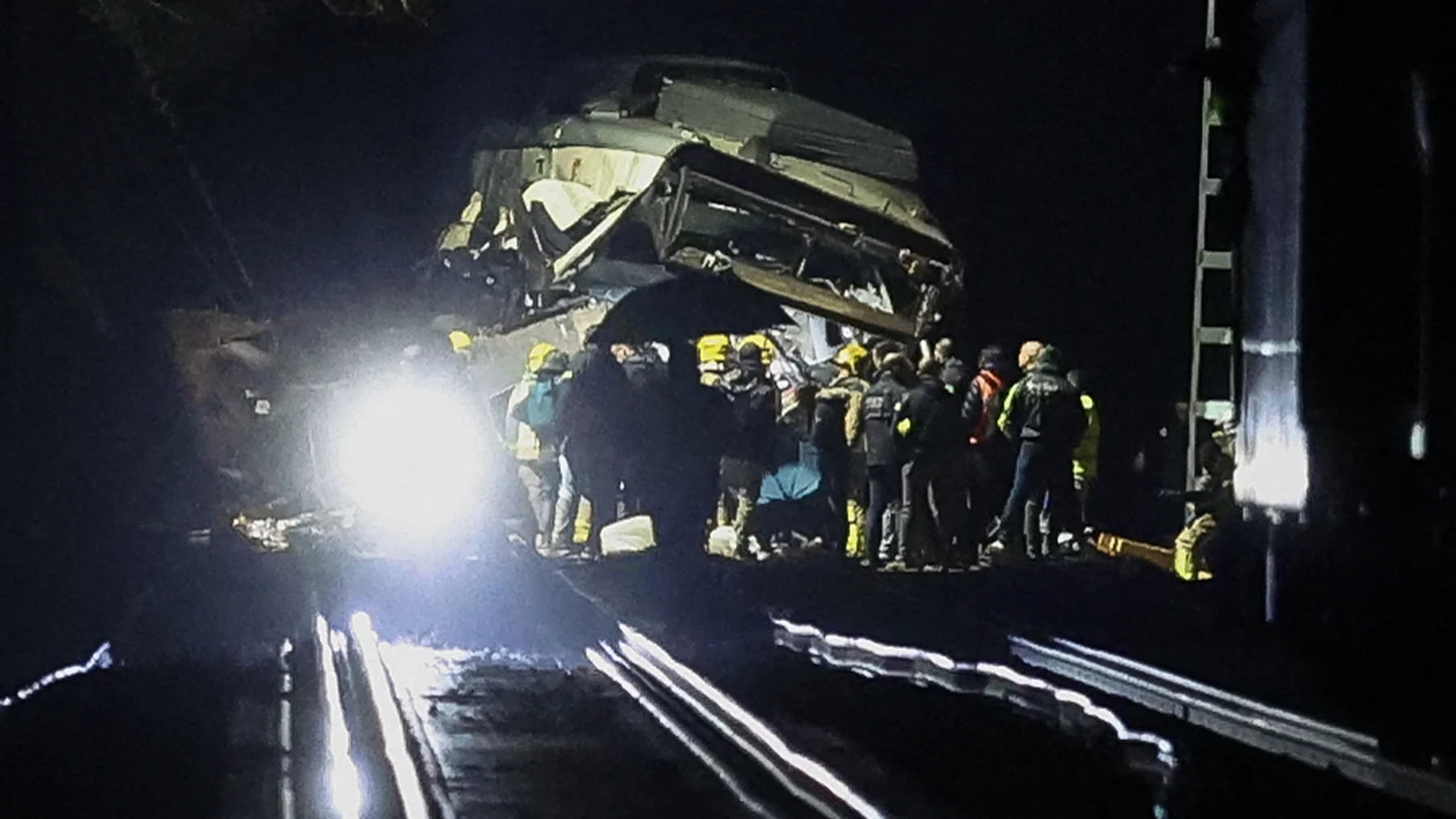
On a rain-slick morning just west of Barcelona, a commuter carriage met something it never should have: the rubble of a fallen retaining wall. Metal folded, lives were rearranged, and a quiet Catalan town called Gelida awoke to sirens and the thin blue light of emergency torches cutting through smoke and dust.
By evening, officials confirmed the grim tally: one person dead, 37 injured — five of them in serious condition. It was a small, brutal headline, but its timing made the blow feel far larger. Two days earlier, Spain had suffered its deadliest rail catastrophe in more than a decade when two high-speed trains collided in Andalusia, leaving 42 people dead and more than 120 injured.
Gelida: A commuter route turned crime scene
The scene in Gelida could not have felt more ordinary before disaster — terraced vineyards, a castle on a nearby hill, commuters boarding suburban trains bound for Barcelona’s bustle. Then a storm rolled through, authorities say, and the retaining wall that hugged the tracks gave way.
“We regret to announce the death of one of the passengers on the train,” Catalonia’s Interior Minister told local media, while regional civil protection agencies described the wall collapse as the immediate cause of the accident. Adif, Spain’s rail infrastructure operator, said the storm knocked the masonry into the path of the commuter train.
Witnesses described a scene of confusion and fear. “There was a huge bang, then everyone was thrown forward,” said Marta, a local shopkeeper who rushed to the station. “People were coughing, there was dust everywhere, and some had blood on their faces. It looked like a nightmare.” Emergency teams used torches to pick through crumpled metal as they freed passengers and carried the injured away.
The accident suspended commuter services across the Catalan network as crews worked to secure tracks and investigate the cause. For a town of narrow streets and tile-roofed houses, the image of a commuter train turned into twisted metal has already become a wound in the local memory.
Andalusia: A nation grieves
If Gelida felt personal, the crash in Andalusia felt national. Near Adamuz, an Iryo train travelling from Málaga to Madrid jumped its track and crossed into the path of an oncoming service headed to Huelva. Both trains derailed. Forty-two people perished; dozens more were badly hurt. The king and queen visited survivors in hospital and stood at the wreckage as photographers captured the raw, aching scenes.
Flags went to half-mast. Television anchors wore black. The government declared three days of national mourning as ministers pledged a full, transparent probe.
“I was thrown through the carriage; it felt like being on a carousel,” said Santiago Salvador, a Portuguese passenger whose face showed the cuts and bruises left by the crash. “It looked like hell. There were people who were very seriously injured.” His words — visceral, shock-laced — echoed what rescuers reported at the scene.
What investigators are looking at
Investigators are piecing together two very different scenes. In Andalusia, attention has focused on a marked crack discovered in the track — a fissure more than 30 centimeters long that may have been a failed weld or a piece of rail that deteriorated under stress. Transport Minister Oscar Puente described the section of track as recently renovated and the Iryo train as “practically new,” calling the accident “extremely strange.”
Authorities have said human error and sabotage appear unlikely so far. The head of Renfe, Spain’s state rail operator, said human error has “been practically ruled out.” Interior Minister Fernando Grande-Marlaska emphasized there was no evidence pointing to deliberate action.
But questions linger. Was a structural fault the cause or the result of the derailment? Could maintenance schedules have missed a critical weakness? Rail operator Adif temporarily imposed a 160 km/h speed cap on parts of the Madrid–Barcelona high-speed line after drivers reported unusual bumps; normal limits on that stretch are as high as 250 km/h for high-speed services.
“A track failure like the one being discussed can stem from a number of issues — metallurgical flaws, poor welding, or cumulative fatigue exacerbated by heavy traffic,” explained Dr. Ana Ruiz, an independent rail-safety engineer. “But to assign cause we need a systematic forensic analysis: material tests, maintenance records and data from the train’s black boxes.”
Closer to home — and to the climate
Gelida’s wall collapse points to another, quieter thread connecting these disasters: infrastructure under stress. Stormwater can erode foundations, undermine masonry and expose weaknesses that were previously hidden. In recent years, scientists and city planners have warned that more intense rainfall events — projected to increase in many regions due to climate change — could make such failures more common.
“We keep investing in new trains, and that’s right — but infrastructure is a system,” said Javier Ortega, a municipal planner in a nearby town. “If you strengthen one link and ignore the rest, you risk a sudden snap. This is not only about inspections; it is about adapting to a climate that behaves differently than it did when many structures were built.”
Rail travel remains one of the safest ways to move people over long distances. Per-passenger-kilometer fatality rates are generally lower for rail than for private cars. Yet when something goes catastrophically wrong, the human consequences are concentrated and devastating. Spain’s 2013 Santiago de Compostela crash — which killed 80 people — still haunts the national psyche. Comparisons are unavoidable, and public demands for answers and accountability grow louder with each tragedy.
Questions for a country — and for us
What does a modern rail system require beyond well-built trains? How do we balance cost, efficiency, and safety in an era when climate shocks and aging infrastructure collide? Who bears the moral responsibility when maintenance budgets are tight and political attention is fleeting?
These are not abstract questions. They surface in Gelida’s town square where relatives wait for news, and in the hospital corridors of Córdoba where survivors recover. They surface in conference rooms where engineers pore over cracked rails and in ministerial offices where timelines are drafted and promises made.
“We must learn everything from this,” King Felipe said as he left a hospital after visiting the injured, offering condolences on behalf of the nation. “The affection of the entire country is with the victims,” he added — a line that attempts to stitch a national fabric torn by repeated shocks.
A crossroads
Spain stands at a crossroads that is familiar to many countries: a desire to expand and modernize rail — a low-carbon backbone of 21st-century transport — while ensuring the bones of that system are robust. The immediate demand is simple and human: get the injured treated, identify the deceased, and give families the truth. The longer task is harder: a cultural and financial commitment to maintenance, resilient design and transparent oversight.
As investigators work through the night, and as small towns like Gelida return to an uneasy quiet, the question is not only what failed, but what will change. Will this be an inflection point that prompts investment and reform? Or will it fade into the ledger of tragedies and promises?
Look closely at the twisted metal, at the cracked rail, at the toppled wall — and ask yourself: what will it take for a country to truly safeguard the lives it entrusts to steel and speed?