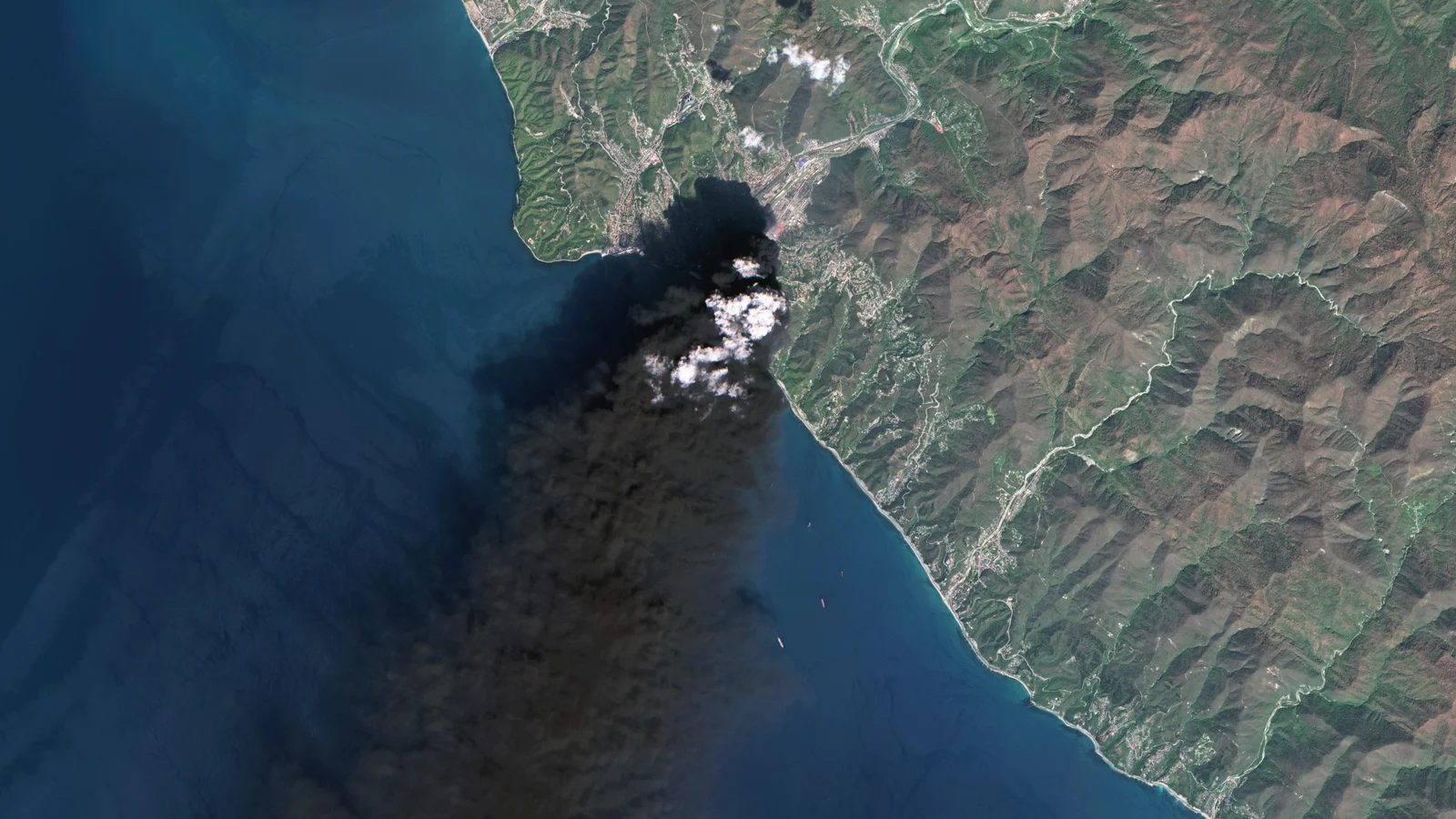
Night on the Black Sea: Smoke over Tuapse
They say the Black Sea remembers everything. On a cool April night the smoke from an oil refinery rose like an ugly exclamation over Tuapse — a coastal town that has long balanced on the seam between seaside leisure and heavy industry.
It was the second blow in less than a week. Flames licked at tanks and pipelines inside Rosneft’s export-oriented Tuapse refinery, a facility capable of processing roughly 240,000 barrels of crude a day and feeding markets with diesel, naphtha and fuel oil. Kyiv’s drone forces commander, Robert Brovdi, published a post claiming responsibility for the strike. Russian officials confirmed a fire and, heartbreakingly, at least one fatality among port workers and residents, with a second person wounded and taken for treatment.
Veniamin Kondratiev, the regional governor, spoke with the clipped formality of an official used to issuing somber updates. “Tuapse came under yet another massive drone attack tonight,” he said, noting damage to a swathe of civilian buildings — apartments, a primary school, a kindergarten, a museum and a church. “I extend my deepest condolences to the family of the deceased.”
On social media and in the narrow streets that slope down to the water, people exchanged versions of the same question: how did we get here, where a seaside town’s boardwalk and a refinery sit within a drone’s reach?
Scenes from the Shore
Tuapse is not Moscow. It is a place where old women in headscarves run samovars by the sea, where fishermen mend nets beneath the shadow of the Caucasus ridges. The promenade is peppered with Soviet-era kiosks selling sun-warmed cherries in summer; now shards of drone debris had sent glass tinkling into stairwells and classrooms.
“We heard something — like a gust, then a bang. The windows on our floor were full of smoke,” said Irina, a shopkeeper who asked that only her first name be used. “My grandson has been terrified since. He keeps asking if the ship will come back. He doesn’t understand why they would fight here.”
Another resident, Sergei, who has worked on the port for 20 years, picked through scorched paper near a loading bay. “We load fuel for ships and trucks. We are not soldiers. This place feeds people’s cars and tractors across the country,” he said. “Now we work under sirens. We all want a normal life — that’s all.”
Collateral Damage: The Human and Cultural Toll
The physical damage is immediate — blown-out windows, the smell of burnt rubber and oil, classrooms lined with broken glass — but the psychological toll lingers. A 14-year-old girl and a young woman had already been killed by a previous nighttime drone strike in the city days earlier. Grief is now an open wound for families, for teachers consoling children, for shopkeepers counting the cost of shattered stock.
Local museum curators rushed to check collections; priests worked late into the night handing out blankets and water. The tiny seaside church — a place where generations have lit candles for calm seas and safe returns — now sits a short distance from the charred ruins of industrial infrastructure.
Why Tuapse Matters
It’s easy to reduce this episode to an isolated headline. But Tuapse matters not only to those who live within earshot of the refinery’s boilers. The port and refinery are nodes in a larger network: pipelines, tankers, routes that feed domestic demand and international buyers. Damage to such a facility ripples through supply chains, creates local fuel shortages and can raise prices at the pump — and all of this happens at a human cost.
“Attacks on energy infrastructure are designed to exert pressure beyond the battlefield,” explained Dr. Lena Myers, an energy security analyst in London. “Even relatively small disruptions can force re-routing, strain logistics and signal that a country’s export lifelines are vulnerable. That’s both an economic and psychological lever.”
Rosneft’s Tuapse refinery is one of several along Russia’s Black Sea coast that enable export-oriented product flows. On a global scale, disruptions to refining capacity are felt unevenly: some markets absorb the shock, others — particularly nearby countries reliant on swift deliveries — may see immediate shortages.
The New Face of an Old Conflict
If anything, what unfolds in Tuapse is an epitome of modern conflict: a ballet of drones, claims and counterclaims, and a blurring of front lines. Russia’s defence ministry reported that its air defences had “destroyed 112 Ukrainian drones” overnight — an astonishing number that underscores how small, cheap, and ubiquitous unmanned systems have become.
“We’re seeing saturation attacks, where dozens or hundreds of low-cost drones are launched to overwhelm air defences,” said Maj. Tomasz Nowak, a retired air-defence officer who now advises NATO think-tanks. “That changes calculus. It’s asymmetry at scale. Defending fixed infrastructure becomes a resource-intensive and imperfect exercise.”
For locals, however, the technology behind the strikes matters less than the immediate reality of loss, fear and disrupted lives. “We used to wake to gulls and the sea. Now we wake to blasting and sirens. Children ask why the sky is angry,” Irina said, glancing toward the harbor.
Arrests, Accusations, and the Fog of War
Complicating matters, Russian authorities announced the arrest of a German woman in the Caucasus city of Pyatigorsk, alleging she was carrying a homemade explosive device and was part of a plot orchestrated by Ukrainian handlers. The security service (FSB) said the woman, born in 1969, had been “dragged into the plot” by a foreign national working on orders from Ukraine.
Independent verification of such claims is often difficult in wartime. “Propaganda and security announcements are both tools of war,” noted Dr. Mykola Hrytsenko, an expert in information operations. “Some arrests are valid, others are used to justify crackdowns or rally domestic support. Context matters.”
What Comes Next?
There are no neat endings in this story. The refinery will be inspected, repairs will be planned, and lawyers will sift through insurance claims. Families will bury their dead. The wider questions — about escalation, the ethics of targeting infrastructure, and how to protect civilians — will not be solved by a single report.
Consider what is at stake: a port city that lives in the shadow of both mountains and industry, ordinary people who want peace, and a global economy that remains oddly sensitive to the punctures of localized violence. How do we weigh strategic aims against civilian vulnerability? When does a military objective cease to be a legitimate target because of the civilian cost?
As you read this, ask yourself: would you feel safer if such infrastructure were off-limits, or does the reality of modern warfare make that an impossible wish? How do we protect people and livelihoods while resolving political contests?
After the Smoke
In Tuapse, the sea will continue to remember. Fishermen will mend nets, mothers will tend to frightened children, and the refinery’s tanks will either be repaired or replaced. For now, there is smoke, there is sorrow, and there is the stubborn human insistence on carrying on.
“We will clean up the glass, mend the roofs, visit the families,” Sergei said, folding his hands as if in prayer. “We are not heroes. We are just people trying to live in a place we call home.”
- Refinery capacity (Tuapse): ~240,000 barrels per day
- Reported overnight drone interceptions by Russian defence ministry: 112
- Recent civilian fatalities in Tuapse from strikes: at least three in consecutive attacks