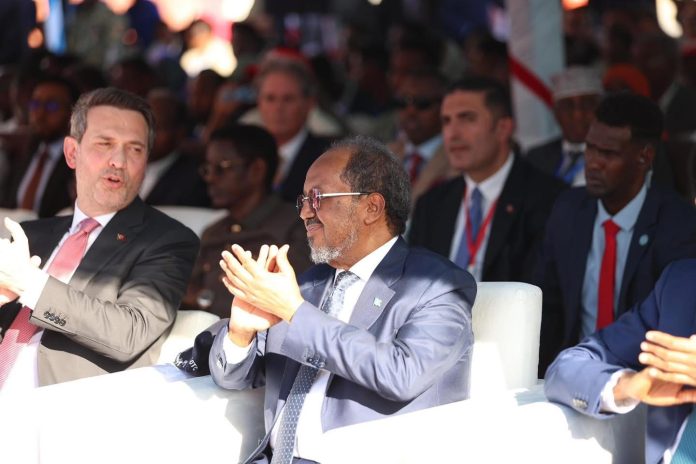
Dec 31 (Jowhar)-The Prime Minister of the Federal Republic of Somalia, Mr. Hamze Abdi Barre, today received in his office the Ambassador of the People’s Republic of China to Somalia, Mr. Wang Yu, and discussed ways to jointly address Israel’s blatant interference in the territorial sovereignty of the Republic of Somalia and defend the interests of the two countries based on security and political cooperation.
Thailand Frees 18 Cambodian Soldiers Held in Custody Since July

When a Border Finally Quieted: Soldiers Returned, but a Fragile Peace Lingers
The morning the 18 Cambodian soldiers stepped across the checkpoint back toward Phnom Penh, there was an odd mix of relief and exhaustion writ across faces on both sides of the Thai-Cambodian frontier. After weeks of artillery duels, drone sorties and tank movements that had turned sleepy border hamlets into emptied shells, the small procession felt less like victory than a delicate stitch in a garment that has been coming apart for decades.
<p”Today, we returned 18 of our neighbors to their families,” said a Thai foreign ministry official in a low, almost hesitant voice. “The release is a demonstration of goodwill and a modest confidence-building step.” The phrasing was formal but the scene at the checkpoint was quietly human: uniforms swapped for hugs, hands wiping damp cheeks, old women bringing plates of rice cakes as if to feed away the trauma.
The Numbers Behind the Headlines
Official counts remain messy, but the scale of the human fallout is unmistakable. The renewed clashes earlier this month killed dozens, and aid agencies estimate that more than one million people were displaced from villages along the roughly 800-kilometre (about 500-mile) Thai-Cambodian border. Families fled with nothing but what they could carry—children, a few photos, a pot. Markets closed. Rice paddies grew quiet under a haze of uncertainty.
The truce, which has held for more than three days at the time of writing, includes promises to stop firing, halt troop movements and launch joint demining operations across disputed sections of the frontier. Leaders on both sides have also pledged to allow residents back into their homes as soon as security can be guaranteed.
Why the Fighting Flares Again
This is not a new story. The flashpoint is a colonial-era border demarcation that left lines on maps that communities have disputed for generations. Around the most contentious spots—ancient temple ruins that both sides claim as part of their cultural patrimony—soldiers have squared off for years. The site most often named in past disputes is the 11th-century Hindu temple Perched On Cliff—known internationally as Preah Vihear—and similar ruins dot the frontier, turning archaeology into geopolitics.
“These are not simply lines on a map,” said a Southeast Asia security analyst, Dr. Anan Chai. “They are the bones of identity for people on both sides. When leaders play up nationalism, local tensions can explode into very lethal encounters.”
Captured Soldiers, A Test of Trust
Cambodia says its troops were seized on 29 July—nearly eight hours after a ceasefire intended to halt a prior round of violence had taken effect. The prior truce had been brokered with help from international mediators, including delegations from the United States, China and Malaysia, who have periodically stepped in to cool this simmering conflict.
“We received word that our men were being handed over. There was no fanfare—just men stepping into custody and then walking home,” said a Cambodian provincial official, eyes tired but steady. “For many families, this is closure. But it is a fragile closure.”
International mediators had urged Thailand to release the soldiers as part of earlier agreements. Promises made in diplomatic communiqués are helpful, analysts say, but words must be backed by sustained action on the ground—particularly the removal of mines, which have maimed or killed troops and civilians alike.
Lives Disrupted: Stories from the Border
In a displaced persons camp beneath a strip of rusting corrugated iron, a woman named Sokha pinned a child’s drawing to a tarp wall and laughed briefly through tears. “We left with our baby and our chickens. We could not pick up the rice—there was gunfire,” she said. “The children ask when the quiet will come. How do I tell them?”
Nearby, a Thai rice farmer, Somchai, cradled an old bicycle as if it were a relic. “We’ve shared water and seeds across this river for generations,” he said. “Now a line on paper tells us to hate one another. It’s painful. We want the scholars to finish the border marking so we can return to ploughing.” His voice was flat with two months of fear and two centuries of history.
What Joint Demining Might Mean
One of the more tangible elements of the ceasefire is a pledge to cooperate on demining. Landmines are a slow, indiscriminate menace that linger long after guns fall silent. Clearing them will be costly, technical and time-consuming, but it is also something that directly protects civilians and could allow agriculture and trade to resume.
“Demining is practical confidence-building,” said Mei-Lin Tan, a humanitarian demining specialist who has worked across Southeast Asia. “It shows that both governments are willing to accept risk for the benefit of civilians. But the process must be transparent and involve local communities to have lasting impact.”
What Comes Next?
The truce is a necessary breathing space, not an endgame. Political leaders will have to negotiate the thornier question: how exactly to demarcate the border where maps and memories disagree. That process will test institutions, international goodwill and the patience of people who have already suffered a great deal.
Regional diplomacy will likely continue to involve outside powers—neighbors and global players who have an interest in stability in Southeast Asia. But for people under the tarps, in the ruined marketplaces, in the temple shadows, international delegations feel abstract. What they need most is safe return, livelihood recovery and guarantees that a child will not lose a leg to a forgotten mine.
“We do not want parades of diplomats here,” said a 62-year-old villager who gave his name only as Mr. Vann. “We want our rice fields back and our children to go to school without fear.”
Reflection: Borders, Identity and the Human Cost
Reading headlines from afar, it is easy to see this as another border scuffle—an arc on a map, another temporary truce. But walk these roads, listen to the laughter and worry in the camps, and the contours of the conflict change. It becomes a story of people bound to place, of temples that mean more than tourism brochures, and of maps that can take a lifetime to redraw.
Are we comfortable with conflicts that flare up because of century-old maps? How much global attention do we owe to places that don’t appear on prime-time broadcasts, even when a million people are displaced? The answer matters, not only to Bangkok and Phnom Penh, but to any nation where borders are both identity and instrument.
For now, the checkpoint where the soldiers crossed back home sits quiet. Children chase a battered football. An old radio plays a country song somewhere down the road. The truce holds, cautiously. The hard work—mapping, demining, reparations and real reconciliation—begins now.
RW Xamze oo Safiirka Shiinaha kala hadlay faragalinta Israel ee madax banaanida Soomaaliya
Dec 31(Jowhar)-Ra’iisul Wasaaraha Xukuumadda Jamhuuriyadda Federaalka Soomaaliya, Mudane Xamze Cabdi Barre, ayaa maanta xafiiskiisa ku qaabilay Danjiraha Jamhuuriyadda Dadka Shiinaha u qaabilsan Soomaaliya, Mudane Wang Yu, iyaga oo ka wada- hadlay sidii meel looga soo wada jeesan lahaa faragelinta qaawan ee Isra’iil ku qaaday madax-bannaanida dhuleed ee Jamhuuriyadda Soomaaliya iyo difaaca danaha labada dal ee ku dhisan iskaashiga amniga iyo siyaasadda.
Postwar Liberal International Order Is Collapsing — Don’t Blame Trump Alone
The Year the Rules Fell Silent
There are years that hum along like a familiar song, and then there are years that sound a different tune altogether — dissonant, jagged, impossible to ignore. 2025 will be remembered by many as one of those years. Walking through capital cities from Brussels to Bangkok, you could feel it in the air: the polite assumptions that guided international life after 1945 — mutual defense, predictable alliances, shared trade rules — were fraying in real time.
Imagine a library where the great volumes of post-war diplomacy have begun to collect dust. The signatures on those pages — treaties, institutions, norms — remain, but their authority has grown thin. And, like readers leaving one by one, the Western-led order that anchored global politics for decades has simply been left with fewer defenders.
Where the Old Script Began to Unravel
What pulled at these threads? Partly it was domestic: a politics of grievance that had been simmering in industrial towns and small cities for decades. Factories moved. Paychecks got squeezed. Trust in institutions ebbed. “People started asking a simple question: what did this international order do for me?” said a former diplomat I spoke with in London. “Once that question went unanswered, the rest followed.”
At the international level the signs were unmistakable. The United Nations — born from the wreckage of world war and long the symbol of a cooperative vision — announced steep cuts in 2025, forced to trim almost a fifth of its workforce as member states clawed back funding. A UN official described the moment bluntly: “We’re in a race to bankruptcy.” For many staffers who had spent careers trying to keep humanitarian programmes afloat, the phrase felt like an elegy.
NATO, too, lay under strain. The compact that once bound North America and Europe in mutual defense was being reinterpreted and, to some, quietly cast aside. European leaders, who once took for granted the certainty of American backing, now spoke in the language of contingency. “Prepare to stand alone,” warned a senior German official in a private conversation. The public phrases were sharper: Europe’s foreign ministers made urgent shuttle trips across capitals in search of new guarantees, new partners, even a new grammar of security.
Decisions and Detonations
Then there were the decisions that felt like punctures. Tariffs were slapped on long-standing trading partners. Ambitious rhetoric about expanding borders — from Panama to Greenland — surfaced in bewildering public statements. Naval skirmishes in international waters made headlines, and a White House increasingly comfortable with transactional diplomacy seemed to prefer courting illiberal powers over consoling traditional allies.
A small-business owner in Ohio, who had once voted for openness and trade, told me over coffee: “My town’s been hollowed out. Policies didn’t protect us. Now politicians are telling me they’d put America first — I want to believe it means jobs, not just grandstanding.”
For Europeans, the shock was visceral. At the UN General Assembly the rhetoric turned personal: leaders were chastised openly about migration, climate policy, and “decay.” Public figures in finance piled on — Jamie Dimon, for example, called Europe into question over competitiveness, and media columns followed, wondering whether the old transatlantic compact had outlived its purpose.
Alliances Reframed, Values Recast
What worries many is less the collapse of a set of institutions than the erosion of the values they championed. Human rights, the inviolability of borders, and the idea that the global arena could be governed by rules rather than brute force — these were centuries in the making. Now they are being reframed, challenged, and in some corners, openly rejected.
Beijing and Moscow, long uneasy partners, tightened an axis of convenience in 2025. In a frank exchange, a senior Chinese diplomat told his European counterpart that China “cannot afford” for Russia to falter in its contest with the West — a statement that made many in Brussels wince. Inside international forums, Beijing has pushed a narrative that prioritizes state sovereignty and development over what it calls “Western universals” like individual civil liberties.
At the same time, inside the United States a campaign to strip diversity, equity and inclusion programs from federal institutions and allied organizations created friction with the UN’s human-rights agenda. That clash, seemingly technical to some, struck at the core of what international cooperation had been trying to do for decades: build shared norms around dignity, equality and protection.
Voices from the Ground
“We used to assume the West spoke with one voice,” said an EU diplomat who preferred not to be named. “Now we see different agendas even among allies. It’s not just policy — it’s identity.”
“My family remembers when NATO feel like a promise you could write a cheque on,” said a teacher in Warsaw. “Now the cheque has been returned with a note: ‘Use at your own risk.'”
How Did We Get Here?
Historians remind us that systems crack long before they collapse. The post-1989 moment — when the Iron Curtain fell and many believed “the end of history” had arrived — sowed hubris. Globalization brought incredible growth and lifted millions from poverty, but it also hollowed out communities and concentrated wealth. Policymakers often prioritized capital mobility and corporate interests over working-class stability, and those decisions have political consequences.
“There is a sense of dislocation that didn’t appear overnight,” said an academic specializing in trade and labor. “When domestic policies ignore the social cost of openness, the political backlash is inevitable.”
And when leaders answer that backlash with blunt nationalistic remedies — tariffs, tightened borders, military posturing — the international web that had evolved over decades may not be able to absorb the shock.
So What Comes Next?
There are three broad possibilities, and none are tidy. First, a more fractured world in which regional blocs operate with greater autonomy — Europe hedging, Asia coalescing, the Global South forging new arrangements. Second, a return to renewed, if narrower, cooperation built around pragmatic interests rather than lofty ideals. Or third, a world where might increasingly defines right, and the old rules become relics.
A veteran aid chief I spoke with said: “We shouldn’t mourn an imagined golden age. But we should mourn the decline of institutions that, imperfectly, saved lives and reduced suffering.” His point was simple: institutions are means, not ends, and their erosion has human consequences.
Meanwhile, scholars talk of a “multiplex” system — a patchwork of powers and norms, a world less centered on Washington and Brussels and more shaped by emerging capitals in Asia, Africa and Latin America. “It could be messier, certainly,” said a geopolitical analyst. “But it could also be more representative of a world in which power is not the monopoly of one or two blocs.”
Questions for the Reader
As you scroll through this moment from afar, what do you feel? Alarm? Relief? Something in between? Do you believe the world will reknit itself into new patterns of cooperation — or are we entering an era where the loudest nations write the rules?
There are no easy answers. But there are real lives caught in these shifts: aid budgets that dry up, soldiers on increasingly uncertain alliances, workers in towns where factories closed and never returned. If the post-war liberal order is indeed giving way, then what replaces it will be the work of policymakers and citizens alike. It will be argument, negotiation, and, crucially, the willingness to protect the vulnerable rather than scores of interests alone.
The old volumes are still on the shelf. Whether we open them with care, tear out pages, or write new chapters is up to us. The question is urgent: what kind of world do you want to wake up to tomorrow?
Madaxweyne Xasan oo shaaciyay Saddex arrin oo Israel kaga bedelatay Somaliland Aqoonsiga
Dec 31(Jowhar)-Madaxweynaha Soomaaliya, Xasan Sheekh Maxamuud ayaa soo bandhiggay Saddex dalab oo ay Israel ka heshay Somaliland si ay usiiso aqoonsi.
Soomaaliya oo la safatay Sucuudiga, kana hor-timid Imaaraatka Carabta
Dec 31(Jowhar)-Dowladda Federaalka ah ayaa xalay sii daysay bayaan ku qoran luqad adag oo dublumaasiyadeed kaas oo ay ku taageertay siyaasadda iyo hoggaaminta Boqortooyada Sucuudiga ee arrimaha dalka Yemen.
United States Says It Struck Venezuelan Dock Used by Drug Smugglers
When the Sea Exploded: A Shoreline Story of Drugs, Diplomacy and Deepening Doubt
It was a sound that did not belong to the rhythm of the Venezuelan coast — a distant boom that swallowed the night and left fishermen counting their boats as if inventorying lives. News of a U.S. strike that “knocked out” a docking area used by alleged drug-running vessels began as a terse presidential line delivered from Mar‑a‑Lago, and by morning it had spread into an argument about sovereignty, the rule of law, and the shadow wars of interdiction.
“At first we thought it was thunder,” said Ana Ricardo, a 42‑year‑old fisherwoman from a small village outside Maracaibo. “Then everyone ran to the shore. The smell — like burnt rubber and diesel — stayed with us for hours. We are tired of breaking the days between fear and hunger.”
Tonight’s Blast—A Fragmentary Account
President Donald Trump told reporters that U.S. forces had “hit all the boats” and destroyed an “implementation area” along a shoreline where drug shipments were loaded. He would not specify whether the operation was military or carried out by the Central Intelligence Agency; U.S. media outlets later reported that sources familiar with the matter told CNN and The New York Times the CIA had launched a drone strike on a port facility.
According to those reports, the target was connected to Tren de Aragua, a sprawling Venezuelan criminal network whose reach has reportedly extended from prisons to informal border economies. Officials said no casualties were reported at the site because the docks had been empty at the time of the strike.
But absolute certainty remains out of reach. The Venezuelan government offered no immediate official comment, the Pentagon referred questions to the White House, and U.S. officials were tight‑lipped on location and operational detail. In the absence of transparent confirmation, the air filled with competing narratives.
What we do know — and what we must treat as unresolved
- The U.S. president publicly confirmed an attack on a shore facility used in alleged drug trafficking.
- U.S. outlets reported the CIA conducted a drone strike; those reports cite unnamed sources.
- There were reportedly no casualties at the targeted docks.
- The U.S. military announced an additional maritime strike in the eastern Pacific that it said killed two people, bringing its reported maritime campaign total to at least 107 dead.
Voices on the Ground
On the windswept spit at the mouth of the Gulf, locals have grown adept at turning disaster into story. “I have seen the coast change more in one year than in ten,” said José Alvarez, a second‑generation boat builder in Zulia. “The sea gives and the sea takes, but now strangers take on the sea. Planes, drones — they are new weather.”
An NGO volunteer distributing water to displaced families described the scene with weary clarity: “You can’t separate the drugs issue from the collapse of institutions. People turn to informal economies because formal ones have disappeared. When a strike happens, the ones who lose are not the big men — they are the wives who lose a day’s fish.”
Back in Washington, one retired legal adviser to the Pentagon—speaking on condition of anonymity—said, “These operations are being framed as law enforcement at sea, but the line between law enforcement and military action on foreign soil is legally thin. The administration believes it’s disrupting supply chains. Critics warn it could violate international law.”
The Moral and Legal Ledger
The strikes in the Caribbean Sea and eastern Pacific that Washington has conducted since September are controversial not only for their lethality but because they are carried out largely without public evidence of wrongdoing, according to human rights groups and some international law scholars. Several organizations have flagged the maritime campaign as raising grave questions about extrajudicial killings and sovereignty.
“When a state uses force in another state’s territory without consent and without judicial process, it enters legally fraught territory,” said Dr. Helena Moretti, an international law scholar at the Atlantic Institute. “There are avenues under self‑defense and consent, but these operations often lack the transparency required to justify such exceptions.”
That opacity has consequences beyond the courtroom. It shapes narratives about who is attacking whom, feeds recruitment myths for criminal organizations, and can harden popular anger. It also leaves families and communities in limbo — uncertain whether the looming drones are their protectors or the next danger.
Numbers that Matter
Data and statistics are the ballast in this storm of rhetoric. The U.S. military announced that the maritime campaign had resulted in at least 107 deaths from strikes it claims targeted drug smuggling operations. Meanwhile, the UN Office on Drugs and Crime (UNODC) and other agencies have been tracking shifting smuggling routes and rising flows of cocaine through the Caribbean and Central America, though precise figures on interdicted tons versus produced supply vary year to year.
Experts warn that interdictions alone rarely change global supply. “You can sink boats and seize shipments, but unless demand and the production economies are addressed, the market adapts,” said Professor Miguel Torres, a drug policy expert. “We need a strategy that combines interdiction with development, strong courts, and regional diplomacy.”
Local Color and the Everyday Stakes
To understand the stakes, you must imagine a Sunday market in a coastal town: plantains sizzling on a makeshift grill, a radio playing salsa, children chasing a dog between baskets of cassava. In places where state services have receded, informal economies — some illicit, some not — become the fabric of daily life. Dockside crew who once mended nets now take jobs moving opaque cargo; boatyards that once built casitas for festivals are repurposed into quick, utilitarian docks.
“We are musicians, not smugglers,” laughed Rafael, a makeshift bandleader whose terraza is a popular stop for sailors. His laugh was a shield for a more guarded reality: “If you are hungry, you take what work you can get. It is not pride. It is survival.”
Why this matters beyond Venezuela
When a powerful country carries out actions along another country’s littoral in the name of counter‑drug operations, the reverberations are global. The strike raises questions about the rule of law, the political uses of force, and the effectiveness of single‑minded interdiction strategies. It also spotlights the tangled connections between corruption, porous borders, economic collapse, and organized crime.
And it asks an unsettling question: do quick, kinetic strikes provide a durable answer to a problem rooted in demand, poverty, and weak governance? Or do they simply push trafficking routes and fuel cycles of violence that cost more in blood and trust than they ever remove from the market?
Where Do We Go From Here?
Policymakers in Washington and capitals across Latin America face a stark choice. They can double down on remote strikes and risk legal blowback and local resentment, or they can invest in the slower, messier work: judicial reform, economic opportunity, anti‑corruption measures, and regional cooperation that is not perceived as coercion.
“We cannot bomb our way into stability,” said Dr. Moretti. “If operations continue, they must come with oversight, accountability, and clear multilateral frameworks.”
For the people on the shoreline, these debates are not abstract. They are about children who will sleep through the boom, fishermen who will count their nets, and small towns that will decide whether to welcome development or fear the next drone.
So ask yourself: when you hear of a strike that claims to close a drug corridor, do you imagine a headline ending a story — or the beginning of another chapter we have not yet learned to read? The answer will shape not just the coasts of Venezuela, but the kind of global order we want to live in.
Channel Tunnel services partly resume after significant power outage
When the Tunnel Went Dark: New Year’s Travel Upended Under the Channel
There is a particular kind of hush that falls over a crowded station when the announcements stop making sense. At St Pancras on New Year’s Eve, that hush arrived as a string of cancellations and a single, weary sentence: “Today, nothing at all.” The words, delivered by a Eurostar staff member at the information desk, landed like winter rain—cold, sudden, unavoidable.
For thousands of people trying to cross between Britain and continental Europe, the Channel Tunnel—an artery of commerce and holiday plans for three decades—went inexplicably dark. An overhead power fault, compounded by a train that failed and blocked the line, forced operators to halt all traffic through the 50.45-kilometre tunnel. Eurostar services were suspended; LeShuttle vehicle-carrying trains ground to a halt. The immediate result was a scene of human impatience stitched with small kindnesses: a staff member handing out bottles of water, someone else helping a pair of anxious dogs off a packed car, a last minute exchange of disappointed smiles between would-be revelers.
Voices from the platforms and approaches
“We’d planned Paris as a surprise,” said John Paul, his voice tight with the frustration of a promise interrupted. He and his partner Lucy had been booked on a river cruise and a trip to the Eiffel Tower that night—romance and curtain calls postponed by a train that had returned slowly to London and then stopped for good. “You sit and you hope for an answer. The waiting is worse than the delay.”
In Folkestone, the approach road to the Eurotunnel terminal choked with cars. Drivers hunkered over steering wheels, windows fogged with impatience. Tim Brown, who’d been trying to get home from Germany with two spaniels, described being stuck on a LeShuttle vehicle for hours with little access to food or water. “My dogs are hating life,” he said, laughing ruefully. “And the strangest sting? Nobody really came round with water. For all the technology, the basics were missing.”
It is in those small, human details that the story landed hardest: the dog clutching a soggy toy, the child asking one question and getting no answer, the couple watching the city they’d hoped to kiss under remain forever across the tracks.
Technical failure, human fallout
Getlink—the operator of the Channel Tunnel—confirmed the incident stemmed from an issue with the overhead power supply. A subsequent technical problem involving a LeShuttle train compounded the situation and required an on-site intervention. “Our teams are working to restore the situation as quickly as possible,” a company spokesperson said, expressing apologies for the disruption and promising that LeShuttle traffic would begin to resume gradually from around 2pm, with waiting times continuously updated.
LeShuttle warned drivers to expect long delays at the Folkestone terminal—estimates of up to six hours were circulated by staff and posted on social media. Eurostar, too, advised travelers not to journey to stations while services were suspended, an instruction that left many stranded or rerouted at the last minute.
On the scale of the problem
The Channel Tunnel has been the backbone of UK–France rail links since it opened in 1994. It accommodates passenger trains, high-speed Eurostar services and LeShuttle vehicle trains moving freight and personal cars. Last year, Eurostar carried a record-high 19.5 million passengers—up nearly 5% on 2023—driven in part by surges of demand for Paris-bound travel during events like the Olympics. When the tunnel is taken offline, the ripple effects are immediate and broad.
Is it simply bad luck? Perhaps. But infrastructure experts point to the way modern transport systems concentrate risk. “When you’re carrying millions through a single piece of infrastructure, you’ve got to design for redundancy,” said Dr. Amina Patel, a transport resilience specialist. “Failures like an overhead line fault are relatively rare, but they show how vulnerable we remain when a single incident can grind travel—and livelihoods—to a halt.”
Small comforts, large frustrations
Staff tried to manage the crowd. At St Pancras, one member of staff handed out water bottles to people corralled behind a cordon. It was a small balm. “We’re doing everything we can,” said a station worker, who asked not to be named. “It’s not how you want to start the year—both for customers and for us.”
But small gestures only paper over systemic anxiety. Travelers spoke of lost bookings, missed celebrations and additional costs. “We lost a night in a Paris hotel and a dinner we’ve been dreaming about,” John Paul said. “It’s not just the money. It’s the moment.”
Broader lines of tension
The incident also raises questions about competition and resilience in cross-Channel rail. Eurostar has monopolized passenger services through the tunnel since the mid‑1990s, though rival plans are on the horizon. British entrepreneur Richard Branson has announced ambitions to enter the market with a competing service, and Italy’s state-owned Trenitalia has stated intentions to compete on the London–Paris route by 2029. Will increased competition drive investment and resilience? Or could it fragment an already delicate system?
“Competition can incentivize upgrades,” Dr. Patel said. “But we also need coordinated capital investment in maintenance and emergency response capabilities. Otherwise, we’re back to depending on luck.”
What travelers can do now
- Check official operator updates: Eurostar and Getlink social channels and websites tend to publish the latest information first.
- Confirm refunds and rebookings: If your trip is cancelled, secure your refund or alternative transport as soon as possible.
- Pack for contingencies: Snacks, water and essentials in your carry-on are worth their weight in calm.
Looking beyond the delay
A tunnel is more than steel and rock; it’s habit and expectation, a pact between nations that said travel should be swift, reliable, and unobtrusive. When that pact is tested, the human stories it carries come into focus: the dog panting in a car, the couple postponing a kiss under the Eiffel Tower, the commuter whose calendar now needs rewriting. It is tempting to reduce this to an engineering failure, but the truth is wider: it is about how we plan for failures in an increasingly interconnected world.
So what should we demand from the systems that stitch our lives together? More redundancy. Better on-the-ground support. Transparent communication when things go wrong. And, perhaps, a little more patience—though that, too, must be matched by visible competence from those who run the networks.
As services slowly began to resume and traffic management plans kicked in, there was relief in the air—tempered by the knowledge that, for some, the night was irretrievably altered. “Today was a reminder,” said one weary traveler. “We can survive a delay. But we shouldn’t have to accept it as normal.”
German bank heist: gang steals €30m in cash and gold

A Hole in the Quiet: How a Gang Turned a Gelsenkirchen Bank Into a Treasure Vault for the Holidays
On a cold, white-misted morning in Gelsenkirchen, the automatic blink of a bank’s fire alarm did something it rarely does: it woke an entire community. What followed was not the polite flutter of emergency crews responding to a false alarm but a tableau that looked ripped from a heist film — except the grief and fury in the faces of the people outside the branch were painfully real.
By the time daylight broke over the Ruhr valley, crews discovered a gaping breach in the underground vault at a Sparkasse branch beneath a municipal parking garage. The thieves had not come with masks and a getaway driver for a quick draw. They had come prepared to live inside the bank — literally, investigators suspect — and to spend the long Christmas holidays carving open safety deposit boxes with a large drill and cold efficiency.
Numbers that feel like a punch
The tally reads like the beginning of a thriller: more than 3,250 safe deposit boxes, over 95% of them forced open, an estimated damage figure circling €30 million. Police say the average insured value per box was north of €10,000. But insurance numbers only tell part of the story — several customers told authorities the sentimental and actual value of what disappeared far exceeded any paperwork figure.
“My grandmother’s wedding band has been in that box for thirty years,” said one woman who stood shivering outside the shuttered branch, clutching a worn photograph against her chest. “It’s not about money — it’s about lineage. They don’t understand what they took.”
How they did it
Police allege the gang bored their way in from the parking garage directly above the vault, a shadowy excavation that took advantage of the long public holiday. Germany’s businesses closed for the Christmas holidays on Thursday and Friday, and the suspects likely used the quiet to their advantage, possibly lingering through the weekend as they opened boxes one by one.
Witnesses described the eerie sight of men hauling large bags in the stairwell in the small hours between Saturday and Sunday. Security footage later captured a black Audi RS6 — a powerful, fast estate car — leaving the garage in the dim hours, occupants masked. Investigators added a small detail that felt particularly brazen: the Audi’s license plates had reportedly been stolen earlier in Hanover.
“This was not opportunistic,” a police spokesperson told reporters. “A great deal of planning and criminal energy went into this. It’s professional, methodical. Think Ocean’s Eleven tactics but with a harsher, real-world aftermath.”
The human consequences
Outside the bank, a crowd of customers and onlookers gathered, their faces drawn and eyes bright with exhaustion. Hundreds, by most counts, demanded answers, pressed for reassurances, for the return of family heirlooms — jewelry, cash tucked away for a child’s education, and documents no amount of insurance could replace. Tension rose quickly when threats were reportedly made against bank staff, forcing the branch to remain closed for safety.
“They kept saying, ‘You have to tell us what you know, you have to tell us who to talk to,'” a bank employee later recalled. “We were shocked, we were frightened. There were tears. There were shouts. This is supposed to be the place where people feel secure.”
The bank has set up a hotline and promised written notices to affected customers while coordinating with its insurer. Sparkasse officials publicly expressed their shock, saying they were standing by customers and would do everything in their power to assist. Still, for many, the immediate question was not about paperwork: it was about trust.
Voices from the Ruhr
“Gelsenkirchen is a working-class town,” said Mahmoud, owner of a small jewelry stall near the old market. “People here value things differently. A watch from your grandfather, a bracelet from a parent — these are memories. It’s painful for them to see those gone.”
Soccer fans passing by — the blue and white scarves of the local FC Schalke 04 are a common sight here — paused to watch the police vans. For a city that has reinvented itself since the last coal mine closed, the heist felt like an assault on a fragile security net.
Why this matters beyond Gelsenkirchen
Physical safety deposit boxes exist in an era where so much of our wealth is intangible: cryptocurrency wallets, stock portfolios, cloud backups. Yet many people still choose to stash their most private, irreplaceable items in concrete vaults beneath banks. This robbery forces a global question: how secure are our last refuges?
Security experts say this kind of operation, while rare, illuminates a broader vulnerability: when criminals are willing to invest time and specialization, they can overcome static defenses. “The human element — the ways institutions underestimate downtime, assume no one would risk remaining onsite — is often the weak link,” a security consultant who asked not to be named told me. “Physical security requires not just walls and cameras, but rotation, detection algorithms, and often unpredictable human oversight.”
There are deeper social trends at play too. As policymakers and banks push for digital transitions, sometimes the protections for physical assets lag behind. And when thefts of this magnitude happen, they don’t just redistribute wealth — they erode confidence.
Old stories, new methods
Heists have always captured public imagination — from the Antwerp diamond robbery to cinematic capers — but what makes this episode so unnerving is its ordinariness: it happened in a mid-sized town on a holiday weekend, with people who had entrusted banks with their most private possessions.
“It feels like a betrayal,” a retired teacher waiting for information said calmly, wiping frost from her hands. “We put things in safes because the world outside feels uncertain. Now what? Will the bank change its vault? Will they compensate memories?”
After the dust settles: questions and consequences
Investigators continue to search for the perpetrators. For the people of Gelsenkirchen, the longer ramp-up to Christmas morning — the quiet streets, the closed storefronts — will now be remembered as the time when the familiar formally opened its cracks.
For readers in other cities, the scene invites reflection. Where do you keep what’s irreplaceable? How much trust do you place in institutions — and what happens when that trust is shaken?
This heist is a story about money and metal, yes, but it is also about the fragile economies of memory and belonging. It reminds us that security is not simply a vault or a camera; it’s the consensus we maintain with one another that certain places remain safe sanctuaries.
As police piece together how the gang tunneled, drilled and spirited away millions, the residents of Gelsenkirchen face the long, quiet work of inventorying what’s gone and, perhaps harder, deciding what it will take to feel safe again.
“We want our things back,” a man who had stored his father’s medals in a box said, voice breaking. “But even if we get them, I wonder if I will ever put anything valuable away again.”
What would you do if a trust you had in place for decades suddenly collapsed over a holiday weekend? How much of our personal history is safe, and how much is sitting in a vault simply waiting for the right pair of hands?