A City Breathes Again: Glasgow Central’s Partial Reopening After the Fire
Walk into Glasgow these days and you’ll notice the small, telling signs of a city coming back to its feet: a trolley rattling past scaffolding, the faint tang of smoke dust still clinging to winter coats, and a line of commuters hesitating at the gates of Glasgow Central as if testing the air. The station—an iron-and-glass cathedral that has ferried tens of millions of people through Scotland’s busiest transport hub each year—has finally begun to reopen after a devastating blaze ripped through a neighbouring Victorian block in early March.
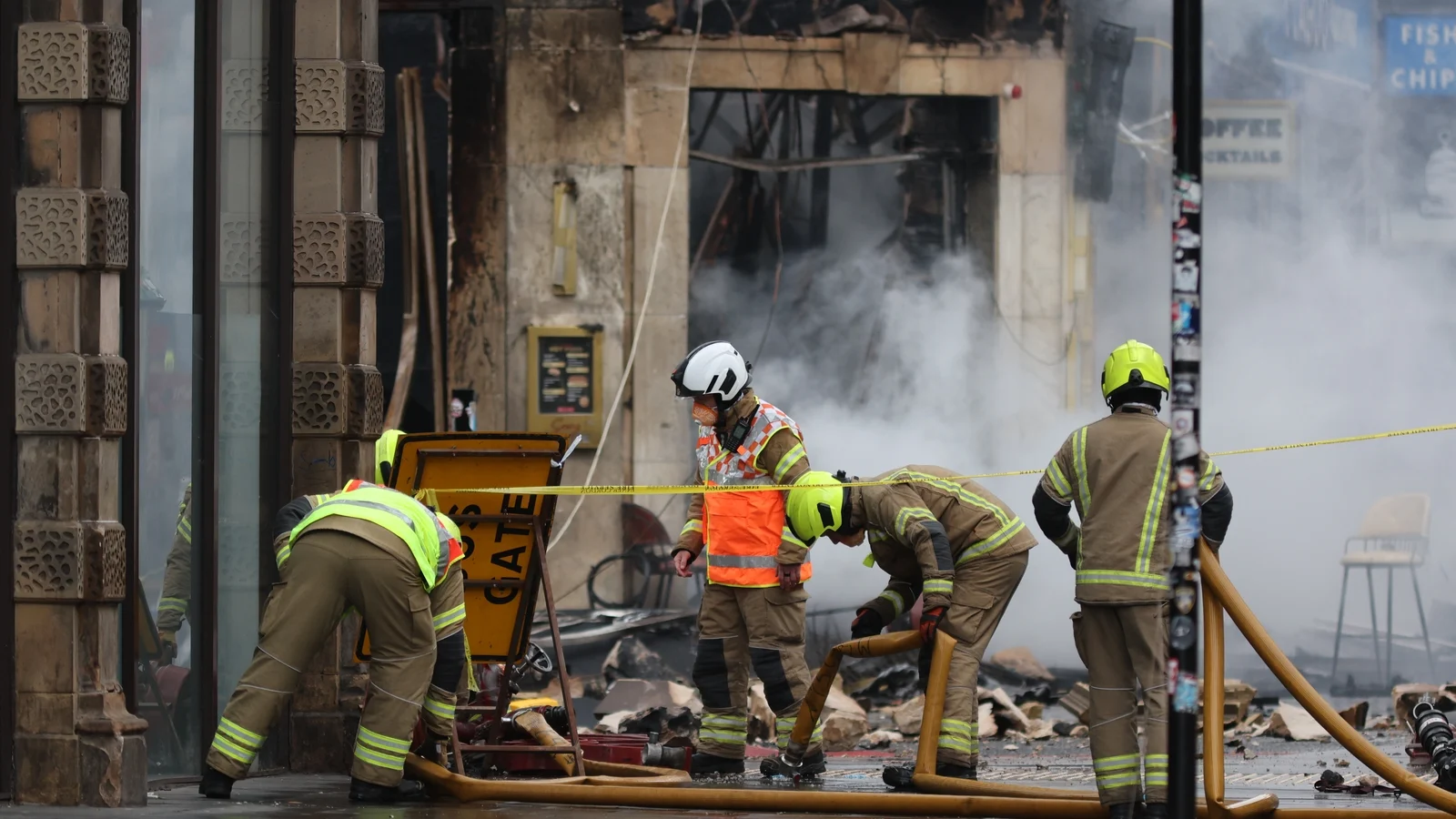
For much of the past month the main concourse has been closed, trains rerouted, and the familiar rhythm of platform announcements replaced with the quieter choreography of buses and taxis absorbing the overflow. On 8 March everything changed: a fire started in a vape shop on Union Street and, in a terrifying instant, spread through the building and around the corner. The result was a landscape of collapsed floors, a lone facade clinging to Gordon Street, and more than a hundred years of architectural history rendered very unstable.
First Steps Back
Last week, as demolition teams carefully dismantled the worst of the damaged structure, the lower-level platforms at Glasgow Central began to hum with life again. Network Rail announced a partial reopening, but warned passengers that capacity would be limited. “The station will look different,” they said, and they were right: taped-off corridors, temporary signage, and staff stationed like guides through a changed terrain.
Transport Scotland chief executive Alison Irvine—who shared an update on social media—captured something the city felt in its bones: “I think it will be great to get the station partially reopened, to improve accessibility to areas where we’ve not been able to operate train services,” she said. “What we have seen through the response from Network Rail staff and from ScotRail staff, it’s been a phenomenal effort to bring people together to get the station into a position where it can be made available to passengers.”
ScotRail’s chief operating officer David Ross echoed that gratitude. “I am very pleased we will be able to welcome customers back to Glasgow Central,” he said. “We realise the closure is causing significant disruption for our customers, and we’re very sorry for the impact it is still having on journeys.”
On the Ground: Voices from the City
At a nearby café, owner Amina Khan wipes flour from her hands and watches the station entrance like a shopfront starer. “Business took a hit,” she says. “Lunch crowd was smaller—people who’d normally grab a sandwich between trains just weren’t coming. But when the platforms opened last week, there was a lift in spirits. People came in and said, ‘It feels like the city’s heartbeat again.’”
For commuters like Ian McFarlane, the return of services is practical salvation. “My commute from Paisley is simpler now,” he told me. “I used to have to take a long detour—extra time, extra cost. Seeing the lights on in the lower level platforms felt like progress. There’s still dust in the air, but at least the trains are back.”
But not everyone’s relief is untroubled. Professor Elspeth Grant, an architectural historian at the University of Glasgow, places a hand against the remaining stonework and reflects on what was lost. “Victorian façades like these are not merely decoration. They are narratives—stories of commerce, of civic pride. To see them eaten away by flames is profoundly sad. Still, public safety must come first. The demolition, while painful, may be necessary to prevent further harm.”
Safety, Demolition, and the Long Road Ahead
Glasgow City Council declared the remaining structure “very unstable,” prompting careful demolitions by specialist teams. These operations are painstaking: controlled takedowns, debris containment, continuous assessment for secondary collapse. “We are working with the utmost caution,” a demolition expert on site—who asked to be named Mark—told me, wiping his hard hat. “Every beam, every wall, we treat like it could tell us a secret about how it fell. And right now, the secret is safety.”
Emergency services and infrastructure teams have also been combing the site for hazards. ScotRail said stringent safety checks were completed before reopening parts of the station. Still, passengers are urged to check journey times and to expect reduced capacity. Staff are being deployed to direct travelers and provide advice; accessibility groups have been brought into the conversations to ensure temporary arrangements don’t exclude those with mobility needs.
Small Details, Big Impact
The impact ripples beyond platforms and timetables. Local businesses, many of which depend on the constant trickle of office workers and visitors, have had to adapt or suffer. Street vendors who once relied on the surge of morning footfall now empty their carts too early. Hotels report cancellations. But there are quieter threads of community response too: volunteers offering free hot drinks to displaced workers, musicians playing impromptu sets outside rerouted entrances, a mural appearing on a temporary hoarding that declares: “We rebuild together.”
These small acts are the civic glue of a city in recovery. They ask an important question: what does it mean to reconstruct not just stone, but the social fabric that binds people to a place?
What This Means in a Wider Context
Fires that begin in small, everyday businesses—like the vape shop that sparked this tragedy—touch on larger global dynamics: the proliferation of lithium-ion batteries in e-cigarettes and portable devices, the evolving safety standards in older urban fabric, and the tension between preserving heritage and ensuring modern resilience. Fire services have increasingly warned about battery-related fires, which can be sudden and intense.
There are also economic calculations. Glasgow Central is a pivotal node in Scotland’s transport network—moving commuters, tourists, and freight. Before the pandemic, the station handled tens of millions of journeys a year; its partial closure created knock-on effects that spilled into busier roads, longer travel times, and lost trade in the city center.
Rebuilding presents an opportunity, too. Cities around the world are wrestling with how to renew ageing infrastructure while honoring history and improving safety. Glasgow’s challenge is a familiar one: can we weave modern standards of fireproofing, accessibility, and climate resilience into the ornate skeleton of an earlier era? Can we do it in a way that feels like regeneration, not erasure?
Practical Notes for Travelers
- Check ScotRail and Network Rail websites or apps before you travel for the latest platform and timetable information.
- Allow extra time—reduced capacity means potential delays and longer queues.
- Look for staffed helppoints if you need assistance navigating temporary routes or if you have accessibility needs.
- Support local businesses—many are offering special deals to help recover footfall lost during the closure.
Hope on the Platforms
There is no neat ending yet. The scaffolding will come down long before new stone goes up. Investigations will continue. Insurance and restoration debates will unfold. But for now, the photographs of the deserted concourse are giving way to the sound of shoes on tiling, to the patient ritual of the ticket barrier, to the small human dramas that have always animated this place.
“It’s not just bricks,” Amina says as she locks up at the end of the day. “It’s where my customers meet their lovers before a trip, it’s where my aunt caught her first train to London—these places hold a lifetime of beginnings. That’s what we want back.”
When you next pass through a rebuilt or reforged station—whether here in Glasgow or somewhere else—consider the invisible labour that stitched it together: the emergency crews who rushed in, the demolition teams who worked under threat, the staff who guided bewildered passengers, and the citizens who refused to let a city’s story end in smoke. What would you miss most if your local station fell silent? How would your town come to its senses again?