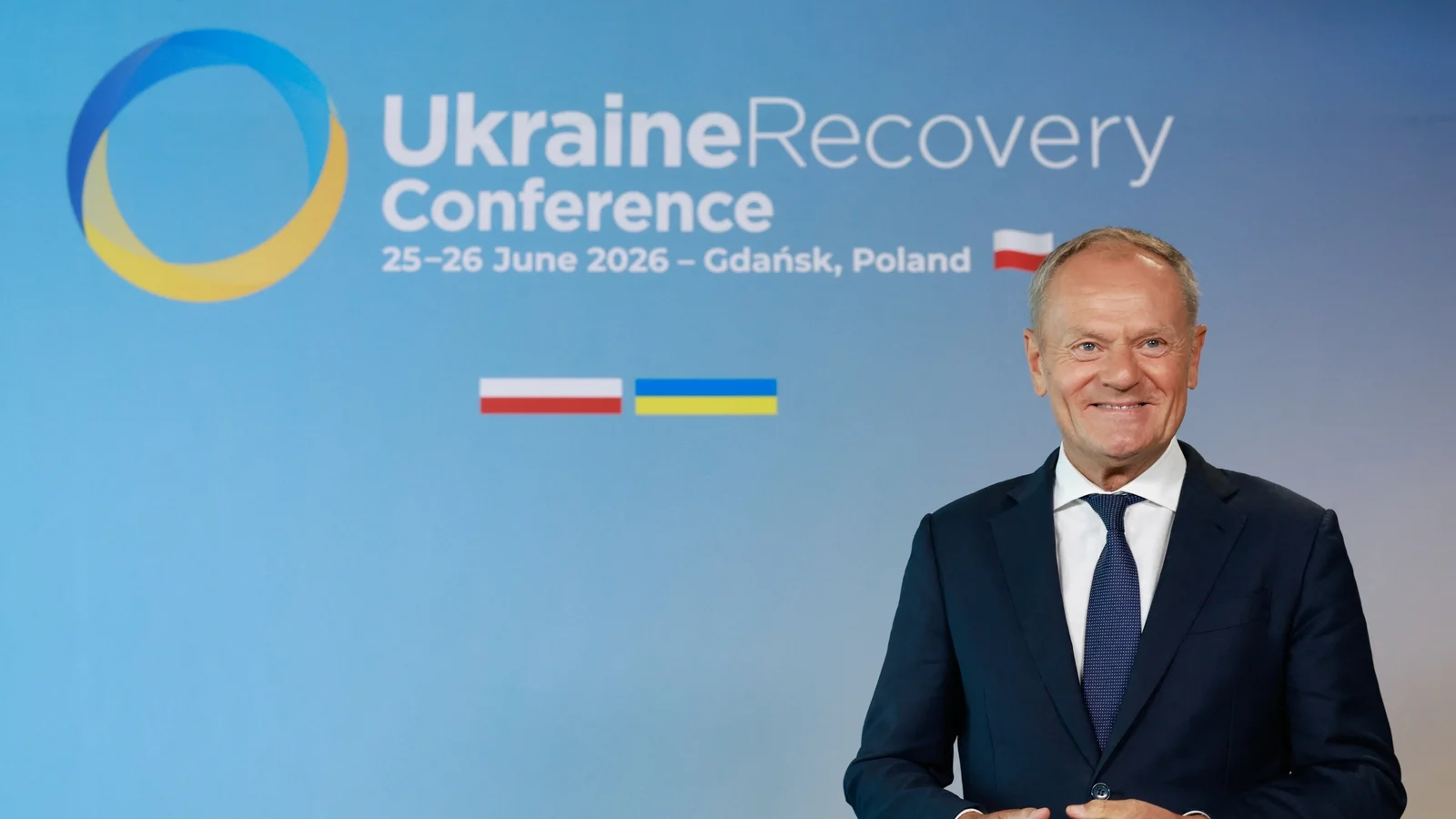
In the shipyard city of Gdansk — a place that knows what it means to rebuild from devastation — Poland and Ukraine opened the annual Ukraine Recovery Conference seeking to cool a sudden diplomatic row, even as President Volodymyr Zelensky stayed away.
Polish Prime Minister Donald Tusk urged Western backers to keep faith that a post-war Ukraine will “rise from the ruins,” invoking the example of his native Gdansk, which was largely destroyed during World War II and later restored.
Ukraine’s economy has been shattered by Russia’s invasion, leaving the country in need of hundreds of billions of dollars for reconstruction.
After weeks of doubt over whether the gathering would go ahead, the conference launched under heavy security.
Tensions flared after Mr Zelensky angered many in Poland by signing a decree naming a military unit after the WWII UPA nationalist insurgents, who took part in massacres against Poles in the 1940s.
“We can build the future only on truth, on mutual respect, on an understanding of history,” Mr Tusk told delegates.
But in remarks likely to unsettle Kyiv, he added that Ukraine should “understand its own history” and demonstrate an “authentic capacity and readiness for reconciliation” if it hopes to join the EU.
The dispute has spiralled into a political crisis between two allies now in the fifth year of Moscow’s invasion.
Mr Zelensky, who typically attends the annual conference designed to spur investment into Ukraine, did not travel to Gdansk as relations deteriorated.
Ukraine instead sent Prime Minister Yulia Svyrydenko, as European leaders joined EU chief Ursula von der Leyen at the event.
‘Something so emotional’
Ms Svyrydenko also worked to project warmth from the podium.
“Thank you for your help when it was the most urgent time to support us,” she said, pointing to Poland’s decision to open its borders and take in more than a million Ukrainian refugees after Russia’s full-scale invasion in 2022.
Poland has since become a logistics hub for Western military assistance flowing into Ukraine.
The clash, however, has caught the EU off guard, leaving Brussels unsure how to respond and hoping the fallout does not linger.
Marta Kos, the EU Commissioner for Enlargement, told AFP she worried “something so emotional can affect the rationality of the businesses”.
She called it regrettable that Mr Zelensky — “a symbol of Ukrainian courage” — was absent, but downplayed the impact, saying she did not believe it “harmed” the conference.
Warsaw has repeatedly said throughout the war that it wants Kyiv to ultimately join the EU.
Yet as the conflict has dragged on, nationalist parties have fuelled anti-Ukrainian sentiment.
A recent opinion poll found 59.7% of Poles now oppose Ukraine’s accession to the EU.
On rebuilding, Poland is eager for its companies to capitalise on geographic proximity — and not be eclipsed by larger Western firms — once a peace deal is eventually reached and investment begins to surge into Ukraine.
Inside Gdansk’s Amberexpo venue, Polish business people said they hoped political friction would not spill into commercial talks.
“From the business side, we see no problems,” said Michal Rzepnikowski of Endolink SA, a company that ships Polish prosthetics into Ukraine.
Corruption fears
“We want to help and develop business,” Mr Rzepnikowski said of the diplomatic row, adding: “But of course it does resonate in our relations with Ukraine and it does come up in conversations. But both sides reach the conclusion that it is not a priority during the war.”
With peace talks yielding no breakthroughs, another shadow hangs over reconstruction: corruption fears that have long dogged Kyiv.
“Investors will not come if there will be corruption,” Ms Kos said.
Ukraine has been hit by several corruption scandals this year involving Mr Zelensky’s inner circle.
Kyiv’s allies say they are working with Ukraine to push through reforms required to start the EU accession process.
Among Ukrainians attending in Gdansk, some voiced cautious optimism that Russia’s offensive has slowed markedly.
“We’ve seen advances on the frontline,” said Valery Shyrokov, a soldier in a Ukrainian unit made up of ex-artists, recently returned from the front.
“We are looking with positivism into the future,” he added.
He declined to answer when asked whether the recent spat had changed his view of Poland.