Pope Leo XIV has issued a sweeping appeal to rein in artificial intelligence, urging that the technology be “disarmed” and reshaped into something “human-friendly” as its influence spreads rapidly across economies, politics and daily life.
In his encyclical “Magnifica Humanitas” (“Magnificent Humanity”), the pope warned that the current surge in AI is being fuelled by “a race for ever more powerful algorithms and larger datasets, driven by the desire to secure geopolitical or commercial dominance”.
He also highlighted what he called “new forms of slavery” that can sit behind AI’s rise — from content moderators to miners — while pressing governments to strengthen regulation.
“If technology promises emancipation, yet produces new forms of global subordination, it stands in contradiction to the fundamental principle of human dignity. The fight against new forms of slavery is a decisive test for the ethical discernment of AI,” the pope wrote.
Pope Leo, who has adopted a more forceful tone in recent months and has drawn the ire of US President Donald Trump after criticising the Iran war, filled the lengthy document with urgent messages aimed at political and business leaders.
He argued that ownership of AI data should not be confined to private hands, called on policy-makers to defend workers’ rights and keep children safe from the technology, and urged a de-escalation in the competition among AI companies.
Read More: Pope Leo’s first encyclical focuses on AI concerns
“What is needed is a more active political involvement that is capable of slowing things down when everything is accelerating,” he wrote.
Encyclicals are one of the highest forms of teaching from a pontiff.
The text, spanning nearly 43,000 words, has been in the works nearly since Leo’s election as pope a little more than a year ago.
Pope repudiates ‘just war’ theory
Although AI sits at the centre of the encyclical, the pope also turned to global conflict, condemning the scale of war, warning of weakened multilateral organisations, and suggesting that arms industry profits can help propel violence.
“The past 60 years have been marked by conflicts of astonishing brutality, often affecting civilian populations on a massive scale,” stated Leo, in the English-language text.
“Humanity is slipping into a violent culture of power, where peace no longer appears as a responsibility to be taken on, but as a fragile interval between conflicts,” he said.
In one of the most explicit papal repudiations to date of the “just war” theory — a doctrine used by the Church since at least the fifth century to assess conflict — Leo argued the framework no longer holds.
We need your consent to load this rte-player contentWe use rte-player to manage extra content that can set cookies on your device and collect data about your activity. Please review their details and accept them to load the content.Manage Preferences
The doctrine, which generally says that wars should only be waged in order to defend against aggression, has also been invoked by Trump administration officials, including Vice President JD Vance, a Catholic, to defend the Iran war.
“The ‘just war’ theory which has all too often been used to justify any kind of war, is now outdated,” wrote Pope Leo.
“The use of force, violence and weapons reflects a relational poverty that always has disastrous consequences for civilian populations.”
He also warned that conflict can be used as political cover at home.
“We cannot rule out the possibility that some leaders may consider armed conflict as an effective way of diverting attention from domestic problems and a cynical tool for managing difficulties,” he stated.
Apology for Church’s role in slavery
On the battlefield, the pope said any use of AI must meet “the most rigorous ethical constraints”, and he described it as “not permissible” to place lethal decisions in the hands of AI systems.
Leo, the 14th pope to choose that name, anchored his arguments in centuries of papal teachings on social justice before confronting the ethical stakes of AI systems.
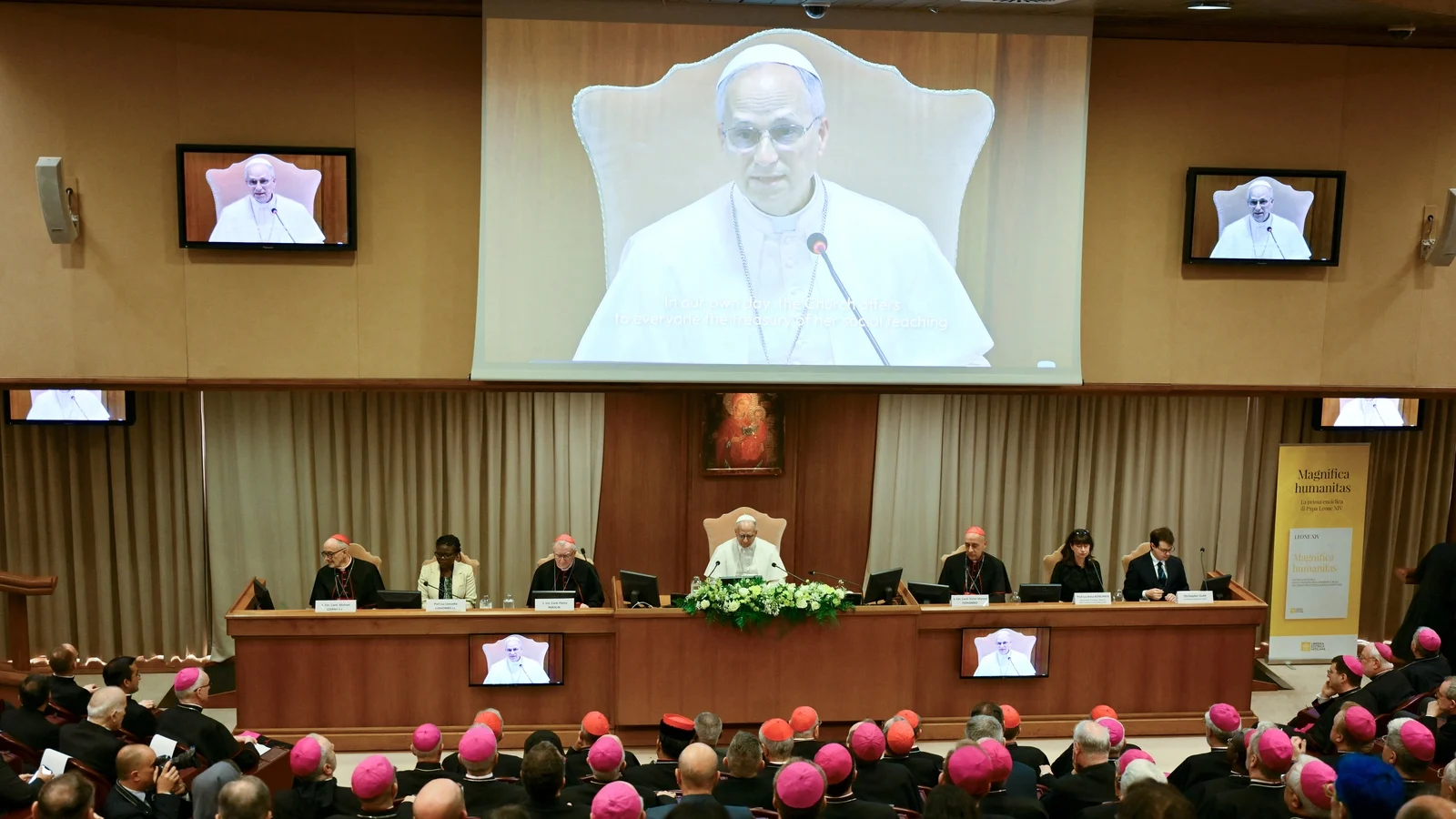
Pope Leo pictured at the presentation of the encyclical
He pointed in particular to Leo XIII, whose landmark 1891 encyclical demanded better wages and working conditions for labourers during the Industrial Revolution.
Leo XIV said today’s technology economy is generating its own exploitation, including “new forms of slavery” for those who maintain AI systems and for factory workers producing the devices — from computers to smartphones — on which AI is deployed.
“In some regions of the world, children and adolescents work in dangerous conditions, crushing the materials from which rare earth elements are extracted,” he wrote.
“The bodies of these people are scarred, injured and worn down so that computational flow may continue uninterruptedly,” he said. “This reality deeply challenges the moral conscience of our time.”
The pope also confronted the Church’s history, noting it did not strongly condemn transatlantic slavery until the 19th century and offering a personal apology.
“This constitutes a wound in Christian memory,” he wrote. “For this, in the name of the Church, I sincerely ask for pardon.”
World urged to address AI risks
Leo said at the outset that he was addressing Catholics and “all people of good will”, and he argued the AI boom raises “crucial questions” about both the technology’s direction and the choices of global leaders guiding it.
Drawing on the biblical account of the Tower of Babel — a people driven by pride to build a tower to reach Heaven, provoking God’s anger — he said the story warns of any project that “aspires to reach heaven without God’s blessing.”
“With the heart of a shepherd and a father, I ask everyone to abandon the construction of yet another Tower of Babel and to join forces in building up the common good,” the pope stated.
He also pushed back against resignation in the face of AI’s scale, insisting the risks remain addressable.
“A subtle temptation may emerge, namely the thought that the problems are too big and we are too small, and that our choices, therefore, cannot make a difference,” he wrote.
“Certainly, not everyone has the same power to make a difference,” Leo said. “Yet, no one is without responsibility. We all have our own areas for action.”