Fresh US strikes on Iranian targets have injected new volatility into a conflict already straining global energy markets, even as Iran’s top negotiators arrived in Doha for talks aimed at ending the war.
US forces hit missile sites in southern Iran and targeted boats attempting to lay mines, US Central Command said.
“US forces conducted self-defence strikes in southern Iran today to protect our troops from threats posed by Iranian forces,” Tim Hawkins, a US Central Command spokesman, said in a statement.
Central Command did not provide further operational details, saying only that the targets included missile launch sites and boats trying to “emplace mines.”
The action risked undermining a ceasefire that has held since 8 April, as Washington and Tehran try to hammer out an accord to end a war that has jolted the global economy by sharply disrupting energy flows.
Momentum toward a deal has wavered in recent days, particularly after Israeli Prime Minister Benjamin Netanyahu pledged to “crush” Iran-backed Hezbollah in Lebanon.
Iran has insisted that any peace accord must also cover the fighting in Lebanon.
In a separate development, Mr Trump wrote in a social media post that he expected Iran’s enriched uranium to be surrendered to the United States for destruction, or otherwise destroyed inside Iran under international observation.
“The Enriched Uranium (Nuclear Dust!) will either be immediately turned over to the United States to be brought home and destroyed or, preferably, in conjunction and coordination with the Islamic Republic of Iran, destroyed in place or, at another acceptable location, with the Atomic Energy Commission, or its equivalent, being witness to this process and event,” Mr Trump wrote.
It was unclear whether Mr Trump was describing a condition tied to a developing agreement with Iran.
The US marked Memorial Day to honour US military personnel
The Atomic Energy Commission referenced by Mr Trump was abolished in 1974, with its responsibilities divided between two successor agencies.
Earlier, Mr Trump said it should be mandatory for Saudi Arabia, the United Arab Emirates, Qatar, Pakistan, Egypt, Turkey, Bahrain and Jordan to sign up to the Abraham Accords — a set of agreements brokered in 2020 with countries historically hostile to Israel — as part of a peace deal with Iran.
Mr Trump said he spoke on Saturday with the leaders of those countries about efforts to end the war with Iran.
Bahrain and the UAE are already signatories to the accords, along with Morocco and Sudan.
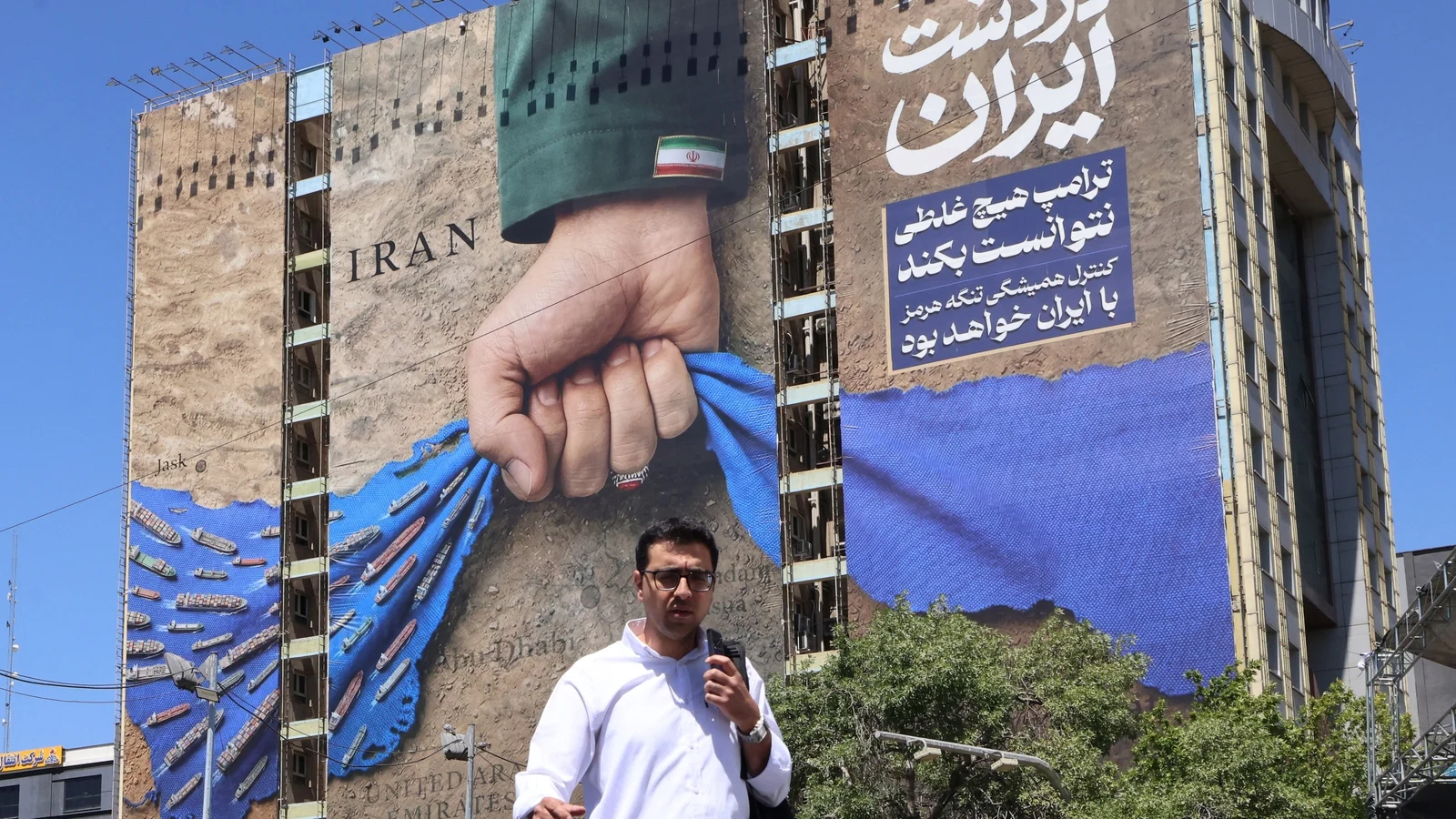
US and Iranian forces have largely adhered to the ceasefire since 8 April while diplomats pursue a negotiated settlement, though Iran has continued to impose controls on Gulf shipping through the Strait of Hormuz and the US Navy has sought to blockade Iran’s ports.
While some welcomed the Abraham Accords, they remain widely unpopular across parts of the Middle East, in part because they do not address the Israeli-Palestinian conflict.
Key Gulf states, including Saudi Arabia and Qatar, have said they will not normalize relations with Israel unless an independent Palestinian state is established.
‘Going crazy’
Anna Jacobs of the Arab Gulf States Institute in Washington said Mr Trump’s latest demand compounded what she described as a disastrous situation for Gulf nations on multiple fronts.
“The national security of the Gulf states has been threatened more than ever before because of President Trump’s reckless decisions, and he expects Arab states to thank him and to normalize relations with Israel, which they will not do at this stage,” she said.
“These expectations and assumptions from this US administration shows how little they understand the Middle East.”
Mr Trump’s hardline stance followed comments by Secretary of State Marco Rubio, who suggested a deal could be reached within the day — remarks that helped send world oil prices lower amid renewed optimism.
“We thought we might have some news last night, maybe today,” Mr Rubio told reporters during a visit to New Delhi, referring to hopes for a deal.
Esmaeil Baghaei of Iran’s Foreign Ministry said that a deal was not imminent
Iran’s foreign ministry spokesman, however, cautioned against expectations of a rapid breakthrough.
“It is correct to say that we have reached a conclusion on a large portion of the issues under discussion,” he told a weekly news briefing.
“But to say that this means the signing of an agreement is imminent — no one can make such a claim.”
‘Critical moment’
On another front, Mr Netanyahu said he had instructed the Israeli military to intensify operations in Lebanon to “crush” Hezbollah, accusing the group of using drones to target Israeli forces.
“I have ordered an even greater acceleration of our operations,” Mr Netanyahu said in a video statement posted on his Telegram channel.
On Sunday, the Israeli leader said he and Mr Trump had agreed that “any final agreement with Iran must eliminate the nuclear threat entirely” before peace was achieved.
Iranian officials have emphasized that, despite the long-standing US demand that Tehran end uranium enrichment, negotiations over the Islamic republic’s nuclear program have been postponed until after an initial agreement.