At the Beijing tarmac: an intimate welcome, a loud message
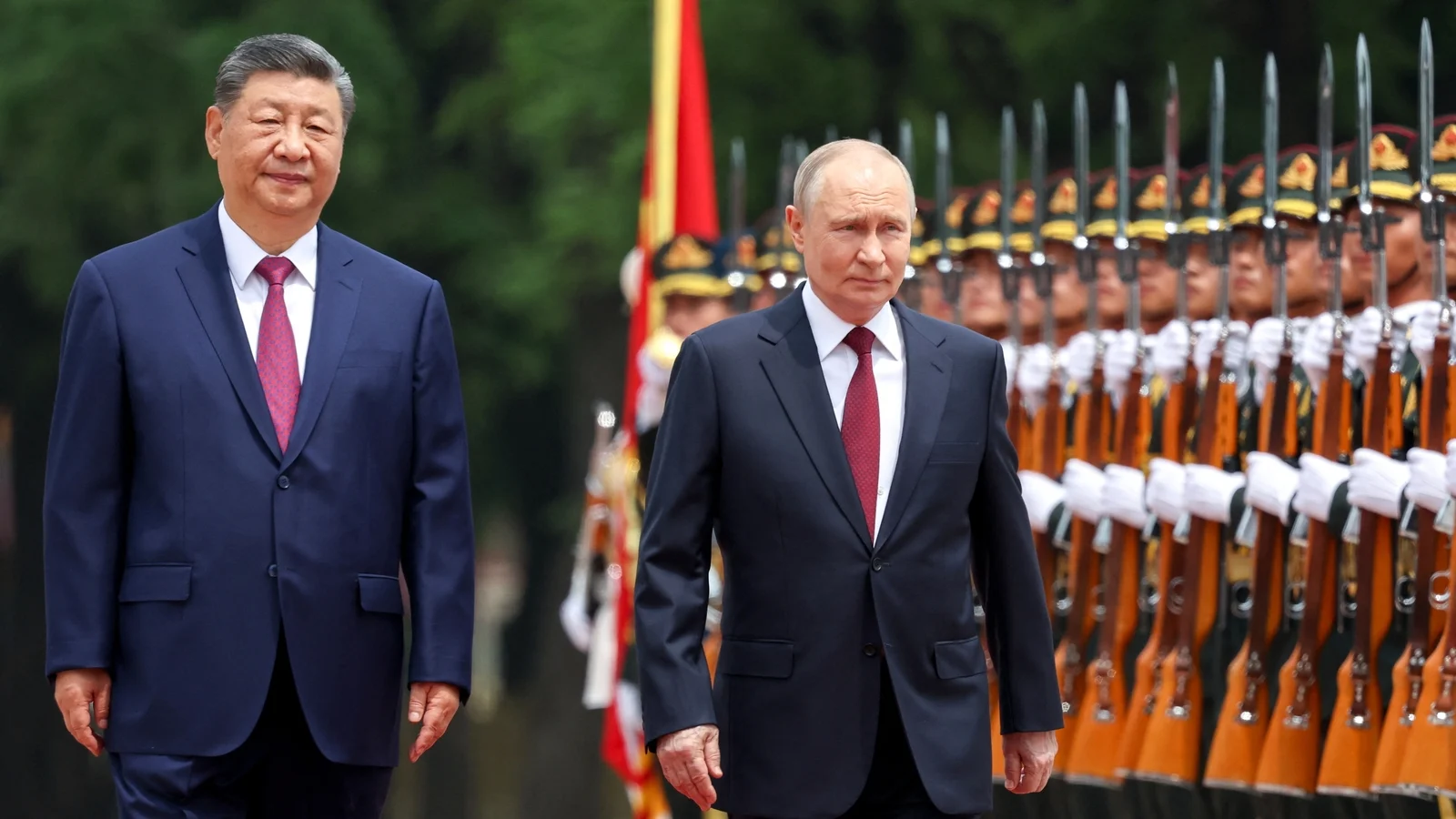
When Vladimir Putin stepped down the steps at Beijing Capital Airport, he was met not by fanfare dripping with spectacle but by a contained choreography: a crisp salute from Chinese Foreign Minister Wang Yi, a measured smile from Xi Jinping, and a joint declaration that read like a long, deliberate paragraph in a global argument.
The ink on the Kremlin’s release had hardly dried when the two countries announced, in strikingly blunt language, that the era of unilateral domination reminiscent of colonial times was over — and yet the world teetered on the brink of something darker: a “return to the law of the jungle.” The sentiment was less a prediction than a warning, dispatched with the kind of gravity that only two powers with real teeth can project.
Look closely and you can see what this visit was trying to do: reassure, rebalance, and quietly rewrite the rules of a world that is no longer comfortable with a single policeman. But what does that mean for countries caught between competing interests, for people living under the shadows of sanctions, and for the energy markets that feed modern life?
Too close for comfort: the energy axis and the stalled pipeline
At the center of many of these calculations sits a pipe that doesn’t yet exist: the proposed Power of Siberia 2. Designed to move 50 billion cubic meters of gas a year across some 2,600 kilometers — from the Yamal Peninsula through Mongolia into China — the pipeline is a prize Moscow has chased for years.
For Russia, which has seen traditional European markets dry up since its 2022 invasion of Ukraine, those northern fields are lifelines. “Those fields used to feed Europe,” said a Russian energy analyst in Moscow. “Now, finding buyers and routes is existential business.”
And yet, after face-to-face talks in Beijing, the Kremlin conceded that while both sides had sketched out a “basic understanding” on routes and construction, there was no firm timetable, no signature on the dotted line. “There are still technical and commercial details to be worked out,” Kremlin spokesman Dmitry Peskov told reporters, a line that reads like both progress and postponement.
Why the hesitation from Beijing? The calculus is more complex than brass tacks. China, while a major buyer of sanctioned Russian oil, balances an appetite for cheap energy with a web of strategic needs: keeping global trade lanes open, protecting supply chains, and limiting dependence on any single exporter. “China needs energy, yes, but it also needs stability in the Straits and ports that carry its goods,” observed James Char, a professor at Nanyang Technological University. “It’s not in Beijing’s interest to see the maritime world destabilised.”
Numbers that matter
Consider the stakes in simple terms: a 50 bcm-per-year pipeline would be a game-changer for Moscow’s pivot east. For context, a single large LNG tanker carries roughly 0.1 bcm — so this pipeline would be equivalent to hundreds of shipments annually, steady and cheap. For China, guaranteed pipeline gas offers a hedge against volatile spot markets and geopolitical flare-ups in the Middle East.
Not just pipelines: politics, perception, and partnership
Diplomacy here operates at two levels: the public theater and the private bargaining table. Last week’s visit by Donald Trump to Beijing played the former role — parade, protocol and platefuls of symbolism. Putin’s arrival felt quieter, more substance-oriented. “The Xi-Putin relationship doesn’t need the pomp we saw with the U.S.,” said Patricia Kim, a senior fellow at the Brookings Institution. “It’s about steady ties, not theatrics.”
And that steadiness is necessary. Russia is increasingly tied economically to China — Beijing is the primary buyer of Russian oil that Western sanctions have sought to curtail. Yet dependency can cut both ways. Moscow wants Beijing as a market and as political cover; Beijing wants energy without strings that could bind it into unwanted conflicts or economic vulnerabilities.
“From a Russian perspective, every tanker that sails eastward now is survival,” said Lyle Morris of the Asia Society. “From China’s perspective, every ruble spent is weighed against risks and alternatives.”
Voices from the ground
In Beijing’s hutongs, a vegetable vendor watched the diplomatic choreography on a small TV and shrugged. “They talk about big ideas — colonial ghosts, new orders — but prices and jobs are what matter to us,” she said. In a Mongolian herder’s yurt, the prospect of a transcontinental pipeline cuts a different figure. “We’ve grazed these lands for generations,” the herder told me by phone. “A pipe brings money and work — and a loss of quiet.”
These local perspectives are reminders that geopolitics ultimately lands in material realities: jobs, fuel bills, ecological footprints, and the soft power of friendly handshakes.
Middle East fires, shifting priorities
The recent war in the Middle East has put new pressure on energy markets and on diplomatic alliances. Some in Washington suggested Beijing could play a larger stabilising role; Trump, according to participants, hoped China might increase oil purchases to help global supplies. Xi, for his part, has been hosting leaders in an increasingly active diplomatic calendar, signaling a desire to be at the center of global dispute resolution.
But Russia and China may not always sing from the same sheet when it comes to the Middle East. “Moscow has benefitted in some ways from the loosening of constraints on its energy exports,” Char told me. “That doesn’t automatically translate into prioritising a rapid pipeline build-out.”
So where does this leave us — and you?
When two great powers speak of the failures of an old colonial order and warn against a relapse into lawlessness, they are doing something more than moralising. They are staking claims to alternative architectures of global governance: spheres of influence, economic corridors, and diplomatic blocs that might reroute the flow of capital, energy, and influence for decades.
For citizens across the globe the implications are tangible: higher energy bills if supplies are interrupted, new projects that reshape local landscapes, and a geopolitical chessboard where alignments can quickly change the rules of trade and security. It’s worth asking: do you want a world where a handful of state actors decide the terms of your energy and security, or a more plural, resilient system of shared rules?
Looking forward
The visit between Xi and Putin was less about spectacle and more about knitting ties at a strategic seam. The Power of Siberia 2 remains a potent symbol — full of promise but tethered to politics, economics, and regional sensitivities. If it is built, it will remap pipelines and power balances. If it stalls, it will spotlight the limits of alignment in an increasingly multipolar world.
Either way, the declaration those leaders issued — that the era of unilateral domination has failed — should make us pause. Old maps are being redrawn. New routes are being proposed. And amid it all, ordinary lives will be altered by the decisions made behind closed doors in palaces and premier offices.
What do you want the new map to look like? Who should be at the table when these decisions are made? That’s the conversation worth having – now, before the pipes are laid and the treaties signed.